Supreme Court Refers Two-Child Election Disqualification to Larger Bench for Reconsideration
Court / Authority
Supreme Court of India
Update / Judgement Date
04 Nov 2026
Source
WCP News Bulletin
Author
Dipanshi Bansal — WCP Legal Desk
Reading Time
5 min read
View Count
1
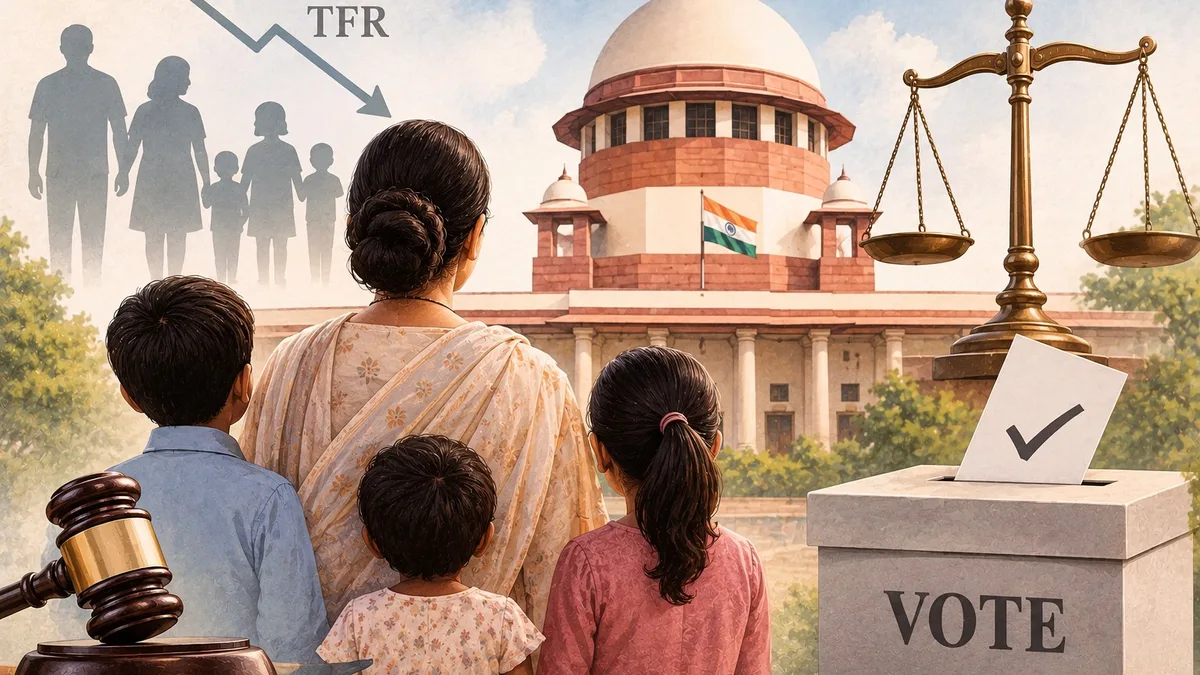
The Supreme Court referred the constitutional validity and continuing relevance of the two-child disqualification principle in Javed v. State of Haryana to a larger Bench for reconsideration. The Court observed that India’s Total Fertility Rate has fallen from about 3.0 in 2003 to 1.9, below the replacement level, and questioned whether the population-control rationale supporting such disqualifications remains sustainable. The appellant’s interim protection as Sarpanch of Kakoda Gram Panchayat will continue until disposal of the Civil Appeal; the Court has not itself finally overruled Javed.
Key Highlights :
- Mangala Bhimrao Ingle’s election as Sarpanch of Kakoda Gram Panchayat was set aside because she had more than two children, under Section 14(1)(j-1) of the Maharashtra Village Panchayats Act, 1959.
- The appellant’s third child was born in 2014; she contested and won the 2022 Panchayat election.
- In Javed v. State of Haryana (2003), the Supreme Court had upheld a similar two-child disqualification under the Haryana Panchayati Raj Act, 1994.
- The judgment records that India’s Total Fertility Rate declined from approximately 3.0 to 1.9, below the replacement fertility level of 2.1.
- The Court examined the effect of such disqualifications on political representation, women’s rights and reproductive autonomy under Article 21.
- The matter was referred to a larger Bench; the interim order permitting the appellant to continue as Sarpanch remains in force until the Civil Appeal is disposed of.
Background :
- The appellant was elected Sarpanch in the 2022 elections despite having a third child in 2014. Her election was set aside by applying Section 14(1)(j-1) of the Maharashtra Village Panchayats Act, 1959.
- The two-child norm had previously been upheld by the Supreme Court in Javed v. State of Haryana, (2003) 8 SCC 369.
- The present Bench considered whether the demographic assumptions underlying Javed had materially changed and whether the precedent required reconsideration in light of current population data and constitutional principles.
- The judgment also reviewed the social impact of the norm, including its disproportionate consequences for women and the burden it places on reproductive choice.
What Has Changed :
- Issue – Continuing validity of the two-child disqualification principle : Finding – The Court observed that the demographic basis for population-control restrictions had substantially changed. India’s Total Fertility Rate is now below replacement level, and the original policy rationale requires fresh constitutional scrutiny. Outcome – The correctness of Javed was referred to a larger Bench for reconsideration; it has not been finally overruled by this judgment.
- Issue – Effect on political participation : Finding – The Court questioned the rational connection between the number of children and an individual’s capacity to hold elected local-government office. Such restrictions exclude a class of citizens from democratic representation. Outcome – The concern forms part of the reasons for placing Javed before a larger Bench.
- Issue – Impact on women and reproductive autonomy : Finding – The Court noted that women may bear disproportionate consequences because reproductive decisions are often shaped by unequal social conditions. It recognised reproductive choice, including whether and how many children to have, as an aspect of dignity, privacy and personal liberty under Article 21. Outcome – The constitutional implications are to be reconsidered by the larger Bench.
- Issue – Interim status of the appellant’s elected office : Finding – The High Court judgment had been stayed while the appeal was being considered. Outcome – The interim order allowing the appellant to continue as Sarpanch will remain operative until disposal of the Civil Appeal.
Who Is Affected :
- Persons contesting or holding Panchayat and other local-government offices where a two-child disqualification is prescribed.
- Women whose electoral eligibility may be affected by reproductive decisions and family circumstances.
- State legislatures and election authorities administering local-government eligibility rules.
- Courts considering the continuing application of Javed and similar statutory provisions.
Compliance Action Points :
No direct compliance action. The Registry has been directed to place the judgment before the Chief Justice of India for constitution of an appropriate larger Bench.
Analysis & Impact :
- For CA / CS / Tax & Legal Professionals: For legal practitioners, the immediate point is that Javed remains a precedent pending reconsideration by a larger Bench. Pleadings should distinguish the present reference from a final declaration invalidating all two-child norms.
- For Businesses & Investors: Limited relevance.
- For News Readers: The Supreme Court has questioned whether disqualifying people from local elections for having more than two children remains justified, but the final decision has been left to a larger Bench.
- Points to Watch: Constitution of the larger Bench, the scope of reconsideration of Javed, and the continuation or modification of interim protection in the appellant’s case.
References :
- Constitution of India – Article 21: right to life and personal liberty, including dignity, privacy and reproductive autonomy.
- Maharashtra Village Panchayats Act, 1959 – Section 14(1)(j-1): disqualification linked to having more than two children.
- Haryana Panchayati Raj Act, 1994 – provision considered in Javed v. State of Haryana.
- Javed v. State of Haryana, (2003) 8 SCC 369 – upheld a two-child disqualification for Panchayat elections.
- Suchita Srivastava v. Chandigarh Administration, (2009) 9 SCC 1 – reproductive choice as part of personal liberty.
- K.S. Puttaswamy v. Union of India, (2017) 10 SCC 1 – privacy and autonomy.
- X v. Principal Secretary, Health and Family Welfare Department, Government of NCT of Delhi, (2023) 9 SCC 433 – reproductive autonomy and women’s dignity.
Source & Attribution :
- Primary source: Supreme Court of India, Mangala Bhimrao Ingle v. The Additional Commissioner, Amravati Division & Ors., Civil Appeal arising out of SLP (C) No. 30772 of 2025, 2026 INSC 1193, judgment dated 04 November 2026.
- No other source used.
Disclaimer: This summary is an editorial aid prepared from the judgment identified above. It is not legal advice. Refer to the complete original judgment and applicable legislation before acting
Full Judgement / Attachment
Full Judgement
Frequently asked questions about Supreme Court of India
- What is the role of the Supreme Court of India?
- The Supreme Court, established on 28 January 1950, is the highest court of appeal in India. Under Article 141 of the Constitution, the law it declares is binding on all courts in India. It also hears writ petitions for enforcement of fundamental rights under Article 32.
- How can I check Supreme Court case status or download a judgement?
- Case status, cause lists, daily orders and judgements are published on the official website, sci.gov.in. Reported judgements are also available free through the Digital SCR (Supreme Court Reports) on the same website.
- What is a Special Leave Petition (SLP) and what is the time limit?
- An SLP under Article 136 asks the Supreme Court for permission to appeal against a judgement or order of any court or tribunal in India. Against a High Court judgement it is ordinarily filed within 90 days. Leave is discretionary, and most SLPs are decided at the admission stage.
- Who can file a case in the Supreme Court?
- Only an Advocate-on-Record, a lawyer who has passed the Supreme Court's AOR examination, can file pleadings in the Supreme Court. A party may appear in person with the Court's permission, but most litigants engage an Advocate-on-Record along with arguing counsel.
- How can White Collar Professional help with a Supreme Court matter?
- Post your requirement on White Collar Professional to receive proposals from verified Advocates, Chartered Accountants and Company Secretaries, compare them, and pay securely through the platform. This page also tracks the latest Supreme Court judgements and legal updates as they are reported.