Supreme Court Affirms State Power to Levy Sales-Tax Surcharge and Upholds S. Kodar
Court / Authority
Supreme Court of India
Update / Judgement Date
04 Nov 2026
Source
WCP News Bulletin
Author
Dipanshi Bansal — WCP Legal Desk
Reading Time
7 min read
View Count
1
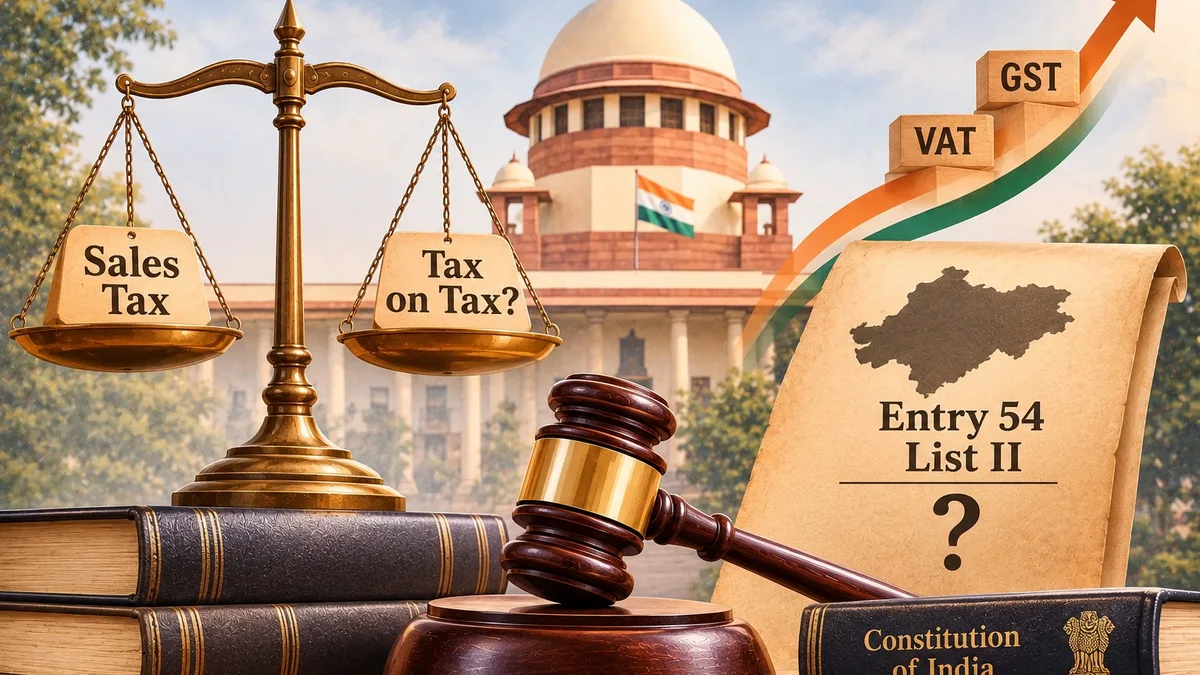
The Supreme Court held that S. Kodar v. State of Kerala was correctly decided and remains good law on the State Legislature’s competence to impose an additional sales-tax levy calculated as a percentage of sales tax payable. The Court found no conflict between S. Kodar and Hoechst Pharmaceuticals and held that later decisions, including Mineral Area Development Authority, did not undermine S. Kodar. It answered the reference and directed that the connected appeals be placed before appropriate Benches for disposal in accordance with the law declared.
Key Highlights :
- The reference concerned whether a State could impose a surcharge calculated as a percentage of sales tax payable by a dealer under the former Entry 54 of List II of the Seventh Schedule.
- Section 5-A of the Orissa Sales Tax Act, 1947 imposed a 10 per cent surcharge on the tax payable by dealers whose gross turnover exceeded ₹10 lakh.
- Section 5(1-C) of the Punjab General Sales Tax Act, 1948 imposed a similar surcharge; Section 30-AA addressed industrial units otherwise enjoying sales-tax exemption.
- The Punjab Social Security Act, 2000 imposed a cess calculated by reference to sales tax payable, with proceeds earmarked for social-security measures.
- The Court distinguished the subject of a tax from the measure used to calculate its amount and held that the method of computation does not by itself change the character of the levy.
- The Court held that S. Kodar continues to be good law and needs no reconsideration; separate questions in the connected matters were left for appropriate Benches.
Background :
- The lead proceedings arose from challenges to the Orissa surcharge and connected challenges concerned similar levies under Punjab legislation.
- The assessees argued that a surcharge computed by reference to sales tax payable was effectively a tax on tax, or on the dealer’s fiscal burden, and fell outside the State’s taxing power under Entry 54 of List II.
- The States maintained that the surcharge was an enhancement of sales tax for a defined class of dealers and that its calculation method did not alter its essential character.
- The reference had travelled through larger Benches. Subsequent developments included Kesoram Industries, the Nine-Judge Bench decision in Mineral Area Development Authority (2024), and the transition from the sales-tax regime to VAT and GST.
What Has Changed :
- Issue – Whether a surcharge calculated on sales tax payable is outside Entry 54 of List II : Finding – The subject of the tax must be distinguished from its measure. Entry 54 empowered States to tax sales or purchases of goods and included latitude to prescribe rates, classes of dealers and methods of computation. A levy measured by reference to the tax payable does not automatically become a tax on the dealer’s income or fiscal burden. Outcome – The Court reaffirmed the principle supporting the validity of the surcharge considered in S. Kodar.
- Issue – Whether later decisions displaced S. Kodar : Finding – The Court held that India Cements, to the extent it treated royalty as a tax, had been overruled by the Nine-Judge Bench in Mineral Area Development Authority. That development did not affect S. Kodar, because the subject matters and constitutional entries involved were different. S. Kodar and Hoechst Pharmaceuticals were found to be consistent. Outcome – S. Kodar was held correctly decided, continuing as good law and requiring no reconsideration.
- Issue – Whether the reference continued to survive : Finding – The intervening constitutional and legal developments had altered the landscape against which the reference had been made. The Court examined the residual questions and the distinct issues arising in the Orissa, Punjab sales-tax and Punjab Social Security Act matters. Outcome – The reference was answered. The Orissa and Punjab General Sales Tax Act appeals were directed to an appropriate Bench; matters concerning the Punjab Social Security Act, 2000 were to be segregated and placed before an appropriate Division Bench.
Who Is Affected :
- Dealers whose sales-tax liability was subject to the surcharge provisions under the Orissa and Punjab sales-tax laws.
- Industrial units claiming sales-tax exemptions but affected by Section 30-AA of the Punjab General Sales Tax Act, 1948.
- State tax departments responsible for administering the relevant surcharge and cess provisions.
- Parties to the connected appeals concerning the Punjab Social Security Act, 2000.
Compliance Action Points :
- No new filing or payment deadline is created by this reference judgment.
- Parties to the connected appeals should monitor listing before the appropriate Benches, as directed by the Supreme Court.
- Tax authorities and litigants should apply the legal position declared in S. Kodar, subject to the specific statutory provisions and issues remaining for decision in the connected matters.
Analysis & Impact :
- For CA / CS / Tax & Legal Professionals: The ruling is important for legacy sales-tax disputes involving surcharges computed as a percentage of tax payable. The distinction between the taxable subject and the measure of a levy remains central. Practitioners should also note that the Punjab Social Security Act challenges raise a separate question concerning the constitutional receipt and appropriation of State revenues under Article 266.
- For Businesses & Investors: The judgment resolves the common legislative-competence issue but does not finally dispose of every connected appeal. The liability and relief in individual matters will depend on the relevant statute and the decisions of the Benches to which those matters are assigned.
- For News Readers: The Supreme Court has reaffirmed that a State sales-tax surcharge does not become invalid merely because it is calculated as a percentage of the sales tax payable.
- Points to Watch: Further hearings in the connected appeals, including the Punjab Social Security Act matters, and the effect of the current GST framework on disputes arising under the earlier sales-tax laws.
References :
- Constitution of India – Article 246: distribution of legislative powers between Parliament and State Legislatures.
- Constitution of India – Article 265: no tax may be levied or collected except by authority of law.
- Constitution of India – Seventh Schedule, List II, Entry 54 (as it stood before the Constitution (One Hundred and First Amendment) Act, 2016): taxes on sale or purchase of goods.
- Constitution of India – Article 266: Consolidated Funds and public accounts of the Union and States.
- Orissa Sales Tax Act, 1947 – Section 5-A: surcharge on tax payable by specified dealers.
- Punjab General Sales Tax Act, 1948 – Sections 5(1-C), 30-A and 30-AA: surcharge and treatment of exempt industrial units.
- Punjab Social Security Act, 2000 – cess calculated by reference to sales tax payable.
- S. Kodar v. State of Kerala, (1974) 4 SCC 422 – upheld the State’s competence in relation to the additional sales-tax levy.
- Hoechst Pharmaceuticals Ltd. v. State of Bihar, (1983) 4 SCC 45 – discussed the scope of State legislative power under Entry 54.
- India Cements Ltd. v. State of Tamil Nadu, (1990) 1 SCC 12; Mineral Area Development Authority v. Steel Authority of India, (2024) 10 SCC 1 – subsequent decisions considered in the judgment.
Source & Attribution :
- Primary source: Supreme Court of India, Arjun Flour Mills v. State of Odisha Finance Department Secretary & Ors. and connected matters, Civil Appeal No. 8763 of 1994, 2026 INSC 1192, judgment dated 04 November 2026.
- No other source used.
Disclaimer: This summary is an editorial aid prepared from the judgment identified above. It is not legal advice. Refer to the complete original judgment and applicable legislation before acting.
Full Judgement / Attachment
Full Judgement
Frequently asked questions about Supreme Court of India
- What is the role of the Supreme Court of India?
- The Supreme Court, established on 28 January 1950, is the highest court of appeal in India. Under Article 141 of the Constitution, the law it declares is binding on all courts in India. It also hears writ petitions for enforcement of fundamental rights under Article 32.
- How can I check Supreme Court case status or download a judgement?
- Case status, cause lists, daily orders and judgements are published on the official website, sci.gov.in. Reported judgements are also available free through the Digital SCR (Supreme Court Reports) on the same website.
- What is a Special Leave Petition (SLP) and what is the time limit?
- An SLP under Article 136 asks the Supreme Court for permission to appeal against a judgement or order of any court or tribunal in India. Against a High Court judgement it is ordinarily filed within 90 days. Leave is discretionary, and most SLPs are decided at the admission stage.
- Who can file a case in the Supreme Court?
- Only an Advocate-on-Record, a lawyer who has passed the Supreme Court's AOR examination, can file pleadings in the Supreme Court. A party may appear in person with the Court's permission, but most litigants engage an Advocate-on-Record along with arguing counsel.
- How can White Collar Professional help with a Supreme Court matter?
- Post your requirement on White Collar Professional to receive proposals from verified Advocates, Chartered Accountants and Company Secretaries, compare them, and pay securely through the platform. This page also tracks the latest Supreme Court judgements and legal updates as they are reported.