Supreme Court Expunges Madras High Court Remarks Against Police Officer After Apology in Detention Case
Court / Authority
Supreme Court of India
Update / Judgement Date
02 Nov 2026
Source
WCP News Bulletin
Author
Dipanshi Bansal — WCP Legal Desk
Reading Time
4 min read
View Count
1
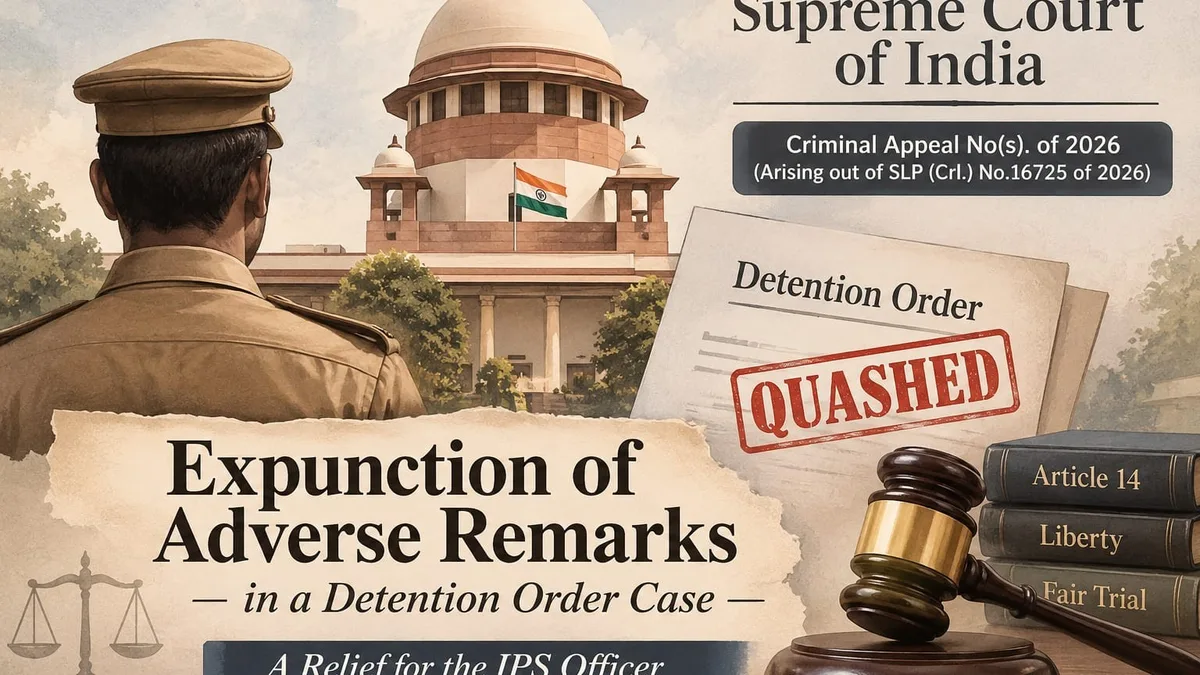
The Supreme Court (Vikram Nath, R. Mahadevan and Aparesh Kumar Singh, JJ.) accepted the unconditional apology of IPS officer A. Arun and expunged the Madras High Court's adverse remarks against him in paragraphs 6, 8, 10 and 19 to 23 of its judgment of 29 May 2026. The High Court's decision setting aside the preventive detention order he passed as Commissioner of Police, Greater Chennai, is untouched. The Court also cautioned that an apology cannot substitute for care when liberty is at stake.
Key Highlights :
- The detention order of 22 September 2025 was made under section 3(1) of the Tamil Nadu Act 14 of 1982, classifying the detenue as a 'Goonda' (para 3.5).
- It rested on Crime No. 178 of 2025 (registered 29 August 2025), alleging non-delivery of an apartment after ₹1,38,08,095 was paid, and forged documents, under IPC sections 409, 420, 465, 468, 471 and 120-B (paras 3.2–3.3).
- The officer filed an affidavit of unconditional apology and gave an assurance of greater care in future (paras 6–7).
- Adverse remarks in paragraphs 6, 8, 10 and 19 to 23 of the High Court judgment in H.C.P. No. 2066 of 2025 were expunged (para 10).
- The order is confined to the remarks and does not disturb the quashing of the detention (para 11).
Background :
- The first respondent's father, the detenue, was a director with his wife of the developer company and was arrested on 01 September 2025 (paras 3.3–3.4).
- The proposal for detention came from the Inspector of Police, Central Crime Branch-II (para 3.5).
- The High Court allowed the habeas corpus petition and made adverse observations against the officer (para 3.6).
What Has Changed :
- Issue: Should the High Court's adverse remarks stay? (paras 6–10); Finding: The officer apologised unconditionally and gave an assurance; remarks could affect his reputation and career; Outcome: Apology accepted; remarks in paras 6, 8, 10 and 19–23 expunged.
- Issue: Standard for preventive detention (paras 8–9); Finding: Power affecting liberty must be used with utmost circumspection and strictly in line with law; a senior officer must appreciate this duty; Outcome: Court cautions that apology is no substitute for due care.
- Issue: Effect on the detention case (para 11); Finding: The order is limited to the remarks; Outcome: High Court's setting aside of the detention order stands.
Who Is Affected :
- Senior police officers who pass preventive detention orders.
- Persons detained under State preventive detention laws.
- High Courts that comment on officers in habeas corpus judgments.
Compliance Action Points :
No direct compliance action.
Analysis & Impact :
- For CA / CS / Tax & Legal Professionals: The ruling shows that expunction of remarks against officers may follow an unconditional apology, but the Court still records a caution. Counsel advising officers facing strictures should consider whether early acceptance of error before the High Court is the better route.
- For Businesses & Investors: Directors facing criminal complaints over delayed real estate projects should note that civil-nature disputes alone did not sustain the detention order here, as set aside by the High Court; this Court did not review that finding.
- For News Readers: The Court removed criticism of a police commissioner but warned that detention powers must be used with care.
- Points to Watch: Use of the cautionary paragraphs in later challenges to preventive detention orders.
References :
- Tamil Nadu Prevention of Dangerous Activities of Bootleggers, Cyber Law Offenders, Drug Offenders, Forest Offenders, Goondas, Immoral Traffic Offenders, Sand Offenders, Sexual Offenders, Slum-Grabbers and Video Pirates Act, 1982 – section 3(1).
- Indian Penal Code, 1860 – sections 409, 420, 465, 468, 471 and 120-B (underlying FIR).
- Madras High Court judgment dated 29 May 2026 in H.C.P. No. 2066 of 2025.
Source & Attribution :
- Primary source: Supreme Court of India, Judgment in A. Arun v. Varsha Sharma & Ors., arising out of SLP (Crl.) No. 16725 of 2026, dated 02 November 2026 (2026 INSC 1186). Link: Not stated in source.
- No other source used.
Disclaimer: This summary is an editorial aid prepared from publicly available information. It is not legal, tax or investment advice. Refer
Full Judgement / Attachment
Full Judgement
Frequently asked questions about Supreme Court of India
- What is the role of the Supreme Court of India?
- The Supreme Court, established on 28 January 1950, is the highest court of appeal in India. Under Article 141 of the Constitution, the law it declares is binding on all courts in India. It also hears writ petitions for enforcement of fundamental rights under Article 32.
- How can I check Supreme Court case status or download a judgement?
- Case status, cause lists, daily orders and judgements are published on the official website, sci.gov.in. Reported judgements are also available free through the Digital SCR (Supreme Court Reports) on the same website.
- What is a Special Leave Petition (SLP) and what is the time limit?
- An SLP under Article 136 asks the Supreme Court for permission to appeal against a judgement or order of any court or tribunal in India. Against a High Court judgement it is ordinarily filed within 90 days. Leave is discretionary, and most SLPs are decided at the admission stage.
- Who can file a case in the Supreme Court?
- Only an Advocate-on-Record, a lawyer who has passed the Supreme Court's AOR examination, can file pleadings in the Supreme Court. A party may appear in person with the Court's permission, but most litigants engage an Advocate-on-Record along with arguing counsel.
- How can White Collar Professional help with a Supreme Court matter?
- Post your requirement on White Collar Professional to receive proposals from verified Advocates, Chartered Accountants and Company Secretaries, compare them, and pay securely through the platform. This page also tracks the latest Supreme Court judgements and legal updates as they are reported.