Supreme Court Upholds Husband's Murder Conviction and Family's Dowry-Death Convictions, Orders Surrender in Four Weeks
Court / Authority
Supreme Court of India
Update / Judgement Date
02 Nov 2026
Source
WCP News Bulletin
Author
Dipanshi Bansal — WCP Legal Desk
Reading Time
5 min read
View Count
1
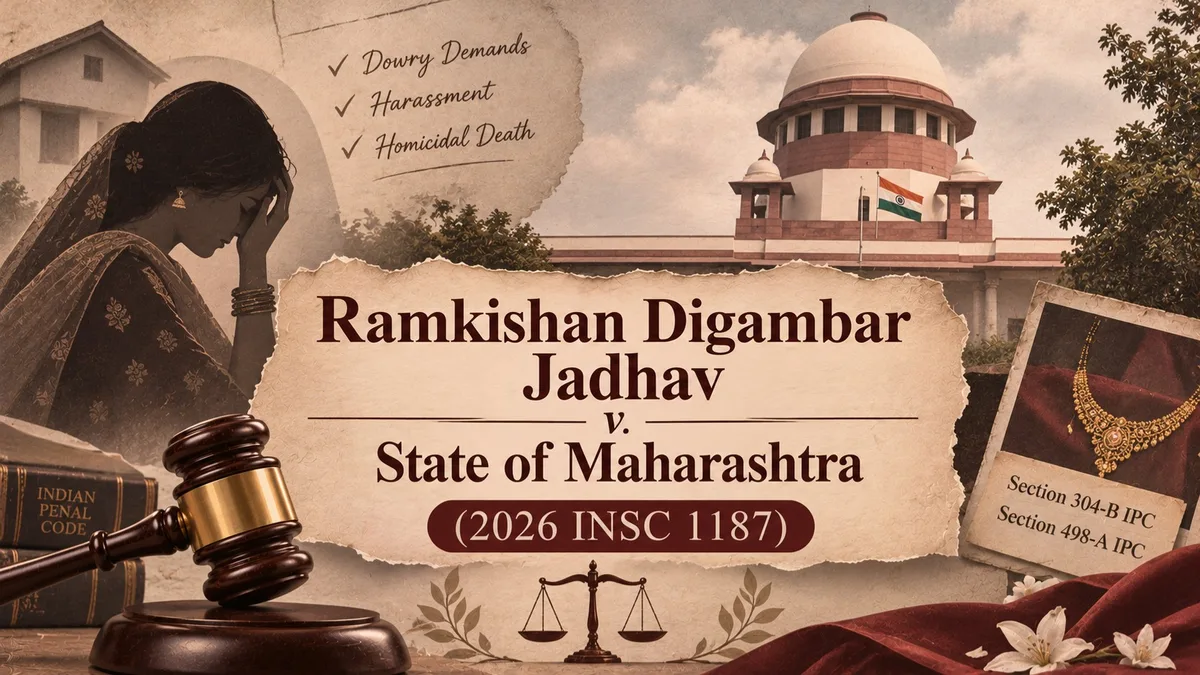
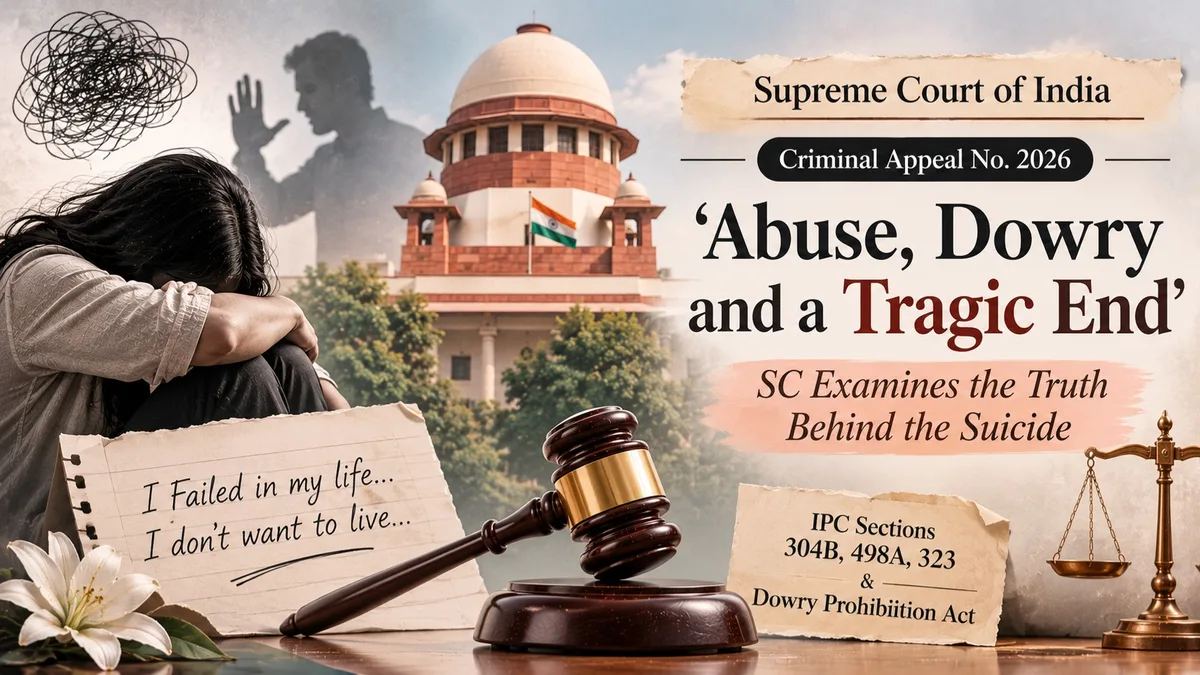
The Supreme Court (Sandeep Mehta and Devendra Kumar Upadhyaya, JJ.) dismissed the appeals against the Bombay High Court's judgment of 03 July 2013. The husband's conviction for murder, with life imprisonment and a fine of ₹5,000, stands, as do the convictions of him and his brother under sections 498-A and 304-B read with section 34 of the Indian Penal Code, 1860 (IPC). Both appellants, who were on bail, must surrender before the trial court within four weeks.
Key Highlights :
- The wife died within nine months of the marriage of 12 May 1995; the post-mortem opinion was asphyxia due to throttling (paras 8, 34).
- The husband's defence of accidental death during an epileptic seizure was held false and contradicted by the medical evidence (paras 35–36).
- Because the death occurred in the exclusive company of the husband at home, section 106 of the Indian Evidence Act, 1872 placed the burden on him to explain it; a false defence added a link to the chain (paras 38–40).
- The presumption under section 113-B of the Evidence Act applied as cruelty for dowry demands was proved through several witnesses and was not rebutted (paras 43–44).
- The High Court had reversed the trial court's acquittal of the husband under section 302; this Court found no reason to interfere (paras 32, 45).
- Bail bonds are cancelled and the appellants must surrender within four weeks, failing which non-bailable warrants may issue (para 47).
Background :
- The trial court (Additional Sessions Judge, Biloli) on 21 September 1998 convicted three accused under sections 498-A and 304-B read with section 34 (one year's rigorous imprisonment and ₹500 fine; seven years' rigorous imprisonment), and acquitted all six of murder (paras 14–15).
- The State appealed against the murder acquittal; the High Court convicted the husband under section 302, sentenced him to life imprisonment with ₹5,000 fine and upheld the acquittal of the others on that charge (paras 3–4).
- The father-in-law's appeal abated on his death (para 6).
- The alleged dowry demands were a television set, a tape deck, a plot in the MIDC area and ₹50,000 in cash (para 8).
What Has Changed :
- Issue: Was the death homicidal and who must explain it? (paras 34–40); Finding: Medical evidence showed throttling; the husband alone was with the wife at the time and offered a false explanation; Outcome: Section 302 conviction of the husband upheld; section 106 burden not discharged.
- Issue: Dowry cruelty and presumption (paras 41–44); Finding: Consistent evidence from the brother, father, mediator and two neighbours of cruelty linked to dowry; death within seven years of marriage; Outcome: Convictions under sections 498-A and 304-B read with section 34 upheld; section 113-B presumption not rebutted.
- Issue: Parity argument for the brother (paras 21–22, 41); Finding: The argument that acquittal of three female relatives on the same evidence required his acquittal was not accepted; Outcome: Conviction of the brother upheld.
- Issue: Final order (paras 45–47); Finding: No perversity in the High Court judgment; Outcome: Appeals dismissed; bail cancelled; surrender within four weeks.
Who Is Affected :
- The two surviving appellants, who must surrender.
- Prosecutors and defence counsel in cases of death inside a matrimonial home, where section 106 and section 113-B arguments arise.
- The State of Maharashtra as respondent.
Compliance Action Points :
Appellants: surrender before the trial court concerned → within four weeks of 02 November 2026 → failing which the trial court may issue non-bailable warrants (para 47).
Analysis & Impact :
- For CA / CS / Tax & Legal Professionals: The judgment applies Trimukh Maroti Kirkan to say that the prosecution's burden is lighter when a crime occurs in the privacy of a home, and that a false explanation can complete the chain of circumstantial evidence. Defence counsel should prepare a credible explanation backed by evidence rather than a bare denial.
- For Businesses & Investors: Limited relevance.
- For News Readers: The Court has confirmed a life sentence for a husband in a 1996 dowry-related killing, nearly 30 years after the death.
- Points to Watch: Surrender by the appellants within four weeks and any review or curative attempt.
References :
- Indian Penal Code, 1860 – sections 302, 304-B, 498-A and 34.
- Indian Evidence Act, 1872 – sections 106 and 113-B.
- Trimukh Maroti Kirkan v. State of Maharashtra, (2006) 10 SCC 681 – burden on inmates to explain a death at home.
- Constitution of India – Article 136 (limits on interference in special leave appeals).
Source & Attribution :
- Primary source: Supreme Court of India, Judgment in Ramkishan Digambar Jadhav v. State of Maharashtra, Criminal Appeal No. 1849 of 2013 with Criminal Appeal No. 962 of 2014, dated 02 November 2026 (2026 INSC 1187). Link: Not stated in source.
- The deceased and witnesses are not named in this summary.
Disclaimer: This summary is an editorial aid prepared from publicly available information. It is not legal, tax or investment advice. Refer to the original notification, circular, order or report before acting.
Full Judgement / Attachment
Full Judgement
Frequently asked questions about Supreme Court of India
- What is the role of the Supreme Court of India?
- The Supreme Court, established on 28 January 1950, is the highest court of appeal in India. Under Article 141 of the Constitution, the law it declares is binding on all courts in India. It also hears writ petitions for enforcement of fundamental rights under Article 32.
- How can I check Supreme Court case status or download a judgement?
- Case status, cause lists, daily orders and judgements are published on the official website, sci.gov.in. Reported judgements are also available free through the Digital SCR (Supreme Court Reports) on the same website.
- What is a Special Leave Petition (SLP) and what is the time limit?
- An SLP under Article 136 asks the Supreme Court for permission to appeal against a judgement or order of any court or tribunal in India. Against a High Court judgement it is ordinarily filed within 90 days. Leave is discretionary, and most SLPs are decided at the admission stage.
- Who can file a case in the Supreme Court?
- Only an Advocate-on-Record, a lawyer who has passed the Supreme Court's AOR examination, can file pleadings in the Supreme Court. A party may appear in person with the Court's permission, but most litigants engage an Advocate-on-Record along with arguing counsel.
- How can White Collar Professional help with a Supreme Court matter?
- Post your requirement on White Collar Professional to receive proposals from verified Advocates, Chartered Accountants and Company Secretaries, compare them, and pay securely through the platform. This page also tracks the latest Supreme Court judgements and legal updates as they are reported.