Supreme Court Acquits Husband in Dowry-Linked Suicide Case for Lack of Abetment Evidence
Court / Authority
Supreme Court of India
Update / Judgement Date
03 Nov 2026
Source
WCP News Bulletin
Author
Dipanshi Bansal — WCP Legal Desk
Reading Time
4 min read
View Count
1
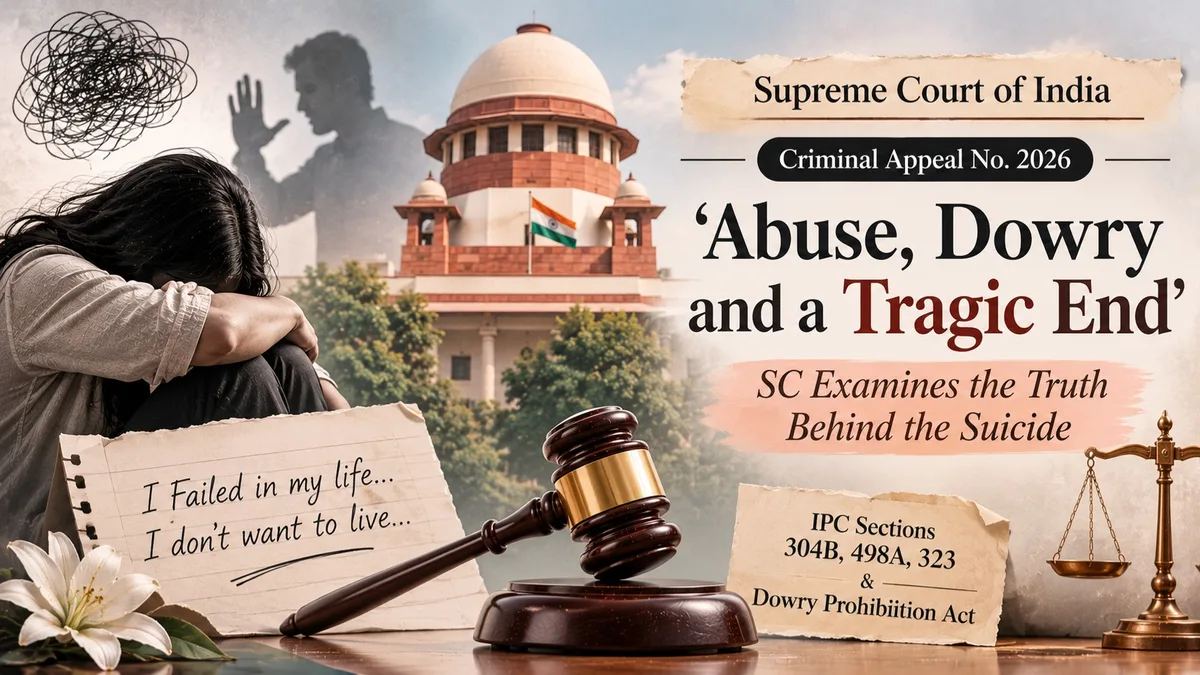
The Supreme Court has acquitted a husband who had been convicted of abetting his wife’s suicide, holding that the prosecution did not establish the legal ingredients of abetment beyond reasonable doubt. The Court found that the letters relied on by the prosecution, read as a whole and in their factual setting, did not amount to instigation under Section 107 of the Indian Penal Code.
Key Highlights :
- The appeal arose from a conviction under Section 306 IPC in Sessions Case No. 27 of 2011.
- The trial court had sentenced the appellant to ten years’ rigorous imprisonment and a fine of ₹50,000, with three months’ further rigorous imprisonment in default.
- The Rajasthan High Court at Jaipur dismissed the appellant’s appeal on 11 May 2017.
- The deceased wife had been living at her father’s house for more than two years and was pursuing matrimonial litigation.
- The Supreme Court held that the letters, even if written by the appellant, did not establish the necessary ingredients of abetment under Section 107 IPC.
Background :
- The prosecution alleged harassment connected with dowry and matrimonial disputes. The appellant was tried for the offence of abetment of suicide after his wife died by suicide.
- The prosecution relied, among other material, on letters written by the appellant which urged the deceased to return, withdraw pending proceedings and resume cohabitation.
- The trial court convicted the appellant; the High Court affirmed the conviction. The Supreme Court examined whether the material proved instigation or abetment beyond reasonable doubt.
What Has Changed :
- Issue: Whether the appellant’s conduct and letters constituted abetment of suicide under Sections 306 and 107 IPC.
- Finding: The letters contained pressure, hostility and offensive expressions, but they also reflected appeals for reconciliation. The Court assessed them as a whole rather than isolating individual phrases.
- Finding: The deceased had been living separately for over two years and was actively pursuing litigation. The letters, by themselves, could not be treated as the instigating material that immediately caused the suicide.
- Outcome: The prosecution failed to prove instigation or abetment beyond reasonable doubt. The trial court and High Court judgments were set aside; the appellant was acquitted. His bail bonds were discharged and he was not required to surrender.
Who Is Affected :
- Accused persons prosecuted under Section 306 IPC, where the alleged conduct is said to have driven another person to suicide.
- Prosecutors and defence counsel assessing whether communications, threats or matrimonial pressure satisfy the statutory ingredients of abetment.
- The ruling is fact-specific; it does not mean that coercive or threatening communications can never amount to abetment.
Compliance Action Points :
No direct compliance action. The judgment determines the criminal appeal and acquits the appellant.
Analysis & Impact :
- For CA / CS / Tax & Legal Professionals: Limited relevance to finance and compliance professionals. For criminal-law practitioners, the decision reinforces the need to prove the ingredients of abetment rather than relying on distressing or offensive communications in isolation.
- For Businesses & Investors: Limited relevance.
- For News Readers: A difficult or hostile matrimonial relationship, without proof of legally sufficient instigation or intentional aid, does not automatically establish the offence of abetting suicide.
- Points to Watch: The decision turns on the contents of the letters, the period of separation and the prosecution evidence. Future cases will still require a fact-specific assessment of intention, conduct and causal connection.
References :
- Indian Penal Code, 1860 – Section 306: punishment for abetment of suicide.
- Indian Penal Code, 1860 – Section 107: defines abetment through instigation, conspiracy or intentional aid.
- Criminal Appeal No(s). 1394 of 2017 – Supreme Court judgment dated 03 November 2026.
Source & Attribution :
Supreme Court of India, Criminal Appeal No(s). 1394 of 2017, Goverdhan v. State of Rajasthan, judgment dated 03 November 2026. The uploaded judgment is the primary source.
Disclaimer: This summary is an editorial aid prepared from the uploaded source document. It is not legal, tax or investment advice. Refer to the original order or judgment before acting.
Full Judgement / Attachment
Full Judgement
Frequently asked questions about Supreme Court of India
- What is the role of the Supreme Court of India?
- The Supreme Court, established on 28 January 1950, is the highest court of appeal in India. Under Article 141 of the Constitution, the law it declares is binding on all courts in India. It also hears writ petitions for enforcement of fundamental rights under Article 32.
- How can I check Supreme Court case status or download a judgement?
- Case status, cause lists, daily orders and judgements are published on the official website, sci.gov.in. Reported judgements are also available free through the Digital SCR (Supreme Court Reports) on the same website.
- What is a Special Leave Petition (SLP) and what is the time limit?
- An SLP under Article 136 asks the Supreme Court for permission to appeal against a judgement or order of any court or tribunal in India. Against a High Court judgement it is ordinarily filed within 90 days. Leave is discretionary, and most SLPs are decided at the admission stage.
- Who can file a case in the Supreme Court?
- Only an Advocate-on-Record, a lawyer who has passed the Supreme Court's AOR examination, can file pleadings in the Supreme Court. A party may appear in person with the Court's permission, but most litigants engage an Advocate-on-Record along with arguing counsel.
- How can White Collar Professional help with a Supreme Court matter?
- Post your requirement on White Collar Professional to receive proposals from verified Advocates, Chartered Accountants and Company Secretaries, compare them, and pay securely through the platform. This page also tracks the latest Supreme Court judgements and legal updates as they are reported.