Supreme Court Quashes Dowry-Death FIR Against Husband for Lack of Dowry Evidence in Foreign Suicide Case
Court / Authority
Supreme Court of India
Update / Judgement Date
02 Nov 2026
Source
WCP News Bulletin
Author
Dipanshi Bansal — WCP Legal Desk
Reading Time
5 min read
View Count
2
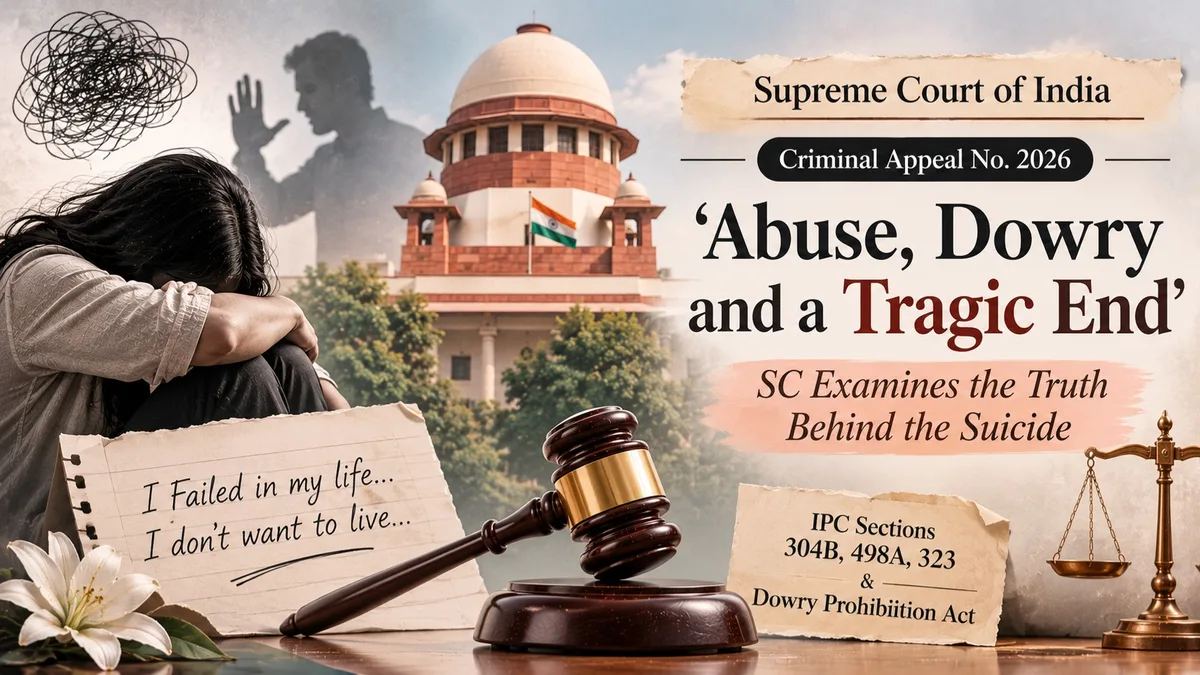
The Supreme Court (B.V. Nagarathna and Manmohan, JJ.) set aside the Bombay High Court order of 08 January 2025 and quashed FIR No. 212/2023 against a husband booked for dowry death and cruelty after his wife died by suicide in Toronto. The Court found no cogent material of any dowry demand or of cruelty linked to the death, and held that continuing the case would abuse the process of law.
Key Highlights :
- FIR No. 212/2023 of 30 June 2023 (Satara Police Station, Aurangabad Town) invoked IPC sections 304B, 323, 498A and 504 read with section 34, and sections 3 and 4 of the Dowry Prohibition Act, 1961 (para 2).
- The Court found no allegation of dowry demand between the marriage on 03 January 2021 and the death on 11 June 2023, and noted the FIR came only after the death (para 38).
- The Toronto coroner's statement and police report found no sign of foul play, no police interaction with the couple and handwriting matching the note; the husband was not at home (paras 6–7, 39).
- Gifts of gold at the wedding and first Diwali, and a transfer of ₹1,00,000 by the wife's brother, were not shown to be dowry (paras 40–42).
- Calling the wife 'stupid' and 'useless' and being short-tempered was held not to amount to cruelty or criminal intimidation (para 43).
- Bhajan Lal categories (1), (2), (3), (5) and (7) were held to apply (para 47).
Background :
- The High Court had quashed the FIR for the husband's parents and sister because the wife was not living with them soon before her death, but refused relief to the husband (para 9).
- A chargesheet was filed and non-bailable warrants issued on 04 February 2025; on 11 August 2025 this Court directed that no coercive steps be taken (paras 10, 12).
- The State argued that custodial interrogation was needed as the husband held the wife's laptop, phone and diary (para 17).
What Has Changed :
- Issue: Dowry death, section 304B (paras 28–29, 41); Finding: No cogent evidence of a dowry demand or of cruelty soon before death with a nexus to the suicide; the suicide note does not mention the husband or his family; Outcome: Offence not made out; presumption under section 113-B not triggered.
- Issue: Dowry Prohibition Act, sections 3 and 4 (paras 40–42); Finding: Wedding and Diwali gifts were customary and not shown to be demanded; the ₹1,00,000 transfer sat within wider bank transactions; Outcome: No prima facie dowry demand.
- Issue: Sections 323, 498A and 504 IPC (paras 43–45); Finding: Allegations were vague and omnibus, with no specific instances of hurt, cruelty or insult likely to provoke breach of peace; Outcome: Ingredients not satisfied.
- Issue: Power under section 482 CrPC (paras 34–35, 46–48); Finding: Bhajan Lal guidance applies where allegations do not disclose an offence or are not bona fide; Outcome: High Court order set aside; FIR and consequent proceedings quashed.
Who Is Affected :
- Husbands and in-laws facing matrimonial offence complaints with general allegations.
- Complainant families, who must give specific instances and supporting material.
- High Courts exercising inherent powers to quash FIRs.
Compliance Action Points :
No direct compliance action. The proceedings stand quashed.
Analysis & Impact :
- For CA / CS / Tax & Legal Professionals: Counsel seeking to quash FIRs under sections 304B and 498A can rely on the Court's insistence on specific acts and a proximate nexus with the death, and on the weight given to foreign official reports and the contents of the suicide note. Complainants should record specific dates and instances early.
- For Businesses & Investors: Limited relevance.
- For News Readers: The Court ended a dowry-death case against a husband, saying a grieving father's search for a reason cannot replace evidence.
- Points to Watch: Whether the State seeks review, and how High Courts cite the judgment in section 482 petitions.
References :
- Indian Penal Code, 1860 – sections 304B, 323, 498A, 503, 504 and 34.
- Dowry Prohibition Act, 1961 – sections 3 and 4.
- Code of Criminal Procedure, 1973 – section 482; Indian Evidence Act, 1872 – section 113-B.
- State of Haryana v. Bhajan Lal, 1992 Supp (1) SCC 335, para 102; CBI v. A. Ravishankar Prasad, (2009) 6 SCC 351.
Source & Attribution :
- Primary source: Supreme Court of India, Judgment in Piyush S/o Deepak Narlawar v. State of Maharashtra & Others, arising out of SLP (Crl.) No. 12158 of 2025, dated 02 November 2026 (2026 INSC 1183). Link: Not stated in source.
- The deceased is not named in this summary.
Disclaimer: This summary is an editorial aid prepared from publicly available information. It is not legal, tax or investment advice. Refer to the original notification, circular, order or report before acting.
Full Judgement / Attachment
Full Judgement
Frequently asked questions about Supreme Court of India
- What is the role of the Supreme Court of India?
- The Supreme Court, established on 28 January 1950, is the highest court of appeal in India. Under Article 141 of the Constitution, the law it declares is binding on all courts in India. It also hears writ petitions for enforcement of fundamental rights under Article 32.
- How can I check Supreme Court case status or download a judgement?
- Case status, cause lists, daily orders and judgements are published on the official website, sci.gov.in. Reported judgements are also available free through the Digital SCR (Supreme Court Reports) on the same website.
- What is a Special Leave Petition (SLP) and what is the time limit?
- An SLP under Article 136 asks the Supreme Court for permission to appeal against a judgement or order of any court or tribunal in India. Against a High Court judgement it is ordinarily filed within 90 days. Leave is discretionary, and most SLPs are decided at the admission stage.
- Who can file a case in the Supreme Court?
- Only an Advocate-on-Record, a lawyer who has passed the Supreme Court's AOR examination, can file pleadings in the Supreme Court. A party may appear in person with the Court's permission, but most litigants engage an Advocate-on-Record along with arguing counsel.
- How can White Collar Professional help with a Supreme Court matter?
- Post your requirement on White Collar Professional to receive proposals from verified Advocates, Chartered Accountants and Company Secretaries, compare them, and pay securely through the platform. This page also tracks the latest Supreme Court judgements and legal updates as they are reported.