Supreme Court Orders Appointment of Rejected Woman Constable Candidate After Specialist Board Finds Her Eyesight Normal
Court / Authority
Supreme Court of India
Update / Judgement Date
02 Nov 2026
Source
WCP News Bulletin
Author
Dipanshi Bansal — WCP Legal Desk
Reading Time
4 min read
View Count
1
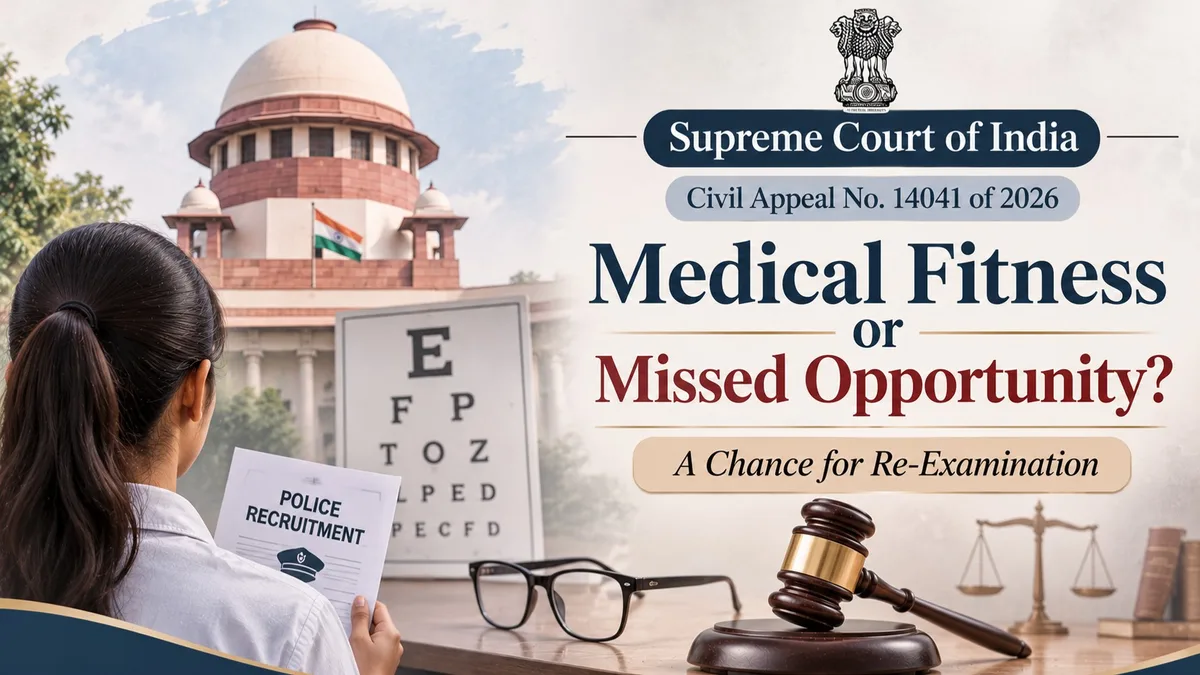
The Supreme Court (Aravind Kumar and Vipul M. Pancholi, JJ.) set aside a High Court order and directed the Uttar Pradesh authorities to issue an appointment order to Akanksha Devi for Constable Civil Police if she is otherwise entitled. A medical board of King George's Medical University, Lucknow, had certified her vision as normal, contrary to the squint-based rejection by the recruitment boards. She cannot claim seniority over candidates already appointed.
Key Highlights :
- The appellant cleared document verification and physical standards on 28 December 2024 under the U.P. Police Constable Civil Direct Recruitment, 2023 (para 2).
- A medical board on 22 April 2025 and a Division Medical Board on 25 April 2025 under Rule 15(6)(d) of the UP Police Constable and Head Constable Service Rules, 2015 (as amended in 2017) found her unfit for squint (para 2).
- Two doctors she consulted privately reported normal vision and colour perception, and her representation of 16 May 2025 was rejected (para 2).
- By order of 15 September 2026 the Court sent her to a four-doctor board at King George's Medical University, which reported on 16 October 2026 after examining her on 08 October 2026 (paras 3–4).
- The report recorded best-corrected vision of 6/6 in both eyes and an exophoria to intermittent exotropia with good control, deviation of 5 to 8 degrees (para 4).
- The High Court had dismissed her petition only because the selection process had concluded (para 2).
Background :
- The same approach of an independent expert board had been used in SLP (Civil) No. 17704/2025 in similar circumstances (para 3).
- No rejection order or endorsement had been given to the appellant after the medical re-examination (para 2).
What Has Changed :
- Issue: Was the medical rejection for squint sound? (paras 3–5); Finding: The KGMU board certified her vision as normal; the Court accepted that she had been deprived of appointment after clearing all tests; Outcome: High Court order set aside; appeal allowed.
- Issue: Relief (para 5); Finding: Appointment is subject to her being otherwise entitled; Outcome: Respondents to issue appointment order or call letter.
- Issue: Seniority (para 5); Finding: Existing appointees should not be disturbed; Outcome: Appellant cannot claim seniority over those already appointed.
Who Is Affected :
- Appellant and similarly placed candidates rejected at medical examination in recruitment drives.
- Uttar Pradesh Police recruitment authorities and medical boards.
- Candidates already appointed, whose seniority is protected.
Compliance Action Points :
Respondents: issue appointment order or call letter to the appellant if she is otherwise entitled → no date fixed in the judgment → consequence of default is not stated in source.
Analysis & Impact :
- For CA / CS / Tax & Legal Professionals: Service-law counsel can cite the use of an independent specialist board when a candidate produces conflicting expert opinions, and the point that conclusion of a selection process alone does not bar relief. The ruling is fact-specific ('peculiar facts').
- For Businesses & Investors: Limited relevance.
- For News Readers: A woman rejected for a police job over an eye condition will now be appointed after the Court's own medical board found her vision normal.
- Points to Watch: Issue of the appointment order and any later disputes on seniority.
References :
- UP Police Constable and Head Constable Service Rules, 2015 (as amended in 2017) – Rule 15(6)(d) (re-examination by Division Medical Board).
- U.P. Police Constable Civil Direct Recruitment, 2023.
- Order of this Court dated 15.09.2026 and the earlier proceedings in SLP (Civil) No. 17704/2025.
Source & Attribution :
- Primary source: Supreme Court of India, Judgment in Akanksha Devi v. State of U.P. & Ors., Civil Appeal No. 14041 of 2026 (SLP (Civil) No. 14082 of 2026), dated 02 November 2026 (2026 INSC 1184). Link: Not stated in source.
- No other source used.
Disclaimer: This summary is an editorial aid prepared from publicly available information. It is not legal, tax or investment advice. Refer to the original notification, circular, order or report before acting.
Full Judgement / Attachment
Full Judgement
Frequently asked questions about Supreme Court of India
- What is the role of the Supreme Court of India?
- The Supreme Court, established on 28 January 1950, is the highest court of appeal in India. Under Article 141 of the Constitution, the law it declares is binding on all courts in India. It also hears writ petitions for enforcement of fundamental rights under Article 32.
- How can I check Supreme Court case status or download a judgement?
- Case status, cause lists, daily orders and judgements are published on the official website, sci.gov.in. Reported judgements are also available free through the Digital SCR (Supreme Court Reports) on the same website.
- What is a Special Leave Petition (SLP) and what is the time limit?
- An SLP under Article 136 asks the Supreme Court for permission to appeal against a judgement or order of any court or tribunal in India. Against a High Court judgement it is ordinarily filed within 90 days. Leave is discretionary, and most SLPs are decided at the admission stage.
- Who can file a case in the Supreme Court?
- Only an Advocate-on-Record, a lawyer who has passed the Supreme Court's AOR examination, can file pleadings in the Supreme Court. A party may appear in person with the Court's permission, but most litigants engage an Advocate-on-Record along with arguing counsel.
- How can White Collar Professional help with a Supreme Court matter?
- Post your requirement on White Collar Professional to receive proposals from verified Advocates, Chartered Accountants and Company Secretaries, compare them, and pay securely through the platform. This page also tracks the latest Supreme Court judgements and legal updates as they are reported.