Supreme Court Directs Uniform Rescue and Rehabilitation Measures for Bonded Labourers
Court / Authority
Supreme Court of India
Update / Judgement Date
02 Nov 2026
Source
WCP News Bulletin
Author
Dipanshi Bansal — WCP Legal Desk
Reading Time
5 min read
View Count
3
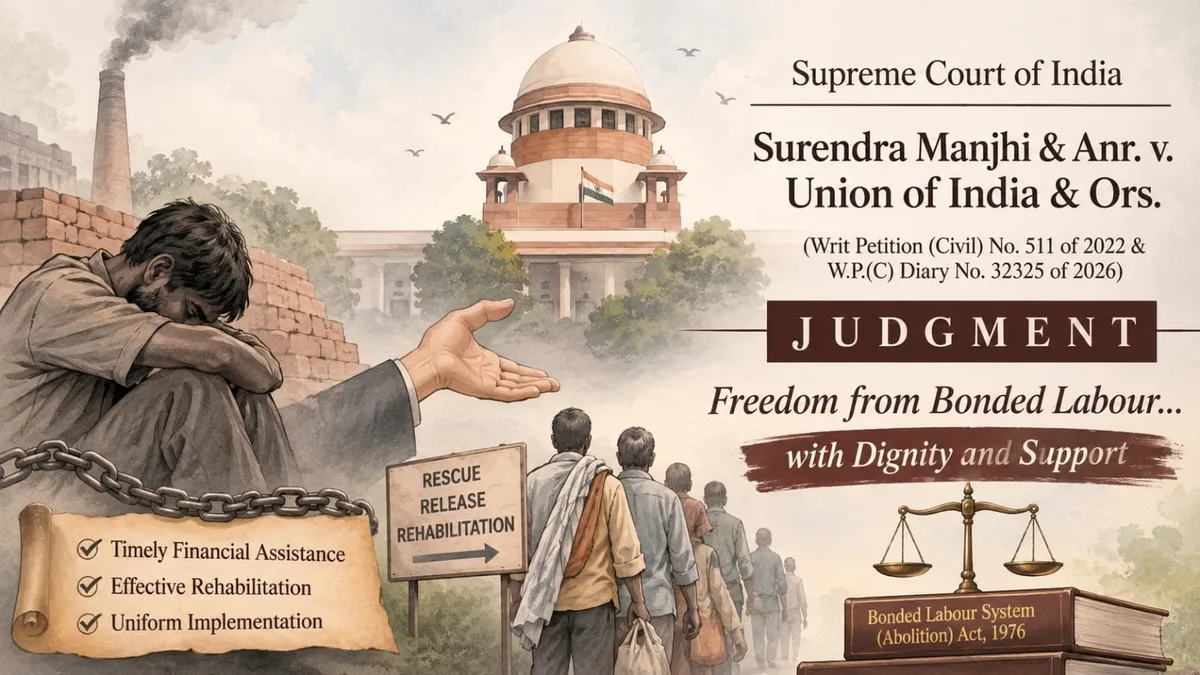
The Supreme Court has issued nationwide directions to improve the identification, rescue, release and rehabilitation of bonded labourers, including fixed timelines for financial assistance and inter-State coordination. The Union and State authorities must implement the revised Standard Operating Procedure and report compliance; the writ petitions will remain pending for further monitoring.
Key Highlights :
- Petitioner Surendra Manjhi was rescued with other labourers from a brick kiln in Shahjahanpur, Uttar Pradesh, on 28 February 2019.
- Of 42 labourers said to have received release certificates, 25 had received immediate financial assistance of ₹20,000 each, while 17 remained unpaid as represented before the Court.
- The Union of India must issue supplementary guidelines, in consultation with the NHRC, within three months.
- Complaints concerning bonded labour should ordinarily be verified within 24 hours; release certificates should ordinarily be issued within 24 hours after identification.
- Immediate assistance under the Rehabilitation Scheme should ordinarily be disbursed within seven days of the release certificate, subject to verification; individual rehabilitation measures must begin within 90 days of rescue.
- States and Union Territories must complete implementation within six months; the Union must file a compliance affidavit within four months.
Background :
- The proceedings arose under Article 32 of the Constitution and concerned delays and inconsistencies in the identification, release and rehabilitation of bonded labourers.
- The first petitioner received immediate assistance only in 2022, nearly three years after his rescue.
- Differences in release-certificate formats between Uttar Pradesh and Bihar had created difficulties in processing assistance for rescued workers.
- The Court considered the revised Standard Operating Procedure dated 14 May 2026 and the proposed revisions to the Central Sector Scheme for Rehabilitation of Bonded Labourers.
What Has Changed :
- Issue: Uniform implementation. Finding: Implementation varied across States and Union Territories. Outcome: The Union must ensure uniform implementation of the revised SOP; States and UTs must comply within six months. Effective / relevant date: Within six months; supplementary Union guidelines within three months.
- Issue: Identification and release. Finding: The record disclosed delays and inconsistent procedures. Outcome: Complaints ordinarily verified within 24 hours; release certificate ordinarily issued within 24 hours after identification; uniform certificate format to be prescribed. Effective / relevant date: As part of the SOP; overall implementation within six months.
- Issue: Financial assistance. Finding: Assistance was delayed in several cases, including the petitioner's case. Outcome: Immediate assistance ordinarily disbursed within seven days after release certificate; rehabilitation plan and measures initiated within 90 days of rescue. Effective / relevant date: Seven days and 90 days respectively.
- Issue: Inter-State cases. Finding: Administrative differences could obstruct assistance after rescue and repatriation. Outcome: Rescuing and receiving States must coordinate; each State/UT must designate a nodal officer and establish coordination mechanism. Effective / relevant date: Within six months.
- Issue: Unpaid assistance to 17 labourers. Finding: Seventeen rescued labourers were stated to be awaiting payment. Outcome: Uttar Pradesh and Bihar must verify entitlement within one month and disburse outstanding assistance preferably within three months, and no later than six months. Effective / relevant date: Verification within one month; payment preferably within three months and at most six months.
- Issue: Monitoring and accountability. Finding: Monitoring and grievance handling required strengthening. Outcome: NAVJIVAN Portal, monthly State-level monitoring, district grievance officers and functioning Vigilance Committees required; grievances ordinarily resolved within 30 days. Effective / relevant date: As directed; overall implementation within six months.
Who Is Affected :
- Union of India, which must issue supplementary guidelines, decide on proposed scheme revisions and file compliance.
- All State Governments and Union Territories, including their district administrations, police and designated nodal officers.
- Rescued bonded labourers and eligible family members entitled to immediate assistance and rehabilitation.
- Children identified as bonded labourers, who must receive age-sensitive protection, education, medical care and counselling.
Compliance Action Points :
- Union of India: issue supplementary guidelines in consultation with NHRC within three months.
- Union of India: file compliance affidavit within four months.
- All States and Union Territories: implement the directions within six months and file compliance affidavits within two weeks thereafter.
- Uttar Pradesh and Bihar: verify the status of assistance for the 17 labourers within one month; disburse any amount found payable preferably within three months and no later than six months.
- The matters are to be listed after seven months for compliance reports and further directions.
Analysis & Impact :
- For Government and Legal Professionals: Authorities should review release-certificate formats, assistance-processing workflows, district rehabilitation funds and inter-State protocols against the timelines fixed by the Court.
- For rescued persons: Pending investigation or criminal proceedings cannot, by itself, justify withholding immediate assistance where scheme requirements are met.
- Points to Watch: The Union's decision on proposed scheme revisions is due within three months. The Court will consider compliance reports when the matters are listed after seven months.
References :
- Constitution of India, Article 32 – basis for the writ proceedings.
- Bonded Labour System (Abolition) Act, 1976 – statutory framework for identification, release and related obligations.
- Central Sector Scheme for Rehabilitation of Bonded Labourers – framework governing immediate financial assistance and rehabilitation.
- Revised Standard Operating Procedure dated 14 May 2026 – procedure directed to be implemented uniformly.
- NAVJIVAN Portal – digital monitoring of identification, rescue, release and rehabilitation.
Source & Attribution :
Supreme Court of India, Writ Petition (Civil) No. 511 of 2022 with connected petition, judgment dated 02 November 2026, 2026 INSC 1185. The uploaded judgment is the source.
Disclaimer: This summary is an editorial aid prepared from the uploaded source document. It is not legal, tax or investment advice. Refer to the original order, judgment or press release before acting.
Full Judgement / Attachment
Full Judgement
Frequently asked questions about Supreme Court of India
- What is the role of the Supreme Court of India?
- The Supreme Court, established on 28 January 1950, is the highest court of appeal in India. Under Article 141 of the Constitution, the law it declares is binding on all courts in India. It also hears writ petitions for enforcement of fundamental rights under Article 32.
- How can I check Supreme Court case status or download a judgement?
- Case status, cause lists, daily orders and judgements are published on the official website, sci.gov.in. Reported judgements are also available free through the Digital SCR (Supreme Court Reports) on the same website.
- What is a Special Leave Petition (SLP) and what is the time limit?
- An SLP under Article 136 asks the Supreme Court for permission to appeal against a judgement or order of any court or tribunal in India. Against a High Court judgement it is ordinarily filed within 90 days. Leave is discretionary, and most SLPs are decided at the admission stage.
- Who can file a case in the Supreme Court?
- Only an Advocate-on-Record, a lawyer who has passed the Supreme Court's AOR examination, can file pleadings in the Supreme Court. A party may appear in person with the Court's permission, but most litigants engage an Advocate-on-Record along with arguing counsel.
- How can White Collar Professional help with a Supreme Court matter?
- Post your requirement on White Collar Professional to receive proposals from verified Advocates, Chartered Accountants and Company Secretaries, compare them, and pay securely through the platform. This page also tracks the latest Supreme Court judgements and legal updates as they are reported.