Pension Deduction from Salary of Retired Public Service Commission Members Upheld
Court / Authority
Supreme Court of India
Update / Judgement Date
04 Nov 2026
Source
WCP News Bulletin
Author
Dipanshi Bansal — WCP Legal Desk
Reading Time
5 min read
View Count
2
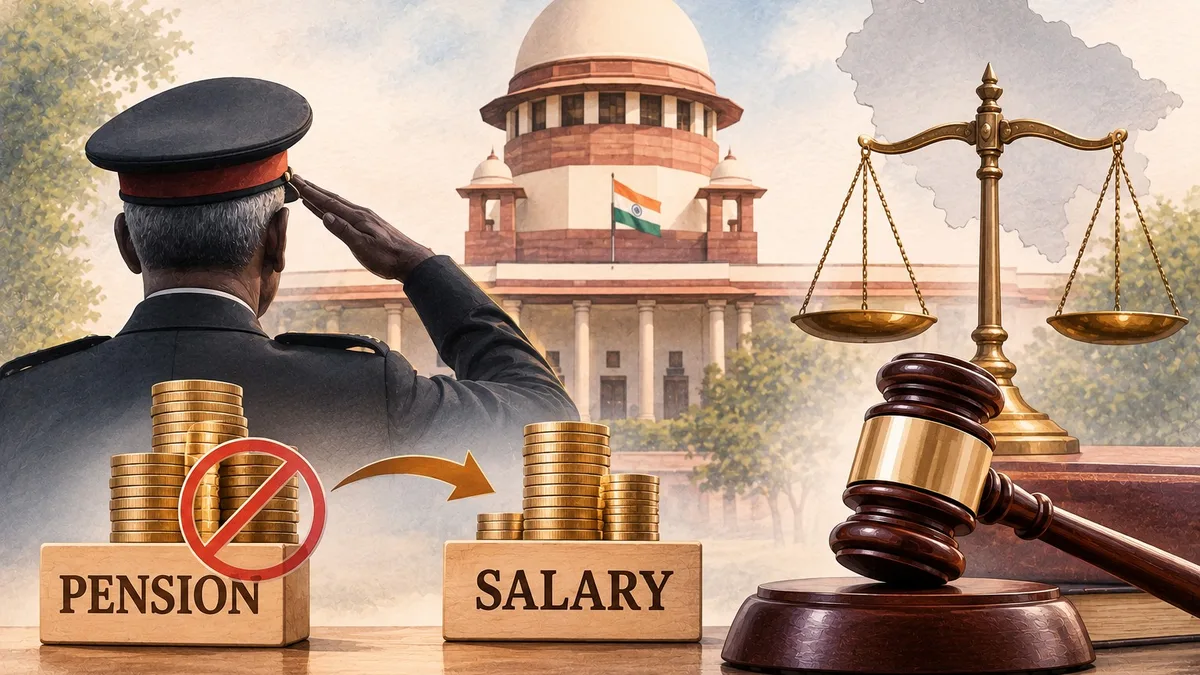
The Supreme Court allowed the State of Uttarakhand’s appeals and restored the validity of Regulation 7(2) of the Uttarakhand Public Service Commission (Conditions of Service) Regulations, 2004. The provision permits deduction of pension earned from previous government service while fixing the remuneration of a retired person appointed as Chairman or Member of the Commission. The Court held that the appointees accepted their posts with knowledge of the applicable service conditions and could not challenge them after enjoying the appointments.
Key Highlights :
- Two appeals challenged the Uttarakhand High Court judgments dated 15 April 2010 in Writ Petition Nos. 182 (SB) and 181 (SB) of 2008.
- Regulation 7(2) was challenged under Articles 14, 16 and 318 of the Constitution.
- M.C. Bhandari, a retired Lieutenant General, was appointed Chairman of the Uttarakhand PSC in November 2006; his pension of ₹17,627 was deducted from the remuneration fixed for the post.
- The second appointee, Sohan Lal, had retired from the Uttarakhand Provincial Civil Service before being appointed as a Commission Member.
- The Supreme Court held that the Governor’s determination under Regulation 7(2), followed by the Office Memorandum dated 16 September 2008, was valid.
- The appeals were allowed and the High Court orders declaring Regulation 7(2) ultra vires were set aside.
Background :
- The appointees had retired from earlier public service and were subsequently appointed to constitutional posts in the Uttarakhand Public Service Commission.
- Their remuneration was fixed after deducting the pension payable for their previous service. Their representations seeking payment without deduction were rejected.
- The Uttarakhand High Court accepted their challenge, held Regulation 7(2) unconstitutional and directed restoration of the deducted amounts.
- The State relied on the regulatory framework governing conditions of service and the Governor’s power to determine remuneration under Regulation 7(2).
What Has Changed :
- Issue – Validity of Regulation 7(2) : Finding – The regulation formed part of the service conditions applicable to the Chairman and Members of the Uttarakhand PSC. The Court found no basis to invalidate it under the constitutional provisions invoked. Outcome – Regulation 7(2) upheld; High Court’s contrary declaration set aside.
- Issue – Authority for deduction of pension : Finding – The record showed that the Personnel and Finance Departments considered the issue and that the matter was placed before the Governor for approval under Regulation 7(2). The Office Memorandum dated 16 September 2008 reflected that decision. Outcome – The salary fixation after deduction of pension was held legally valid.
- Issue – Whether appointees could challenge the service conditions after accepting office : Finding – Both appointees accepted their appointments when the Regulations were already in force, served for more than two years and challenged the conditions only later. The Court applied the principles of estoppel and acquiescence. Outcome – The appointees were not permitted to dispute the applicable service conditions after accepting the posts with knowledge of them.
Who Is Affected :
- Retired government servants and armed forces personnel appointed as Chairman or Members of the Uttarakhand Public Service Commission.
- The State Government and authorities responsible for fixing remuneration under the Uttarakhand PSC Regulations.
- Other public bodies may consider the decision when framing or applying service conditions, subject to their own governing statutes and regulations.
Compliance Action Points :
No direct compliance action. The judgment determines the validity of the service-condition regulation in the appeals before the Court.
Analysis & Impact :
- For CA / CS / Tax & Legal Professionals: The decision highlights the importance of examining the governing service regulations and the process by which remuneration is fixed. The Court relied on the administrative record showing consideration by the concerned departments and approval under Regulation 7(2).
- For Businesses & Investors: Limited relevance.
- For News Readers: A retired official appointed to a public commission cannot ordinarily accept the post under existing service conditions and later challenge those conditions after enjoying the appointment.
- Points to Watch: The judgment may be relevant in future disputes concerning deductions, pension adjustment and acceptance of service conditions in public appointments.
References :
- Constitution of India – Articles 14 and 16: equality and equality of opportunity in public employment.
- Constitution of India – Article 318: power to make regulations governing conditions of service of members and staff of Public Service Commissions.
- Uttarakhand Public Service Commission (Conditions of Service) Regulations, 2004 – Regulation 7(1): remuneration framework; Regulation 7(2): determination of salary and pension adjustment.
- Office Memorandum dated 16 September 2008 – implemented the decision concerning deduction of pension.
- High Court of Uttarakhand judgments dated 15 April 2010 in Writ Petition Nos. 182 (SB) and 181 (SB) of 2008.
Source & Attribution :
- Primary source: Supreme Court of India, State of Uttarakhand through Chief Secretary & Ors. v. M.C. Bhandari & Anr., Civil Appeal Nos. 1614–1615 of 2011, 2026 INSC 1194, judgment dated 04 November 2026.
- No other source used.
Disclaimer: This summary is an editorial aid prepared from the judgment identified above. It is not legal advice. Refer to the complete original judgment and applicable legislation before acting.
Full Judgement / Attachment
Full Judgement
Frequently asked questions about Supreme Court of India
- What is the role of the Supreme Court of India?
- The Supreme Court, established on 28 January 1950, is the highest court of appeal in India. Under Article 141 of the Constitution, the law it declares is binding on all courts in India. It also hears writ petitions for enforcement of fundamental rights under Article 32.
- How can I check Supreme Court case status or download a judgement?
- Case status, cause lists, daily orders and judgements are published on the official website, sci.gov.in. Reported judgements are also available free through the Digital SCR (Supreme Court Reports) on the same website.
- What is a Special Leave Petition (SLP) and what is the time limit?
- An SLP under Article 136 asks the Supreme Court for permission to appeal against a judgement or order of any court or tribunal in India. Against a High Court judgement it is ordinarily filed within 90 days. Leave is discretionary, and most SLPs are decided at the admission stage.
- Who can file a case in the Supreme Court?
- Only an Advocate-on-Record, a lawyer who has passed the Supreme Court's AOR examination, can file pleadings in the Supreme Court. A party may appear in person with the Court's permission, but most litigants engage an Advocate-on-Record along with arguing counsel.
- How can White Collar Professional help with a Supreme Court matter?
- Post your requirement on White Collar Professional to receive proposals from verified Advocates, Chartered Accountants and Company Secretaries, compare them, and pay securely through the platform. This page also tracks the latest Supreme Court judgements and legal updates as they are reported.