Supreme Court Restores Acquittal Where Dying Declarations Conflict
Court / Authority
Supreme Court of India
Update / Judgement Date
05 Nov 2026
Source
WCP News Bulletin
Author
Dipanshi Bansal — WCP Legal Desk
Reading Time
4 min read
View Count
1
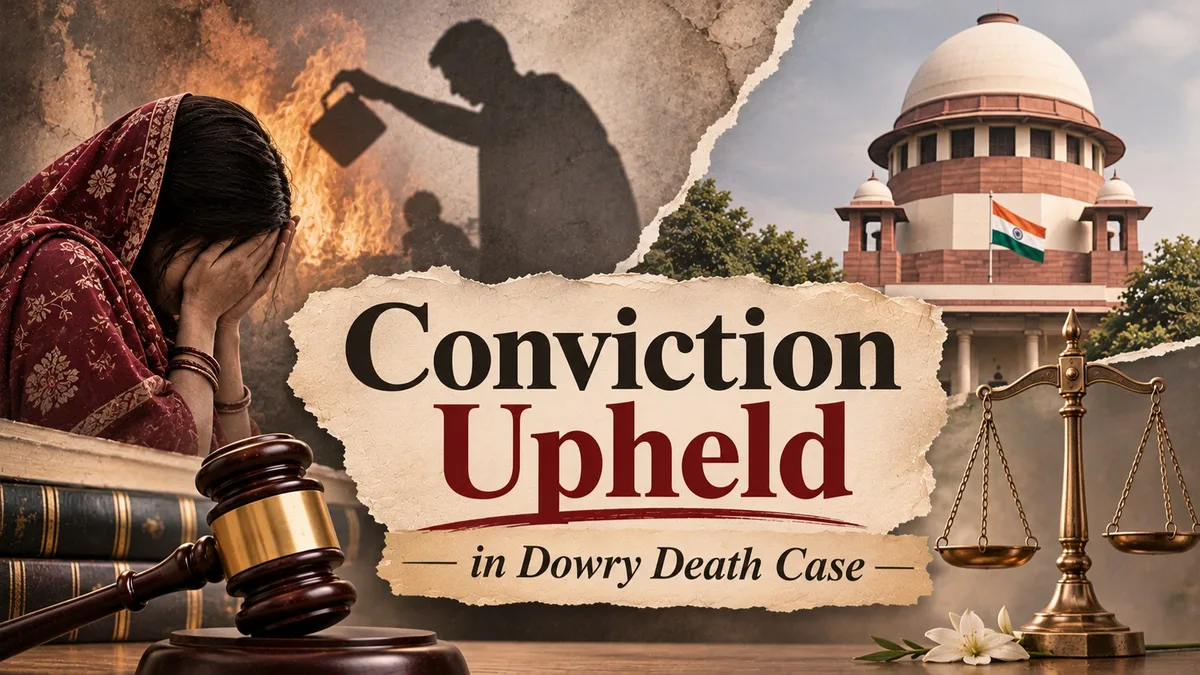
The Supreme Court set aside the Bombay High Court’s conviction of Sau. Kamal bai Waman Patil for murder and restored the benefit of doubt. It found material inconsistencies among the deceased’s three dying declarations and held that the prosecution had not first established the necessary evidentiary foundation to rely on Section 106 of the Evidence Act against the accused.
Key Highlights :
- The appellant had been convicted under Section 302 of the Indian Penal Code and sentenced to life imprisonment with a fine of ₹25,000.
- The prosecution alleged that Sunitabai, the appellant’s daughter-in-law, was set on fire on 10 April 2005 and died on 15 April 2005 after suffering 90 per cent burns.
- The Sessions Court acquitted all accused, finding inconsistencies among dying declarations recorded at Exhibits 44, 48 and 56 and gaps in the prosecution evidence.
- The Bombay High Court reversed the acquittal only in relation to the appellant, relying on the dying declaration at Exhibit 56.
- The Supreme Court held that the High Court had not properly accounted for the conflicting versions and the enhanced presumption of innocence following acquittal.
- The Court quashed the High Court judgment and acquitted the appellant; she was to be set free forthwith if not required in another case.
Background :
- The prosecution alleged prior ill-treatment and dowry-related harassment within the family, followed by the victim being set on fire at the matrimonial home.
- The victim made multiple statements identifying different persons as the person who set her on fire. The Sessions Court treated the inconsistencies and gaps in corroborating evidence as material.
- The High Court accepted one declaration and reversed the acquittal of the appellant, while maintaining the acquittal of the other accused.
What Has Changed :
- Issue: Whether the High Court was justified in reversing the acquittal and convicting the appellant for murder primarily on one dying declaration despite inconsistencies in the victim’s other declarations.
- Finding: The three dying declarations were materially inconsistent. The Sessions Court was entitled to treat those inconsistencies as creating reasonable doubt; the High Court did not give adequate weight to that conclusion.
- Finding: Section 106 of the Indian Evidence Act, 1872 cannot be used to repair gaps in the prosecution case. The prosecution must first establish a prima facie case by proving the elements necessary to establish the offence.
- Finding: The High Court also failed to hear the appellant on the question of sentence after reversing the acquittal, as contemplated by Section 386(a) of the Code of Criminal Procedure, 1973.
- Outcome: The High Court’s judgment dated 28 September 2017 was quashed. The appellant was acquitted under Section 302 of the Penal Code and directed to be released forthwith if not required in another case.
Compliance Action Points :
- No direct compliance action. The judgment does not prescribe a general filing or regulatory deadline.
- At trial and appellate stages, the prosecution must establish the foundational facts before relying on Section 106 of the Evidence Act; appellate courts reversing acquittals must also comply with the applicable sentencing-hearing requirement.
References :
- Indian Evidence Act, 1872 – Section 106: facts especially within a person’s knowledge; the prosecution must first establish a prima facie case before the burden can shift.
- Indian Penal Code, 1860 – Section 302: punishment for murder, the provision under which the appellant had been convicted.
- Code of Criminal Procedure, 1973 – Section 386(a): referred to in relation to hearing the accused on sentence when an appellate court reverses an acquittal and convicts.
- Ramkrushna Prahlad Dongardive v. State of Maharashtra, 2026 INSC 1099: cited on the requirement to hear the accused on the question of sentence.
Source & Attribution :
Primary source: Supreme Court of India judgment, 2026 INSC 1196, dated 05 November 2026, supplied as the source PDF. No external URL is stated in the supplied document.
Disclaimer: This summary is an editorial aid prepared from publicly available information. It is not legal, tax or investment advice. Refer to the original notification, circular, order or report before acting.
Full Judgement / Attachment
Full Judgement
Frequently asked questions about Supreme Court of India
- What is the role of the Supreme Court of India?
- The Supreme Court, established on 28 January 1950, is the highest court of appeal in India. Under Article 141 of the Constitution, the law it declares is binding on all courts in India. It also hears writ petitions for enforcement of fundamental rights under Article 32.
- How can I check Supreme Court case status or download a judgement?
- Case status, cause lists, daily orders and judgements are published on the official website, sci.gov.in. Reported judgements are also available free through the Digital SCR (Supreme Court Reports) on the same website.
- What is a Special Leave Petition (SLP) and what is the time limit?
- An SLP under Article 136 asks the Supreme Court for permission to appeal against a judgement or order of any court or tribunal in India. Against a High Court judgement it is ordinarily filed within 90 days. Leave is discretionary, and most SLPs are decided at the admission stage.
- Who can file a case in the Supreme Court?
- Only an Advocate-on-Record, a lawyer who has passed the Supreme Court's AOR examination, can file pleadings in the Supreme Court. A party may appear in person with the Court's permission, but most litigants engage an Advocate-on-Record along with arguing counsel.
- How can White Collar Professional help with a Supreme Court matter?
- Post your requirement on White Collar Professional to receive proposals from verified Advocates, Chartered Accountants and Company Secretaries, compare them, and pay securely through the platform. This page also tracks the latest Supreme Court judgements and legal updates as they are reported.