Supreme Court Fixes Twenty-Year Schedule for Himachal’s Hydel Power Arrears
Court / Authority
Supreme Court of India
Update / Judgement Date
06 Nov 2026
Source
WCP News Bulletin
Author
Dipanshi Bansal — WCP Legal Desk
Reading Time
5 min read
View Count
5
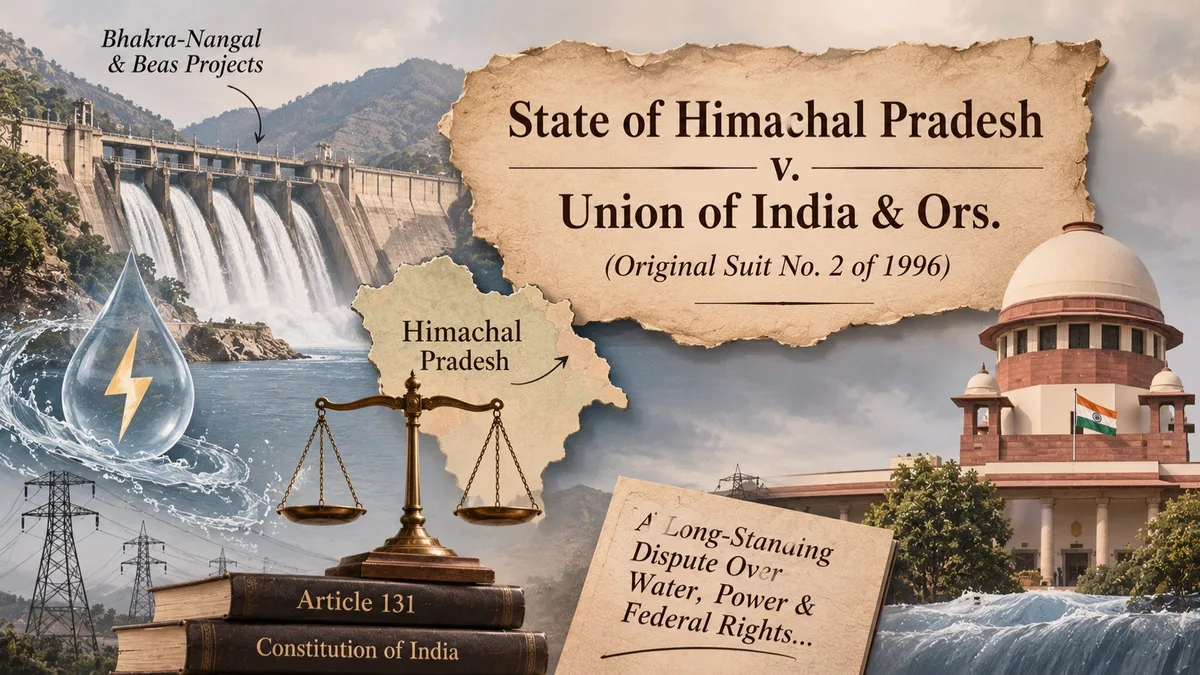
The Supreme Court issued final directions to implement Himachal Pradesh’s entitlement to power from the Bhakra-Nangal and Beas hydro-electric projects. It fixed energy arrears at 13,066 million units, set a 20-lean-season supply schedule, assessed Himachal Pradesh’s capital-cost liability at ₹420.77 crore and directed that the liability be adjusted against part of the energy arrears on a cashless basis.
Key Highlights :
- The State of Himachal Pradesh instituted Original Suit No. 2 of 1996 under Article 131 of the Constitution against the Union of India and other States concerning its share in power from the Bhakra-Nangal and Beas projects.
- A judgment dated 27 September 2011 had declared Himachal Pradesh entitled to 7.19 per cent of the power generated from the projects.
- The present proceedings concerned implementation, computation of energy arrears and the capital-cost liability attributable to Himachal Pradesh.
- The Court fixed the energy arrears at 13,066 million units (MU), to be supplied by Punjab and Haryana at 653 MU per annum over 20 lean seasons from October to March.
- Himachal Pradesh’s 7.19 per cent share of capital cost was assessed at ₹420.77 crore: ₹249.23 crore attributable to Punjab and ₹171.55 crore to Haryana.
- The capital-cost liability is to be adjusted against energy arrears at ₹3.85 per unit, resulting in an adjustment of approximately 1,093 MU and leaving about 11,973 MU payable.
- The remaining 11,973 MU is to be supplied at approximately 598 MU per annum over 20 lean seasons, with project-wise inter se ratios of 58:42 for Bhakra-Nangal and 60:40 for Beas.
- The Court directed cashless implementation and emphasised that its directions are binding and must be implemented without reservation.
Background :
- The Bhakra-Nangal and Beas projects were conceived when Punjab existed as a composite State. Significant land in the territories that now form Himachal Pradesh was submerged for the projects.
- After the reorganisation of Punjab in 1966, power from the projects was principally enjoyed by Punjab, Haryana, Rajasthan and Chandigarh, while Himachal Pradesh asserted an entitlement to a defined share.
- The 2011 judgment declared Himachal Pradesh’s 7.19 per cent entitlement, but disputes continued over the computation of energy due and the capital-cost liabilities to be adjusted.
- The present judgment resolves the outstanding implementation issues after considering the parties’ calculations and submissions.
What Has Changed :
- Issue: What amount of energy arrears remains payable to Himachal Pradesh, how should its share of capital costs be calculated, and over what period should the arrears be supplied.
- Finding: The energy arrears computed by the Union of India are fixed at 13,066 MU. Punjab and Haryana must supply 653 MU annually over 20 lean seasons, October to March, in the ratio of 58:42 for Bhakra-Nangal and 60:40 for Beas.
- Finding: Himachal Pradesh’s capital-cost liability for its 7.19 per cent share, representing the unreimbursed share of loan servicing undertaken by Punjab and Haryana since 1966–67, is ₹420.77 crore, comprising ₹249.23 crore for Punjab and ₹171.55 crore for Haryana.
- Finding: The capital-cost liability must be adjusted against the energy arrears using ₹3.85 per unit, equivalent to approximately 1,093 MU.
- Direction: After the adjustment, the remaining energy arrears are approximately 11,973 MU, to be supplied at approximately 598 MU annually over 20 lean seasons, applying the project-wise ratios stated by the Court.
- Direction: The settlement is to operate on a cashless basis: the capital-cost liability is adjusted against the energy arrears and the balance energy is supplied under the schedule.
- Outcome: Original Suit No. 2 of 1996 was disposed of. The Court declared its directions binding on all concerned parties.
Compliance Action Points :
- Punjab and Haryana: supply the energy arrears in accordance with the 20-lean-season schedule and project-wise ratios fixed by the Court.
- Union of India and the relevant authorities: give effect to the energy arrears figure of 13,066 MU and the annual supply schedule.
- Himachal Pradesh: pay the charges determined by the Bhakra Beas Management Board for the year in which each tranche of energy is received.
- Authorities implementing the settlement: adjust ₹420.77 crore of capital-cost liability against approximately 1,093 MU valued at ₹3.85 per unit, leaving approximately 11,973 MU to be supplied.
- No separate filing deadline is specified; the schedule is to be implemented in accordance with the Court’s 20-lean-season direction.
References :
- Constitution of India – Article 131: original jurisdiction of the Supreme Court in disputes between the Union and States or between States.
- Supreme Court judgment dated 27 September 2011 in Original Suit No. 2 of 1996: declared Himachal Pradesh’s entitlement to 7.19 per cent of power generated from the Bhakra-Nangal and Beas projects.
- Punjab Reorganisation Act, 1966 – Section 78: provisions considered in the earlier proceedings concerning rights and liabilities relating to the Bhakra-Nangal and Beas projects.
- Bhakra Beas Management Board framework: relevant to charges payable by Himachal Pradesh for each tranche of energy received.
Source & Attribution :
Primary source: Supreme Court of India judgment, Original Suit No. 2 of 1996, 2026 INSC 1200, dated 06 November 2026, supplied as the source PDF.
Disclaimer: This summary is an editorial aid prepared from publicly available information. It is not legal, tax or investment advice. Refer to the original notification, circular, order or report before acting.
Full Judgement / Attachment
Full Judgement
Frequently asked questions about Supreme Court of India
- What is the role of the Supreme Court of India?
- The Supreme Court, established on 28 January 1950, is the highest court of appeal in India. Under Article 141 of the Constitution, the law it declares is binding on all courts in India. It also hears writ petitions for enforcement of fundamental rights under Article 32.
- How can I check Supreme Court case status or download a judgement?
- Case status, cause lists, daily orders and judgements are published on the official website, sci.gov.in. Reported judgements are also available free through the Digital SCR (Supreme Court Reports) on the same website.
- What is a Special Leave Petition (SLP) and what is the time limit?
- An SLP under Article 136 asks the Supreme Court for permission to appeal against a judgement or order of any court or tribunal in India. Against a High Court judgement it is ordinarily filed within 90 days. Leave is discretionary, and most SLPs are decided at the admission stage.
- Who can file a case in the Supreme Court?
- Only an Advocate-on-Record, a lawyer who has passed the Supreme Court's AOR examination, can file pleadings in the Supreme Court. A party may appear in person with the Court's permission, but most litigants engage an Advocate-on-Record along with arguing counsel.
- How can White Collar Professional help with a Supreme Court matter?
- Post your requirement on White Collar Professional to receive proposals from verified Advocates, Chartered Accountants and Company Secretaries, compare them, and pay securely through the platform. This page also tracks the latest Supreme Court judgements and legal updates as they are reported.