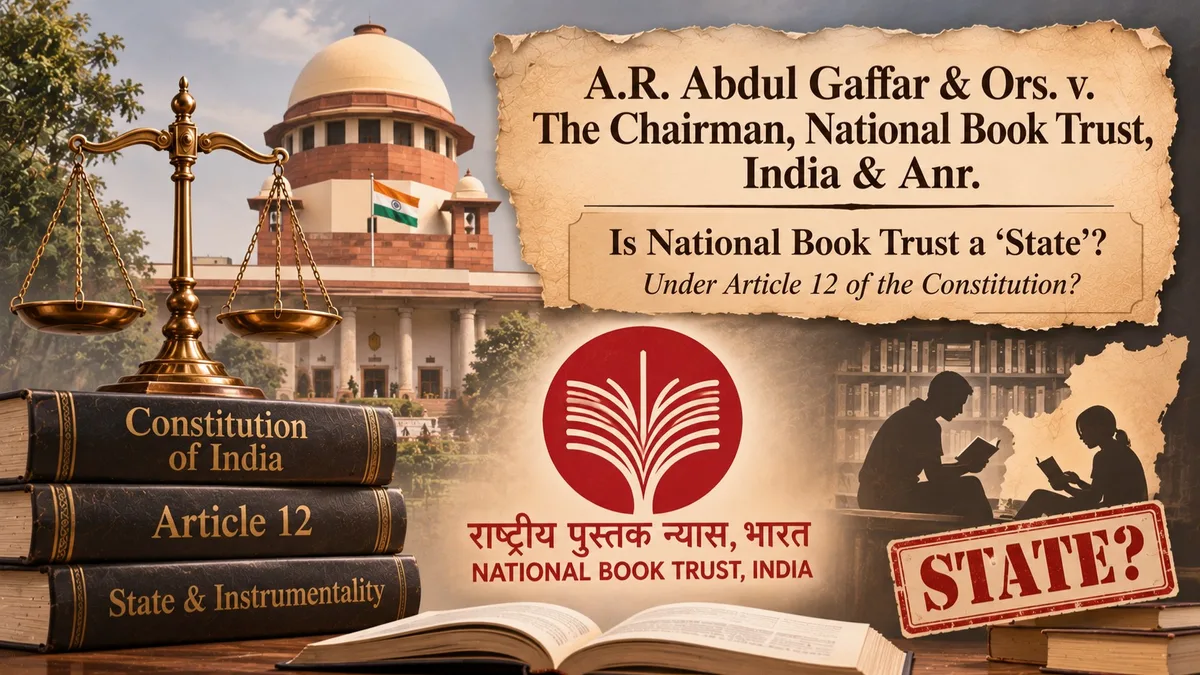
The Supreme Court upheld the Delhi High Court Full Bench decision that the National Book Trust, India is an instrumentality of the State under Article 12 of the Constitution. The Court found that the Union Government’s control over the Trust’s creation, governing body, executive administration, finances, audit and governing rules was deep and pervasive, rather than merely regulatory. Key Highlights : • The appeal arose from the Delhi High Court Full Bench’s conclusion that the National Book Trust, India (NBT) is ‘State’ within Article 12 of the Constitution. • NBT was established through a Government of India resolution dated 15 June 1957 and reorganised by a further resolution dated 28 September 1962. • Under the Trust’s Rules, the Government appoints the Chairman, nominates members and places representatives of the Ministries of Education, Finance, and Information and Broadcasting in its governing structure. • The Government exercises oversight over the Trust’s executive and financial administration, including its accounts, audit, annual reporting and specified changes to its rules and objects. • The Court held that the Article 12 test depends on the cumulative degree of financial, functional and administrative control; the fact that NBT earns income from publications does not displace pervasive governmental control. • The appeal was dismissed. The Court clarified that Article 12 status does not make NBT a Government department or automatically convert its employees into civil servants. Background : • The legal question was whether NBT, a society/trust rather than a conventional statutory corporation, falls within the expression ‘other authorities’ in Article 12. • The Delhi High Court Full Bench examined NBT independently under the constitutional tests governing governmental instrumentalities and agencies. • The Trust contended that it was not a State authority and relied, among other things, on its legal form and its ability to generate income through publication activities. What Has Changed : • Issue: Whether the National Book Trust, India is ‘State’ within the meaning of Article 12 of the Constitution. • Finding: The form of incorporation or registration is not decisive. A society or trust can fall within Article 12 if the cumulative facts establish that the Government financially, functionally and administratively dominates or pervasively controls it. • Finding: Government involvement in NBT is structural: the Government created the Trust, appoints its Chairman, nominates members to its governing and executive bodies, participates in financial administration, receives annual reports and accounts, and retains oversight over audit and specified amendments to the governing framework. • Finding: Government grants are relevant but not conclusive. Nor does the Trust’s independent revenue from publication sales negate the broader pattern of control. • Clarification: NBT’s Article 12 status attracts the constitutional discipline applicable to State action under Part III. It does not, by itself, make NBT a Government department or confer civil-servant status or all protections under Articles 309, 310 and 311 on its employees. • Outcome: The Supreme Court upheld the Full Bench decision and dismissed the appeal. Who Is Affected : • National Book Trust, India, including its governing and executive bodies. • Persons seeking to enforce fundamental rights against NBT in relation to State action. • Employees and other persons dealing with NBT, subject to the Court’s clarification that Article 12 status does not automatically confer Government-service status. Compliance Action Points : 1. No direct regulatory filing or compliance deadline is prescribed. 2. NBT should account for the constitutional standards governing State action under Part III when exercising its powers and performing its functions. 3. Persons considering proceedings against NBT should distinguish Article 12 status from the separate legal questions governing service conditions and civil-servant protections. Analysis & Impact : • For CA / CS / Tax & Legal Professionals: The decision is relevant to public bodies, societies and government-supported institutions. Article 12 analysis turns on the cumulative structure of control, not merely the entity’s legal form or the proportion of its income derived from grants. • For Businesses & Investors: Limited relevance. The judgment does not concern a commercial transaction or impose a new financial reporting obligation. • For News Readers: The Supreme Court has confirmed that the National Book Trust is a State authority for fundamental-rights purposes because of the Government’s pervasive control over its functioning. • Points to Watch: The Court expressly limited the consequence of the ruling: Article 12 status does not automatically make NBT employees Government servants or extend Articles 309–311 protections. References : • Constitution of India – Article 12: defines ‘State’ for the purposes of Part III, including ‘other authorities’. • Constitution of India – Part III: fundamental rights and constitutional discipline applicable to State action. • Constitution of India – Articles 309, 310 and 311: referred to by the Court to clarify that Article 12 status does not automatically confer civil-servant status or associated service protections. • Ajay Hasia v. Khalid Mujib Sehravardi, (1981) 1 SCC 722: factors for determining whether a body is an instrumentality or agency of the State. • Pradeep Kumar Biswas v. Indian Institute of Chemical Biology: the cumulative test of financial, functional and administrative domination or pervasive control. • Ramana Dayaram Shetty v. International Airport Authority of India: foundational principles concerning State instrumentalities. • Zee Telefilms Ltd. v. Union of India, (2005) 4 SCC 649: public function alone is insufficient to establish Article 12 status. Source & Attribution : Primary source: Supreme Court of India judgment, Civil Appeal No. 14369 of 2015, 2026 INSC 1202, dated 06 November 2026, supplied as the source PDF. The judgment also refers to NBT’s official history and Rules. Disclaimer: This summary is an editorial aid prepared from publicly available information. It is not legal, tax or investment advice. Refer to the original notification, circular, order or report before acting.
Court / Authority
Supreme Court of India
Update / Judgement Date
06 Nov 2026
Source
WCP News Bulletin
Author
Dipanshi Bansal — WCP Legal Desk
Reading Time
4 min read
View Count
3
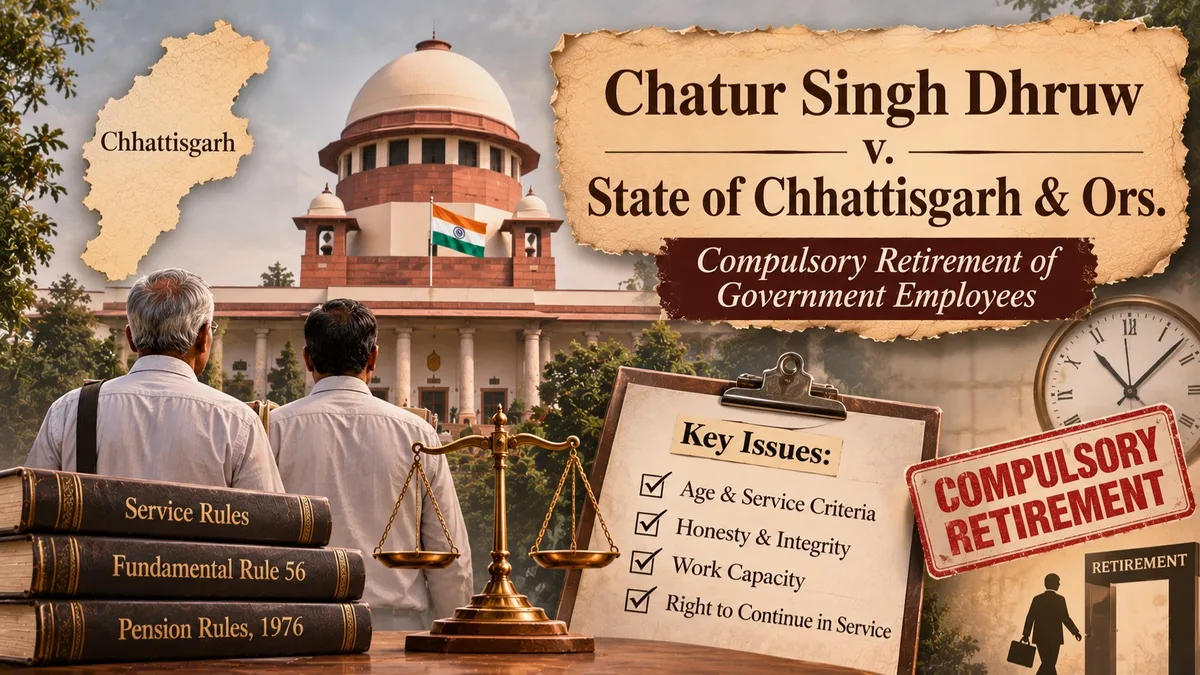
The Supreme Court upheld the compulsory retirement of two Assistant Grade-III employees of the Chhattisgarh Legal Metrology Department. It found that the State had reviewed their complete service records under the applicable rules and the 25 April 2017 circular, and that the retirement orders were neither punitive nor stigmatic and were not shown to be arbitrary, mala fide or perverse.
Key Highlights :
- The appellants were initially appointed as Peons in 1989 and 1993, promoted to Assistant Grade-III in 2012 and 2013, and regularised on 19 June 2015.
- The Government of Chhattisgarh issued a circular on 25 April 2017 directing review of service records for compulsory retirement under the applicable service provisions.
- The circular prescribed review of integrity, physical capacity, reputation and work efficiency, the complete service record, and whether the overall grading was below ‘Good’.
- The appellants were compulsorily retired by separate orders dated 09 October 2017.
- The Court held that compulsory retirement is ordinarily neither punitive nor stigmatic and that the authority may consider uncommunicated adverse entries while assessing the entire service record.
- The Supreme Court affirmed the Chhattisgarh High Court judgments dated 12 April 2023 and dismissed both appeals without costs.
Background :
- The appellants challenged their retirement before the Chhattisgarh High Court; the Single Judge declined to interfere on 23 August 2019 and the Division Bench affirmed that decision on 12 April 2023.
- They argued that similarly situated employees had not been treated in the same way, that the orders were founded on allegations of misconduct, and that uncommunicated confidential-report entries could not be relied upon.
- The State maintained that the review was conducted under the applicable service framework and on the basis of the appellants’ complete service records.
What Has Changed :
- Issue: Whether the compulsory-retirement orders were arbitrary or discriminatory, punitive or stigmatic, or invalid because uncommunicated confidential-report entries were considered.
- Finding: Compulsory retirement is a measure taken in public interest and is not ordinarily punitive or stigmatic. The Court examines the order itself and the material supporting the competent authority’s opinion.
- Finding: The authority may consider the entire service record, including uncommunicated adverse remarks, when forming an opinion on compulsory retirement. The absence of communication of such remarks does not, by itself, invalidate the order.
- Finding: The Court distinguished Dev Dutt and Sukhdev Singh, which concerned communication of entries affecting promotion or career progression, from the separate legal principles governing compulsory retirement.
- Finding: The orders did not record a finding of misconduct or impose a punishment. The Court found relevant and cogent material and no arbitrariness, mala fides, perversity or violation of constitutional or statutory guarantees.
- Outcome: The appeals were dismissed and the High Court judgments were affirmed.
Compliance Action Points :
- State departments conducting compulsory-retirement reviews should apply the governing statutory provisions and applicable circular consistently and assess the employee’s complete service record.
- Authorities should base the decision on relevant material and a bona fide public-interest assessment; the judgment does not authorise arbitrary or punitive action under the label of compulsory retirement.
- No new general filing deadline or penalty is prescribed.
References :
- Fundamental Rule 56: provision referred to in the Chhattisgarh circular for review and compulsory retirement.
- Chhattisgarh Civil Services (Pension) Rules, 1976 – Rule 42B: service provision referred to in the circular governing compulsory retirement.
- Government of Chhattisgarh, General Administration Department Circular dated 25 April 2017: prescribed the review parameters applied to the appellants.
- State of Uttar Pradesh v. Bihari Lal, (1994) Supp. 3 SCC 593: cited in the circular in relation to review of the complete service record.
- Baikuntha Nath Das v. Chief District Medical Officer: cited for the principle that consideration of uncommunicated adverse remarks does not, by itself, invalidate compulsory retirement.
- Dev Dutt v. Union of India and Sukhdev Singh v. Union of India: distinguished as decisions concerning promotion and career progression rather than the distinct compulsory-retirement framework.
Source & Attribution :
Primary source: Supreme Court of India judgment, 2026 INSC 1205, arising from SLP(C) Nos. 24392 and 25201 of 2023, dated 06 November 2026, supplied as the source PDF.
Disclaimer: This summary is an editorial aid prepared from publicly available information. It is not legal, tax or investment advice. Refer to the original notification, circular, order or report before acting.
Full Judgement / Attachment
Full Judgement
Frequently asked questions about Supreme Court of India
- What is the role of the Supreme Court of India?
- The Supreme Court, established on 28 January 1950, is the highest court of appeal in India. Under Article 141 of the Constitution, the law it declares is binding on all courts in India. It also hears writ petitions for enforcement of fundamental rights under Article 32.
- How can I check Supreme Court case status or download a judgement?
- Case status, cause lists, daily orders and judgements are published on the official website, sci.gov.in. Reported judgements are also available free through the Digital SCR (Supreme Court Reports) on the same website.
- What is a Special Leave Petition (SLP) and what is the time limit?
- An SLP under Article 136 asks the Supreme Court for permission to appeal against a judgement or order of any court or tribunal in India. Against a High Court judgement it is ordinarily filed within 90 days. Leave is discretionary, and most SLPs are decided at the admission stage.
- Who can file a case in the Supreme Court?
- Only an Advocate-on-Record, a lawyer who has passed the Supreme Court's AOR examination, can file pleadings in the Supreme Court. A party may appear in person with the Court's permission, but most litigants engage an Advocate-on-Record along with arguing counsel.
- How can White Collar Professional help with a Supreme Court matter?
- Post your requirement on White Collar Professional to receive proposals from verified Advocates, Chartered Accountants and Company Secretaries, compare them, and pay securely through the platform. This page also tracks the latest Supreme Court judgements and legal updates as they are reported.