Inland Gold Seizure Needs More Than a Foreign Mark: CESTAT Chandigarh Sets Aside Confiscation of ₹3.66 Crore Gold and ₹50 Lakh Penalty on Amritsar Jeweller
Court / Authority
Indirect Taxes and Customs (CBIC)
Update / Judgement Date
03 Nov 2026
Case No.
Customs Appeal No. 60160 of 2026
Author
Arshee Saifi — WCP Legal Desk
Reading Time
7 min read
View Count
3
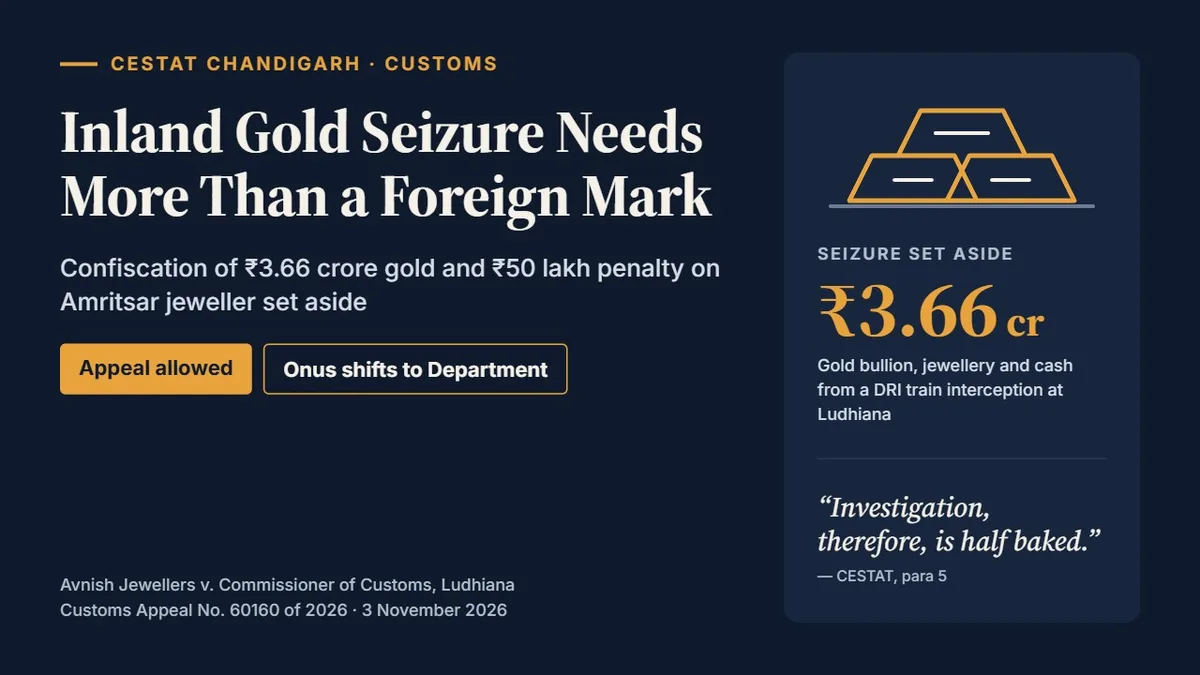
Key Proposition: In an inland seizure of gold not made at a port or border, where the possessor produces invoices, books of account and supplier statements showing domestic procurement, the onus shifts back to the Department, and confiscation cannot rest on an untested foreign-looking mark on a single cut piece without proof of 999.9 purity or a trail to an import.
A. Background / Synopsis :
The appellant has run a jewellery shop at Amritsar since July 2003, making nose pins (nath) and ear rings (walian), and is GST-registered. (Para 1.1)
13.06.2024: intercepted on Train No. 13005 at Ludhiana; luggage held 1,558 g of bullion cut pieces, nose pins and ear rings (gross 5,610 g) and ₹7,70,000 in cash, all seized on 14.06.2024. (Paras 1.2–1.3)
DRI searched his Amritsar shop on 14.06.2024 and 19.06.2024 and found no stock variation; that stock was not seized. (Para 1.13)
Show cause notice dated 20.11.2024 → Order-in-Original dated 30.09.2025 (Joint Commissioner, Ludhiana): absolute confiscation of the bullion, jewellery (₹2,54,82,600) and cash, and a ₹50 lakh penalty → Order-in-Appeal dated 24.04.2026 upheld it. (Paras 1.4–1.6)
B. Issues For Consideration :
- Whether the Department had a sustainable basis to treat the seized bullion and jewellery as smuggled foreign-origin gold under Section 123.
- Whether the onus shifted back to the Department once the appellant produced invoices, books and supplier statements.
- Whether confiscation of the jewellery and cash, and the penalty under Section 112, could stand.
C.Submissions Of Parties :
Appellant:
The bullion was bought against GST invoices from Ansh Jewellers, Amritsar and Shri Ji Traders, Lucknow, and from Navneet Lal Bal Krishna Jewellers, Lucknow (against a sale of nose pins); genuineness was never disputed and no notice went to the suppliers. (Paras 1.7, 1.20)
Pieces bore Indian marks (ABH, BR, JP, Aqua); the valuer did not separate purities or count pieces; the 'SAM' piece was never shown to be 999.9 pure. (Paras 1.8–1.10)
No reasonable belief existed, so Section 123 could not shift the burden; Sections 111(d), (l) and (m) do not apply without an import; cash is not a notified item. (Paras 1.14–1.21)
Relied on Gian Mahtani (SC), Akbar Badruddin Jiwani (SC) and Manisha Devi Jain (CESTAT). (Paras 1.19, 1.21)
Respondent (Revenue):
The appellant admitted carrying bullion; the 'SAM TM' marking, cut pieces in taped and newspaper packets, cash hidden in the bag and the absence of documents justified the belief. (Para 2.9)
Post-seizure stock reconciliation is not proof; Section 123(2) covers gold and its manufactures wherever seized; gold imported in breach of conditions is 'prohibited goods'. (Paras 2.6, 2.10–2.11)
Relied on Premal Ketan Radia (Cal HC) and D. Bhoormull (SC): the Department need not prove its case with mathematical precision. (Para 2.9)
D. Court's Observations & Analysis :
- Re: Issue (i): Foreign origin and Section 123
The goods were seized in transit; invoices and supplier names were given during investigation, and the Department cannot call them later interpolations when it delayed follow-up searches. (Para 3)
The valuer treated all bullion as one purity; ABH, BR, JP and Aqua are Indian marks; the 'SAM' cut piece had no purity test or biscuit number. (Paras 3–4)
Since 1993 gold bullion is restricted rather than prohibited, so in a town seizure invoices and book entries deserve credence and more evidence is needed than at a port or border. (Para 3)
Indian manufacturers now also make 99.9% gold, and for jewellery no presumption of foreign origin arises in an inland seizure. (Para 4)
Held: the Department failed to discharge even the initial burden of showing the goods were smuggled. (Para 4)
- Re: Issue (ii): Shifting onus
The same kinds of stock at the shop were accepted as genuine, so treating goods in transit differently shows 'double standards'. (Para 4)
Supplier statements recorded at Lucknow showed local purchases; the onus shifted to the Department, which did not trace the gold to any Bill of Entry. (Paras 4–5)
Held: the investigation was 'half baked' and, even on preponderance of probability, the Department's case fails. (Para 5)
- Re: Issue (iii): Confiscation of jewellery and cash, and penalty
Nothing links the jewellery or the cash to smuggled gold; how a traveller keeps cash is his prerogative. (Paras 3–4)
Held: seizure vacated; confiscation and penalty cannot survive. (Paras 4–5)
Notable Observations: “This points to the double standards of the department” (Para 4); “Investigation, therefore, is half baked.” (Para 5)
E. Decision & Directions :
- Appeal allowed with consequential relief; the Order-in-Appeal dated 24.04.2026 upholding absolute confiscation of the bullion, jewellery and cash and the ₹50 lakh penalty does not survive. (Para 5)
- Costs: Not stated in judgment.
F. Legal Provisions Discussed & Precedents Cited :
- Customs Act, 1962 – Section 123 – burden of proof for gold seized in the reasonable belief that it is smuggled.
- Customs Act, 1962 – Sections 111(d), 111(l), 111(m), 120 and 121 – confiscation of goods, manufactures from smuggled goods, and sale proceeds.
- Customs Act, 1962 – Sections 112(a) and 112(b) – penalty for improper importation (₹50 lakh, set aside); Section 114AA penalty already dropped by the adjudicating authority.
- Customs Act, 1962 – Section 2(33) 'prohibited goods' and Section 125 redemption fine – argued by the parties.
- Doctrine applied: shifting onus of proof – onus probandi initio incumbit; deinde, probatis condicionibus legis, onus transit (the burden first lies on the party asserting; once the legal conditions are proved, it shifts). (Para 4)
- Precedents: None discussed in the Tribunal's findings; it said the appellant's case law was 'more relevant' than the Department's without naming either set. (Para 5)
G. Case Details :
- Case / Party Name: Avnish Kumar, Proprietor, M/s Avnish Jewellers, Amritsar v. Commissioner of Customs, Ludhiana
- Case Number(s): Customs Appeal No. 60160 of 2026 (Final Order No. 60590/2026), arising out of Order-in-Appeal No. LUD-EXCUS-001-APP-44-2026 dated 24.04.2026
- Coram / Judges: Hon'ble Mr. Somesh Arora, Member (Judicial) and Hon'ble Mr. P. Anjani Kumar, Member (Technical) – Division Bench; authored by Somesh Arora
- Counsel Appearances: For the Appellant: Shri Sudhir Malhotra, Advocate. For the Respondent: Shri Varun Sharma, Authorized Representative.
Disclaimer: This summary is an editorial aid and does not form part of the judgment. Refer to the original judgment before citing.
Full Judgement / Attachment
Full Judgement
Frequently asked questions about Indirect Taxes and Customs (CBIC)
- What is the CBIC?
- The Central Board of Indirect Taxes and Customs (CBIC), in the Department of Revenue, Ministry of Finance, administers customs, central excise and the Central GST and IGST. It issues notifications, circulars and instructions that field formations follow.
- How do importers and exporters file customs documents?
- Bills of entry and shipping bills are filed electronically through ICEGATE, the CBIC's customs e-commerce gateway. Most bills of entry are assessed under the Faceless Assessment system.
- How do I appeal against a customs order?
- A first appeal lies to the Commissioner (Customs Appeals) within 60 days, with a pre-deposit of 7.5 per cent of the duty in dispute. A further appeal lies to the Customs, Excise and Service Tax Appellate Tribunal (CESTAT) within three months, with a pre-deposit of 10 per cent.
- Where are CBIC notifications published?
- Notifications and circulars on customs, GST and central excise are published on the CBIC website (cbic.gov.in) and in the Gazette of India, under separate series for tariff and non-tariff notifications.
- How can White Collar Professional help with a customs or CBIC matter?
- Post your requirement on White Collar Professional to receive proposals from verified Chartered Accountants, customs brokers and Advocates, compare them, and pay securely through the platform. This page also tracks the latest customs or CBIC CBIC and customs updates as they are reported.