A Drastic Power, Not a Default One: Delhi High Court Quashes 2000 Summary Court Martial of Havildar Who Complained Against His Superiors, Holds Pre-2016 SCMs Still Need 'Grave Reason for Immediate Action'
Court / Authority
Delhi High Court
Update / Judgement Date
16 Oct 2026
Date of Publication
27 Oct 2026
Case No.
W.P.(C) 2433/2003
Source
WCP News Bulletin
Author
Arshee Saifi — WCP Legal Desk
Reading Time
8 min read
View Count
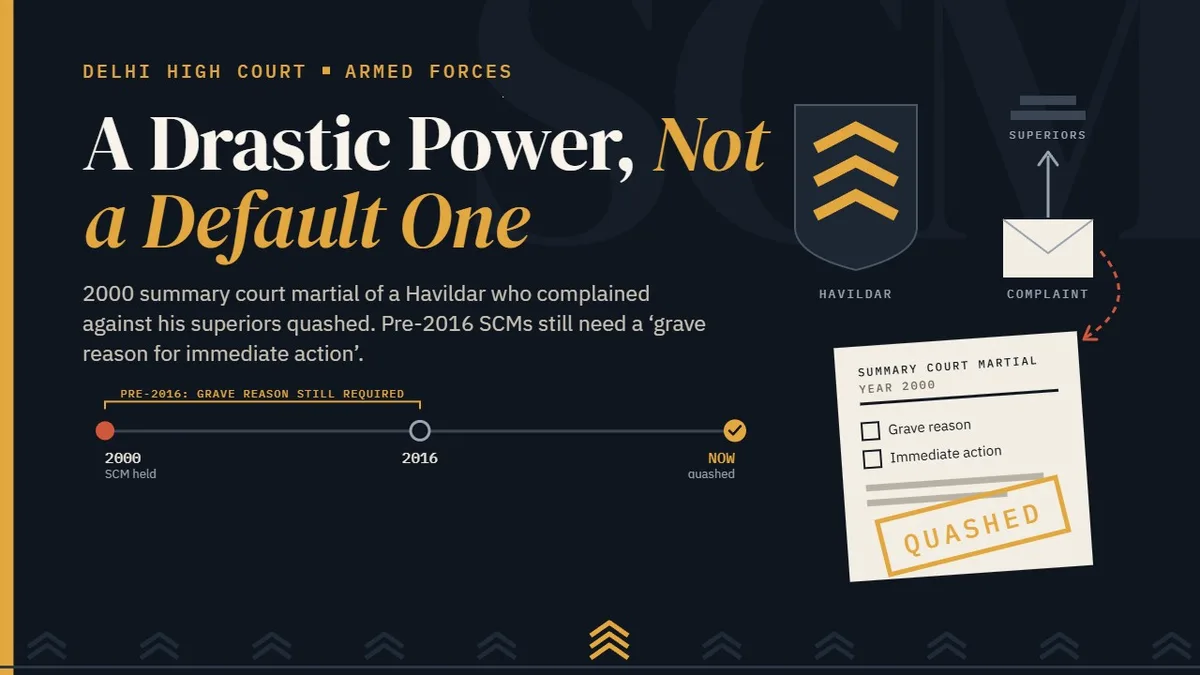
Key Proposition: The power to convene a Summary Court Martial is a drastic power to be exercised only where it is absolutely imperative that immediate action is necessary; the Supreme Court's clarification that recording of reasons is mandatory only from 5 July 2016 does not save an earlier SCM where neither the record nor any satisfaction shows a grave reason for immediate action.
Background / Synopsis :
The petitioner enrolled in the Army on 13 March 1984 and rose to Havildar in 4 Corps Provost Unit, Tezpur (Para 3(i)).
He alleges that from 1998–99 he was targeted for refusing to take part in illegal transport of timber from reserve forests by unit personnel (Para 10(a)).
On 22 February 2000 he complained to the Provost Marshal against his CO, Maj. D.K. Roy, and 2IC; a Court of Inquiry (29 March–15 April 2000, 21 witnesses) found the allegations false and baseless (Paras 3(i)–(ii), 23).
He was attached to 4 Corps Op Signal Regiment for disciplinary proceedings; charges were heard on 17 May 2000 and the SCM held from 13 to 22 June 2000 found him guilty and sentenced him 'to be reduced to ranks and dismissed from service' (Paras 3(iii)–(v), 24).
On 2 August 2001 the Chief of Army Staff, on humanitarian grounds, remitted the sentence so that he was deemed discharged; his pension was fixed in the rank of Sepoy (Paras 2, 3(vi), 10(d)).
The writ petition (filed 21 March 2003) was allowed on 25 January 2008 in Vishav Priya Singh on the ground that the SCM was not held by the CO of his own unit; the Supreme Court reversed that point in 2016 and remitted the matter for decision on merits (Paras 4–7).
Issues For Consideration :
- Whether the SCM convened against the petitioner in June 2000 was valid in the absence of any recorded satisfaction of grave reason for immediate action.
- Whether the Supreme Court's 2017 clarification that recording reasons applies only from 5 July 2016 bars the petitioner's challenge.
- What relief should follow, nearly 27 years after the incident.
Submissions Of Parties :
- Petitioner:
The Supreme Court upheld the principle that an SCM may be convened only when immediate action is imperative; there was no urgency, as his unit was in a peace area (Paras 9, 10(c)).
The Court of Inquiry was predetermined; he was not properly present at the hearing of charge or witness examination, had no effective representation, and the 'friend of the accused' memo was not countersigned (Paras 10(b), (e)).
Reduction to Sepoy halved his pay and pension; as Havildar he would have served till 2010 and benefited from the 6th CPC and MACP (Para 10(d)).
- Respondents (Union of India):
The complaint bypassed the unit head; the Court of Inquiry examined 21 witnesses, including 9 independent ones, and found the allegations false (Paras 11(a)–(b)).
He was attached to another unit to avoid bias; he declined a friend of the accused, cross-examination (except of Maj. Roy) and defence evidence (Paras 11(c)–(d), (f)).
Judicial review of a court martial is confined to procedure (Major A. Hussain; Sachin Kumar Solanki) (Para 11(e)).
Under the review order in Vishav Priya Singh, recording reasons for convening an SCM became necessary only from 5 July 2016; this SCM was in 2000 (Para 11(g)).
Court's Observations & Analysis :
- Re: Issue (i): Validity of the SCM
Section 116 makes the CO alone the court in an SCM; Section 120(2) bars trial without reference to the DCM-convening officer where there is no grave reason for immediate action; Rule 22(3) gives the CO options including disposal under Section 80 or reference to superior authority (Paras 15–17, 19, 21).
As a Havildar (NCO), the petitioner was amenable to Section 80 punishments; the second proviso to Rule 22(3) prohibits ordering an SCM without reference unless there is grave reason for immediate action (Para 22).
No such satisfaction was recorded, none of the options was examined, and the record shows no application of mind before invoking the exceptional power (Paras 22, 25).
Held: The respondents failed to show grave reasons for immediate action; the SCM could not have been convened. (Para 27)
- Re: Issue (ii): Effect of the prospective clarification
In Randhir Singh (2020) 14 SCC 513, the Supreme Court, after noting the 2017 clarification, held that the 'fundamental principle' that SCM power must be used only where immediate action is absolutely imperative still applies, and set aside a 2008 SCM (Para 25).
The Predecessor Bench's view on immediacy in this very case was upheld by the Supreme Court, so the cut-off does not apply here (Para 26).
Held: The clarification does not bar the petitioner's challenge. (Paras 25–26)
- Re: Issue (iii): Relief
Cause of action arose in February 2000 and the SCM was held in June 2000 without articulated reasons; about 27 years have passed (Para 28).
Held: No purpose in remand; the punishment is quashed with notional reinstatement and benefits. (Paras 28–31)
Notable Observations:
"…the power to convene SCM must be exercised rarely, and only when it is absolutely imperative that immediate action is called for, and the satisfaction in that behalf must be articulated in writing or be available on record…" (Para 26)
"The incident in the present case pertains to the year 1999, and approximately 27 years have passed since then, and therefore, no useful purpose would be served, if a direction is given at this stage for remanding the matter back for fresh consideration." (Para 28)
Decision & Directions :
- Writ petition allowed; the SCM sentence 'to be reduced to ranks and dismissed from service', as modified on 2 August 2001 to deemed discharge, is set aside and the petitioner stands reinstated. (Para 29)
- He is deemed in service as Havildar until superannuation on 12 March 2010 (26 years' service) and entitled to all benefits notionally. (Para 30)
- All benefits, including balance pension and retiral dues, to be computed and released within three months, failing which 6% interest per annum. (Para 31)
Legal Provisions Discussed & Precedents Cited :
Army Act, 1950 – Sections 26 (complaints), 56 (false accusations), 80 (summary punishments), 108 (kinds of courts martial), 116 (SCM), 120 (powers of SCM), 164(2) (post-confirmation petition).
Army Rules, 1954 – Rules 22 (hearing of charge), 23 (summary of evidence), 24 (remand), 58, 177 (Court of Inquiry), 180 (character involved).
Constitution of India – Articles 226 and 227.
Doctrines applied: exceptional nature of summary jurisdiction; recorded satisfaction for drastic powers.
Union of India v. Vishav Priya Singh, (2016) 8 SCC 641 and review order (2020) 14 SCC 518 – Applied.
Case Details :
- Case / Party Name: Ex Hav Dharambir Kanker v. Union of India & Ors.
- Case Number(s): W.P.(C) 2433/2003 [Neutral Citation: 2026:DHC:9212-DB]
- Coram / Judges: Nitin Wasudeo Sambre, Acting Chief Justice and Amit Sharma, J. – Division Bench
- Counsel Appearances: For the Petitioner: Mr. S.S. Pandey, Ms. Priyanka Sachdeva and Mr. Roshan Kumar, Advocates, with the petitioner in person. For the Respondents: Mr. Amit Tiwari, CGSC, with Ms. Ayushi Srivastava, Mr. Arpan Narwal, Mr. Kushagra Malik and Mr. Ujjwal Tyagi, Advocates, with Major Anish Muralidhar and Capt. Himanshu Tyagi, Army.
Disclaimer: This summary is an editorial aid and does not form part of the judgment. Refer to the original judgment before citing.
Full Judgement / Attachment
Full Judgement
Frequently asked questions about Delhi High Court
- Where does the Delhi High Court sit and which areas does it cover?
- The Delhi High Court sits in New Delhi. It has jurisdiction over the National Capital Territory of Delhi. It was established on 31 October 1966 and is a leading forum for commercial, intellectual property, tax and arbitration matters.
- How do I check Delhi High Court case status and judgements?
- The official website, delhihighcourt.nic.in, provides case status, cause lists, e-filing and judgements searchable by party, judge or date. Orders are also mirrored on the eCourts Judgments portal (judgments.ecourts.gov.in).
- What are the Delhi High Court's Commercial and IP Divisions?
- Delhi High Court has original civil jurisdiction, so high-value suits in Delhi are filed directly before it. Its Commercial Division hears commercial disputes, and its Intellectual Property Division, set up in 2021 after the IPAB was abolished, hears patent, trademark and copyright cases. It is also a major forum for tax appeals from the ITAT Delhi Benches and for arbitration petitions.
- What is an LPA in the Delhi High Court?
- A Letters Patent Appeal (LPA) under Clause 10 of the Letters Patent lets a party challenge certain single-judge orders, typically in writ matters, before a Division Bench. In commercial cases, appeals lie under Section 13 of the Commercial Courts Act instead. Final judgements can be challenged by a Special Leave Petition under Article 136, ordinarily within 90 days.
- How can White Collar Professional help with a Delhi High Court matter?
- Post your requirement on White Collar Professional to receive proposals from verified Advocates, Chartered Accountants and Company Secretaries, compare them, and pay securely through the platform. This page also tracks the latest Delhi High Court judgements and legal updates as they are reported.