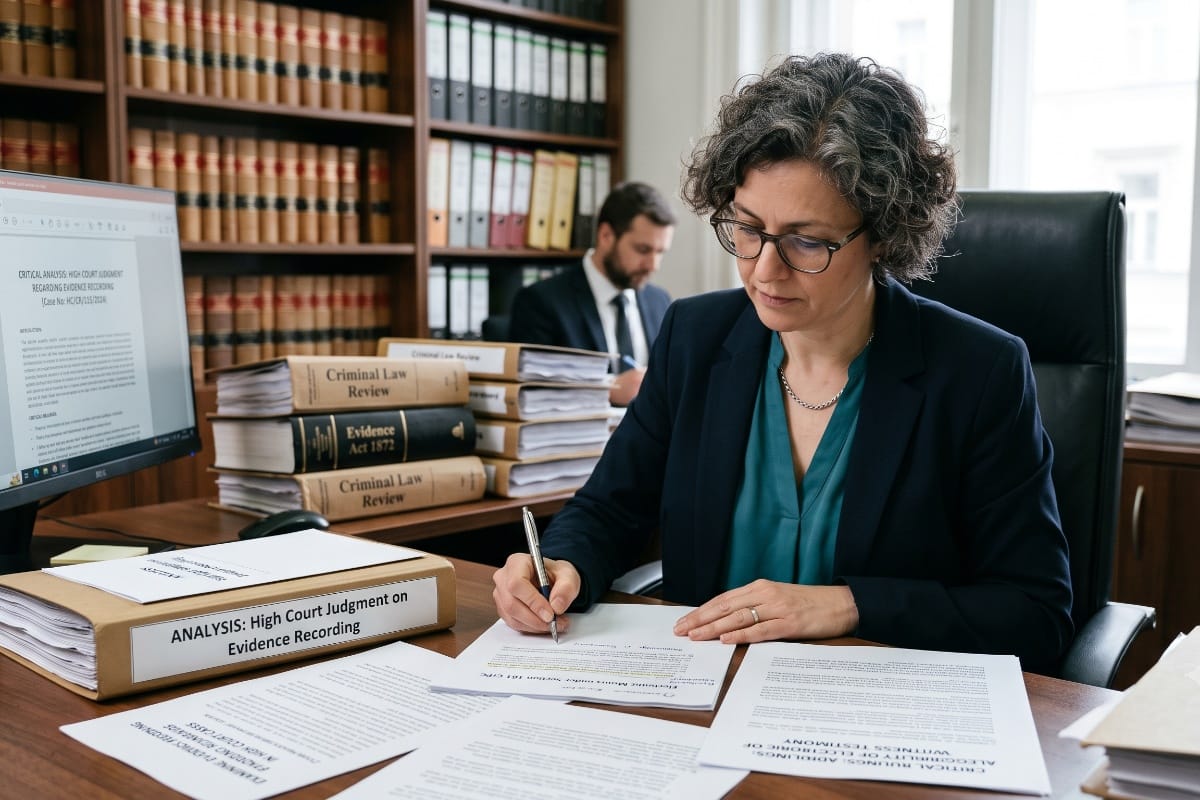
Analysis of the High Court Judgment regarding Evidence Recording
Court / Authority
Delhi High Court
Update / Judgement Date
30 Aug 2026
Source
WCP News Bulletin
Author
Dhruv Chotiya — WCP Legal Desk
Reading Time
2 min read
View Count
- Section 1: Background of the Case
Overview of the civil suit regarding recovery of medical equipment, detailing the procedural history and evidence recording issues.
- Section 2: Legal Proceedings
Details of the applications filed, including the granting of re-tendering of evidence and subsequent court orders.
- Section 3: Arguments by Petitioner and Respondent
Summarizes the petitioner’s claims of res-judicata and delays versus the respondent's contentions for rectifying procedural errors to ensure justice.
- Section 4: Court’s Analysis
The court examines the necessity of recording evidence in accordance with legal provisions and the implications of improper procedure.
- Section 5: Conclusion and Judgment
Reiterates the court's decision to dismiss the petition, affirming the legitimacy of the orders to re-record evidence.
- The chief examinations of witnesses PW-1 and PW-2 were not recorded, leading to procedural irregularities.
- The court determined that procedural lapses can be rectified without falling into res-judicata.
- The decision to allow re-recording of evidence was deemed essential for a fair trial.
- The initial civil suit involved equipment valued at ₹17,36,738.
- Applications for re-recording evidence were filed in different years (2024 and 2025).
- A second Local Commissioner was appointed due to previous failures to record evidence properly.
- The High Court ordered the re-recording of evidence to address procedural inaccuracies.
- Future proceedings must adhere to proper evidence recording protocols to uphold fair trial rights.
- The judgment noted ongoing cases with procedural irregularities, suggesting the need for consistent enforcement of trial protocols.
- No explicit limitations or further studies were mentioned regarding the case itself, but the court acknowledged the potential for delays in trial proceedings due to such irregularities.
Full Judgement / Attachment
Full Judgement
Frequently asked questions about Delhi High Court
- Where does the Delhi High Court sit and which areas does it cover?
- The Delhi High Court sits in New Delhi. It has jurisdiction over the National Capital Territory of Delhi. It was established on 31 October 1966 and is a leading forum for commercial, intellectual property, tax and arbitration matters.
- How do I check Delhi High Court case status and judgements?
- The official website, delhihighcourt.nic.in, provides case status, cause lists, e-filing and judgements searchable by party, judge or date. Orders are also mirrored on the eCourts Judgments portal (judgments.ecourts.gov.in).
- What are the Delhi High Court's Commercial and IP Divisions?
- Delhi High Court has original civil jurisdiction, so high-value suits in Delhi are filed directly before it. Its Commercial Division hears commercial disputes, and its Intellectual Property Division, set up in 2021 after the IPAB was abolished, hears patent, trademark and copyright cases. It is also a major forum for tax appeals from the ITAT Delhi Benches and for arbitration petitions.
- What is an LPA in the Delhi High Court?
- A Letters Patent Appeal (LPA) under Clause 10 of the Letters Patent lets a party challenge certain single-judge orders, typically in writ matters, before a Division Bench. In commercial cases, appeals lie under Section 13 of the Commercial Courts Act instead. Final judgements can be challenged by a Special Leave Petition under Article 136, ordinarily within 90 days.
- How can White Collar Professional help with a Delhi High Court matter?
- Post your requirement on White Collar Professional to receive proposals from verified Advocates, Chartered Accountants and Company Secretaries, compare them, and pay securely through the platform. This page also tracks the latest Delhi High Court judgements and legal updates as they are reported.