BT Global Communications India Private Ltd. v. The Assessment Unit National Faceless Assessment Centre As National Faceless Penalty Centre Income Tax Department New Delhi & Anr.
Court / Authority
Delhi High Court
Update / Judgement Date
13 Oct 2026
Date of Publication
16 Oct 2026
Case No.
W.P.(C) 4767/2023
Source
WCP News Bulletin
Author
Soumya Gupta — WCP Legal Desk
Reading Time
4 min read
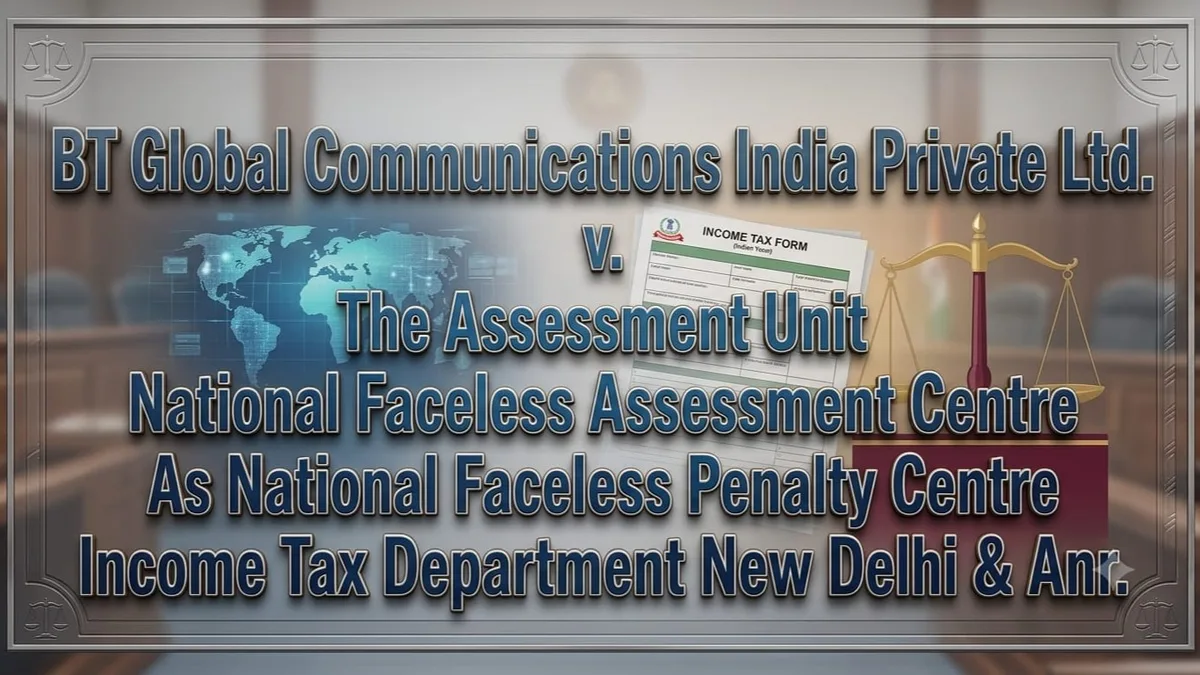
Mandatory Abeyance of Penalty Proceedings During Tribunal Appeal: Section 275(1)(a) of the Income Tax Act, 1961 explicitly provides that penalty proceedings shall be kept in abeyance when the relevant assessment order is the subject-matter of a pending appeal before the Appellate Tribunal.
● Section 253 - Income Tax Act, 1961 - Does Section 275(1)(a) bar passing a penalty order while an appeal is pending before the Tribunal? - Held, yes.
Background / Synopsis:
● The Assessing Officer passed an assessment order dated 28.07.2022 for the assessment year 2018-19 under Section 143(3) read with Section 144C(13) of the Income Tax Act, 1961, recording satisfaction for penalty and issuing a notice under Section 270A [cite: 8, 9].
● The petitioner filed a reply on 17.08.2022 and subsequently filed an appeal against the assessment order before the Income Tax Appellate Tribunal under Section 253 on 29.08.2022 [cite: 9].
● Despite the pendency of the appeal before the Tribunal, the respondent passed the impugned penalty order under Section 270A on 24.03.2023 [cite: 8].
● The petitioner approached the High Court challenging the penalty order as being void and without jurisdiction for violating Section 275(1)(a) of the Act [cite: 8, 9].
Issues For Consideration:
● Whether the Assessing Officer could legally pass a penalty order under Section 270A of the Income Tax Act, 1961 while an appeal against the assessment order was pending before the Income Tax Appellate Tribunal under Section 253 [cite: 8].
Submissions Of Parties:
● Petitioner / Appellant:
○ Argued that the impugned penalty order is void and without jurisdiction as it was passed during the pendency of the appeal before the Tribunal, directly flouting the mandate of Section 275(1)(a) of the Income Tax Act, 1961 [cite: 8, 9, 6].
○ Contended that Section 275(1)(a) leaves no doubt that penalty proceedings must be kept in abeyance during the pendency of appeals filed under Section 253 [cite: 7].
● Respondent / State:
○ Invited the court's attention to paragraph 3 of the assessment order, submitting that the assessee had initially informed the Assessing Officer that it was in the process of filing an appeal [cite: 8, 8].
Court's Observations & Analysis:
● Re: Issue: Validity of penalty order during pending Tribunal appeal
○ The inscription in paragraph 3 of the order indicating the assessee was in the process of filing an appeal appears to have been taken from the petitioner's first reply dated 17.08.2022 [cite: 10].
○ There was no denial that the petitioner actually filed its appeal on 29.08.2022 and gave intimation thereof [cite: 11].
○ Whether intimation was given or not is immaterial, because Section 275(1)(a) unambiguously mandates that penalty proceedings shall be kept in abeyance when an appeal under Section 253 is pending.
○ On the date the impugned order was passed, the petitioner's appeal was pending, and it remained pending.
○ Held: The impugned penalty order is contrary to Section 275(1)(a) of the Income Tax Act, 1961, and is quashed and set aside.
Decision & Directions:
● The writ petition is allowed and the impugned penalty order dated 24.03.2023 is quashed and set aside.
● The Assessing Officer is free to take up penalty proceedings afresh if the Tribunal decides the appeal against the petitioner-assessee and if the law so permits.
● Separate Opinions: None [cite: 8]
Legal Provisions Discussed & Precedents Cited:
● Income Tax Act, 1961 - Section 143(3), Section 144C(13), Section 246, Section 246A, Section 253, Section 270A, and Section 275(1)(a) governing assessments, appeals, and the mandatory abeyance of penalty orders [cite: 8, 9, 10, 11].
● Precedents Cited: None discussed [cite: 8]
Case Details:
● Case / Party Name: BT GLOBAL COMMUNICATIONS INDIA PRIVATE LTD v. THE ASSESSMENT UNIT NATIONAL FACELESS ASSESSMENT CENTRE AS NATIONAL FACELESS PENALTY CENTRE INCOME TAX DEPARTMENT NEW DELHI & ANR. [cite: 8]
● Case Number(s): W.P.(C) 4767/2023 [cite: 8]
● Coram / Judges: Hon'ble Mr. Justice Dinesh Mehta and Hon'ble Dr. Justice Aditi Choudhary - Division Bench [cite: 8]
● Counsel Appearances: Mr. Ankul Goyal and Ms. Tanvi Aggarwal, Advocates for the Petitioner. Mr. Anurag Ojha, Senior Standing Counsel, with Ms. Hemlata Rawat and Mr. VK Saxena, Junior Standing Counsel, for the Respondents [cite: 8]
Full Judgement / Attachment
Full Judgement
Frequently asked questions about Delhi High Court
- Where does the Delhi High Court sit and which areas does it cover?
- The Delhi High Court sits in New Delhi. It has jurisdiction over the National Capital Territory of Delhi. It was established on 31 October 1966 and is a leading forum for commercial, intellectual property, tax and arbitration matters.
- How do I check Delhi High Court case status and judgements?
- The official website, delhihighcourt.nic.in, provides case status, cause lists, e-filing and judgements searchable by party, judge or date. Orders are also mirrored on the eCourts Judgments portal (judgments.ecourts.gov.in).
- What are the Delhi High Court's Commercial and IP Divisions?
- Delhi High Court has original civil jurisdiction, so high-value suits in Delhi are filed directly before it. Its Commercial Division hears commercial disputes, and its Intellectual Property Division, set up in 2021 after the IPAB was abolished, hears patent, trademark and copyright cases. It is also a major forum for tax appeals from the ITAT Delhi Benches and for arbitration petitions.
- What is an LPA in the Delhi High Court?
- A Letters Patent Appeal (LPA) under Clause 10 of the Letters Patent lets a party challenge certain single-judge orders, typically in writ matters, before a Division Bench. In commercial cases, appeals lie under Section 13 of the Commercial Courts Act instead. Final judgements can be challenged by a Special Leave Petition under Article 136, ordinarily within 90 days.
- How can White Collar Professional help with a Delhi High Court matter?
- Post your requirement on White Collar Professional to receive proposals from verified Advocates, Chartered Accountants and Company Secretaries, compare them, and pay securely through the platform. This page also tracks the latest Delhi High Court judgements and legal updates as they are reported.