Copying the Award Is Not Abdicating the Duty: Delhi High Court Division Bench Holds Reproduction of Arbitral Reasoning Does Not Make a Section 34 Judgment Non-Speaking, Dismisses Mumbai Airport’s Appeal Over Sahara Lease
Court / Authority
Delhi High Court
Update / Judgement Date
16 Oct 2026
Date of Publication
18 Oct 2026
Case No.
FAO(COMM)202/2024
Source
WCP News Bulletin
Author
Arshee Saifi — WCP Legal Desk
Reading Time
9 min read
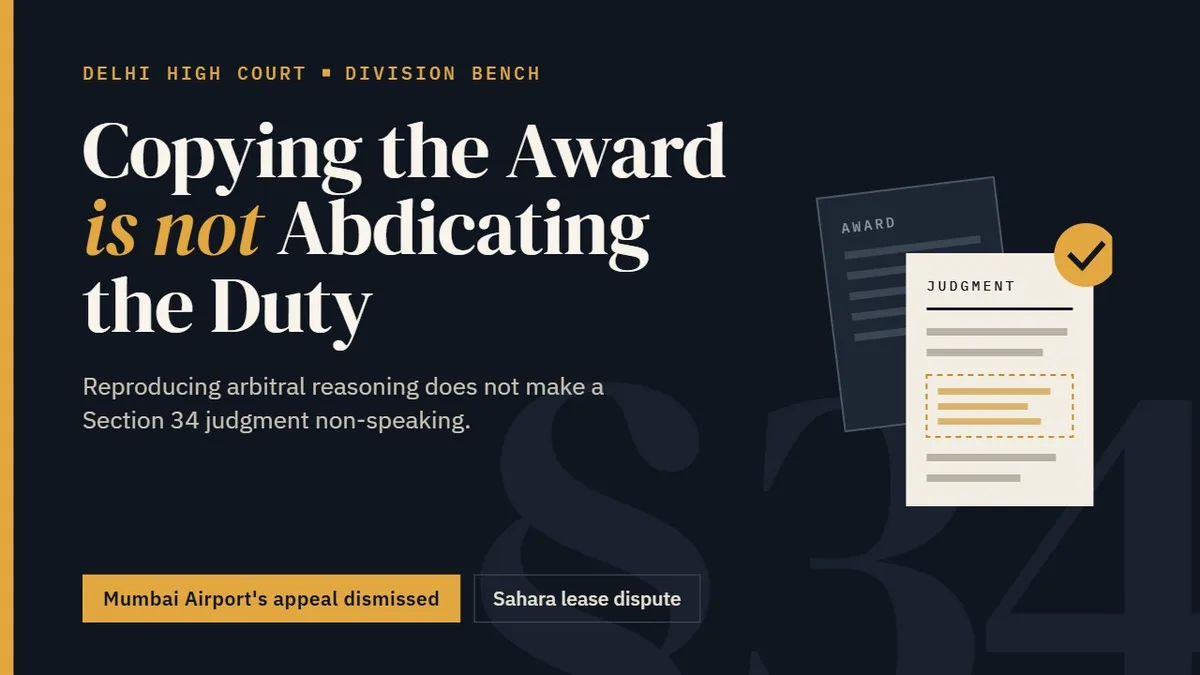
Key Proposition: A judgment under Section 34 of the Arbitration and Conciliation Act, 1996 is not non-speaking merely because it reproduces portions of the arbitral award; it is sustainable if, read as a whole, it shows that the court meaningfully examined the grounds of challenge and applied the statutory standard, and under Section 37 the appellate court may interfere only where the Section 34 court exceeded or failed to exercise its jurisdiction.
Background / Synopsis :
AAI granted Sahara (Batra) Hospitality Pvt. Ltd. a 29-year lease dated 05.06.2002 (ending 04.06.2031) of about 30,047.12 sq. m. of land at Chhatrapati Shivaji Maharaj International Airport, Mumbai.
Under the airport privatisation policy, MIAL was incorporated as a joint venture company; the Operation, Management and Development Agreement (OMDA) was executed on 04.04.2006, the MIAL Lease Deed on 26.04.2006, and MIAL took over the Airport on 03.05.2006.
The OMDA listed the Sahara Lease in Schedule 28 as an ‘Existing Lease’; Article 2.6.1 of the OMDA and Articles 2.1.1–2.1.2 of the MIAL Lease Deed excluded land under Existing Leases from the demise until expiry or early termination, while Article 5.2(b)(i) dealt with transfer or novation of AAI’s existing contracts during the Transition Phase.
The Sahara Lease was never novated and Sahara did not accept MIAL as lessor; AAI passed lease amounts to MIAL for about ten years as an interim arrangement but stopped with effect from 01.04.2019.
MIAL invoked arbitration seeking a direction to transfer or assign the Sahara Lease, land rent, a claim on minimum guaranteed annual payment/turnover levy, and costs; a Tribunal of Justice Deepak Gupta (Retd.), Justice C.K. Thakker (Retd.) and Justice (Dr.) Arijit Pasayat (Retd.) rejected all claims by a unanimous award dated 23.03.2023.
Issues For Consideration :
- Whether the Impugned Judgment discloses a failure to apply the statutory standard governing a Section 34 challenge merely because it reproduces portions of the Award.
- Whether the Tribunal’s interpretation of the OMDA and the MIAL Lease Deed is so perverse or unreasonable as to warrant interference under Section 34.
- Whether the Tribunal’s treatment of the letter dated 09.06.2006, the parties’ subsequent conduct and the Ministry of Civil Aviation communications discloses any ground for interference under Section 34, warranting interference under Section 37.
Submissions Of Parties :
- Appellant (MIAL):
The Impugned Judgment substantially reproduces the Award without independently considering the grounds (Ajay Singh v. Kal Airways; Spicejet v. Kal Airways).
Article 2.6 of the OMDA and Articles 2.1.1–2.1.2 of the Lease Deed deal with the demise of land, while Article 5.2(b)(i) deals with transfer of AAI’s lessor’s rights; they operate in different fields, and Article 5.2(b)(i) contains no exception for Existing Leases – the Tribunal rewrote the contract (also Article 20.3.2 OMDA; Section 109 TPA).
The Tribunal ignored vital evidence, notably AAI’s letter of 09.06.2006 stating that existing land lease agreements had to be assigned or novated to the JVC (Ssangyong Engineering).
AAI’s payments of Sahara rent to MIAL for nearly ten years and MoCA communications of 14.05.2012, 17.06.2013, 27.12.2013 and 06.01.2017 – said to be policy directions under Section 40 of the AAI Act – support MIAL’s reading.
- Respondent (AAI):
The Award considered the contract in detail and the Single Judge rightly refused to substitute another view; the Existing Lease provisions specifically exclude such land from the demise until the lease ends.
The letter of 09.06.2006 was noticed in the Award, and MIAL seeks re-appreciation of evidence; the payments were an interim arrangement, and acquiescence, waiver or estoppel was never pleaded before the Tribunal.
MoCA communications and legal opinions could not amend a bilateral contract and were not policy directions under Section 40 of the AAI Act; a reasoned, unanimous award leaves no ground under Section 34, much less Section 37.
Court's Observations & Analysis :
- Re: Scope of interference under Sections 34 and 37
Section 34 does not permit an appeal on merits; patent illegality under Section 34(2A) must go to the root of the matter, though disregard of vital evidence or an interpretation no fair-minded person could reach may vitiate an award (Para 18).
Section 37 scrutiny is narrower still – the appellate court only checks whether the Section 34 court stayed within its jurisdiction (MMTC v. Vedanta; Punjab State Civil Supplies v. Sanman Rice Mills; UHL Power; McDermott International) (Paras 19–24).
- Re: Issue (i): Reproduction of the Award in the Section 34 judgment
Brief reasoning or adoption of the reasoning under challenge does not make an order non-speaking; a court that finds the Tribunal’s reasoning sustainable may adopt it by reproduction, reference or express agreement (Paras 25–26).
The difference lies between adopting reasoning and mechanically reproducing an award without engaging with the objections; the test is whether any material ground remains unanswered and whether the statutory standard was applied (Paras 27–31).
Proto Developers v. Antriksh Realtech was followed; Ajay Singh, Spicejet, Kalanithi Maran and National Project Constructions were distinguished as cases where objections went unexamined (Paras 32–35).
The Single Judge recorded MIAL’s submissions, considered the OMDA and Lease Deed and dealt with Article 20.3.2, though the letter of 09.06.2006 and rent payments could have been addressed more expressly (Paras 36–37).
Held: The objection that the Impugned Judgment is non-speaking merely because it reproduces the Award was rejected. (Para 38)
- Re: Issue (ii): Interpretation of the OMDA and MIAL Lease Deed
The Existing Lease provisions show the land was not to be demised to MIAL while the lease subsisted; whether AAI separately had to transfer its lessor’s interest turns on Article 5.2(b)(i) (Paras 39–40).
MIAL’s argument that the provisions operate in different fields was ‘not without force’, but the question is whether the Tribunal’s contrary construction falls outside the range of permissible constructions; reading the specific Existing Lease provisions to inform the general novation clause is not impermissible (Paras 41–44).
Article 20.3.2 governs conflicts between the OMDA and project agreements, not reconciliation of OMDA provisions inter se (Para 45); the Single Judge’s remark that no clause dealt with benefits of Existing Leases needed qualification, as Article 5.2(b)(i) has a benefits clause whose scope was in dispute (Para 46).
Section 109 of the Transfer of Property Act, 1882 deals with consequences of a transfer of the lessor’s interest and cannot itself create the contractual obligation; novation of a contract is distinct from transfer of the lessor’s interest (Paras 48–49).
Held: The Tribunal’s interpretation was a plausible reconciliation of the contractual provisions and does not attract interference under Section 34. (Paras 47, 59)
Notable Observations:
“An order does not become non-speaking merely because its reasoning is brief or because the court has adopted the reasoning contained in the decision under challenge.” (Para 25)
“The distinction is between the legitimate adoption of reasoning and the abdication of the duty to adjudicate.” (Para 31)
Decision & Directions :
Appeal under Section 37 dismissed; the Single Judge’s judgment dated 10.04.2024 and the Award dated 23.03.2023 stand. (Paras 59–60)
No specific directions, timelines or guidelines were laid down; costs: not stated in judgment.
Separate Opinions: None (judgment authored by Anil Kshetarpal, J., for the Bench).
Legal Provisions Discussed & Precedents Cited :
Arbitration and Conciliation Act, 1996 (A&C Act) – Section 34, including Section 34(2A) (patent illegality) – limited grounds to set aside an award.
A&C Act – Section 37 – appeal against an order refusing to set aside an award; confined to the limits of Section 34.
Commercial Courts Act, 2015 – Section 13 – appeals from commercial courts and divisions.
Transfer of Property Act, 1882 (TPA) – Section 109 – rights of a transferee of the lessor’s interest; held not to create the contractual obligation claimed.
Airports Authority of India Act, 1994 (AAI Act) – Section 40 – Central Government directions on questions of policy.
Case Details :
- Case / Party Name: Mumbai International Airport Ltd. v. Airports Authority of India
- Case Number(s): FAO(OS) (COMM) 202/2024
- Coram / Judges: Anil Kshetarpal and Bharat Parashar, JJ. – Division Bench
- Counsel Appearances: For the Appellant: Mr. Rajiv Nayar, Senior Advocate with Ms. Kanika Singh, Ms. Ishanee Kapoor, Ms. Janhavi Negi, Mr. Pratham Vir Agarwal and Mr. Naman Maheshwari, Advocates. For the Respondent: Mr. Raghavendra P. Shankar, ASG with Mr. Karan Lahiri, Mr. Prateek Arora, Ms. Pallavi Mishra and Ms. Kanishka Singh, Advocates.
Disclaimer: This summary is an editorial aid and does not form part of the judgment. Refer to the original judgment before citing.
Full Judgement / Attachment
Full Judgement
Frequently asked questions about Delhi High Court
- Where does the Delhi High Court sit and which areas does it cover?
- The Delhi High Court sits in New Delhi. It has jurisdiction over the National Capital Territory of Delhi. It was established on 31 October 1966 and is a leading forum for commercial, intellectual property, tax and arbitration matters.
- How do I check Delhi High Court case status and judgements?
- The official website, delhihighcourt.nic.in, provides case status, cause lists, e-filing and judgements searchable by party, judge or date. Orders are also mirrored on the eCourts Judgments portal (judgments.ecourts.gov.in).
- What are the Delhi High Court's Commercial and IP Divisions?
- Delhi High Court has original civil jurisdiction, so high-value suits in Delhi are filed directly before it. Its Commercial Division hears commercial disputes, and its Intellectual Property Division, set up in 2021 after the IPAB was abolished, hears patent, trademark and copyright cases. It is also a major forum for tax appeals from the ITAT Delhi Benches and for arbitration petitions.
- What is an LPA in the Delhi High Court?
- A Letters Patent Appeal (LPA) under Clause 10 of the Letters Patent lets a party challenge certain single-judge orders, typically in writ matters, before a Division Bench. In commercial cases, appeals lie under Section 13 of the Commercial Courts Act instead. Final judgements can be challenged by a Special Leave Petition under Article 136, ordinarily within 90 days.
- How can White Collar Professional help with a Delhi High Court matter?
- Post your requirement on White Collar Professional to receive proposals from verified Advocates, Chartered Accountants and Company Secretaries, compare them, and pay securely through the platform. This page also tracks the latest Delhi High Court judgements and legal updates as they are reported.