Delhi High Court Acquits Husband in 1999 Bride-Burning Case: Contradictory Dying Declarations of a 100% Burn Victim, Without Medical Proof of Fitness, Cannot Sustain Conviction
Court / Authority
Delhi High Court
Update / Judgement Date
13 Oct 2026
Date of Publication
16 Oct 2026
Case No.
CRL.A. 837/2003
Source
WCP News Bulletin
Author
Dipanshi Bansal — WCP Legal Desk
Reading Time
11 min read
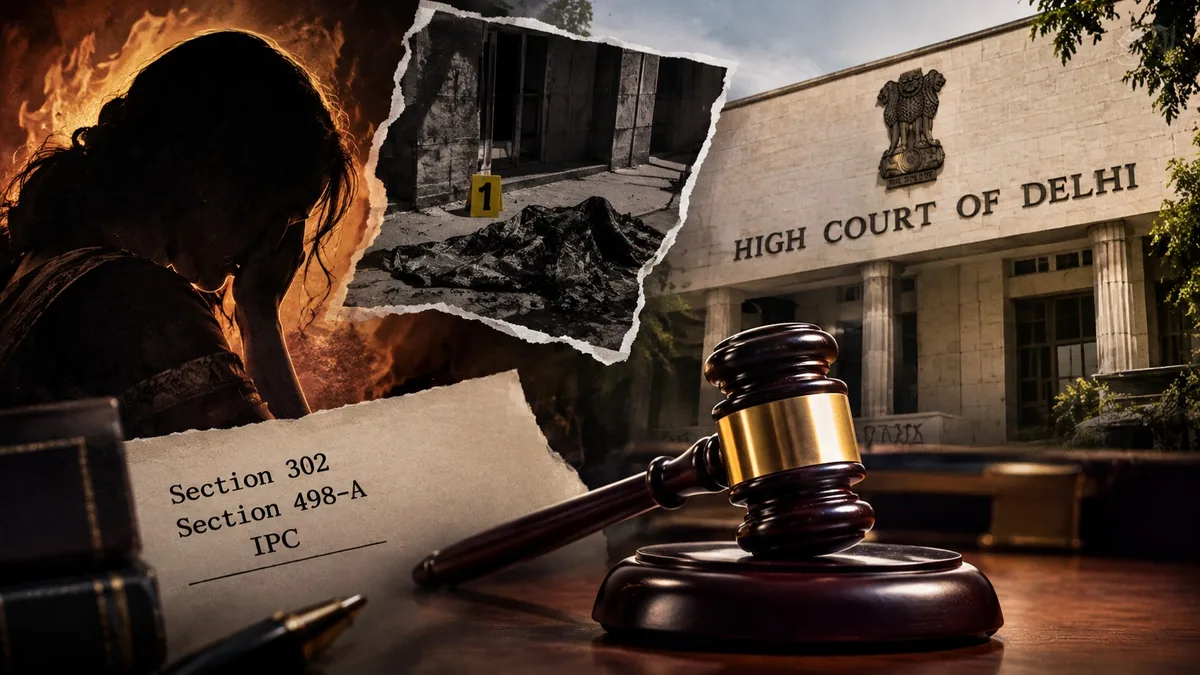
The appellant’s wife died after suffering 100% burns on 11.04.1999, and he was convicted in 2003 under Sections 302 and 498-A of the Indian Penal Code, 1860 largely on her later statements to the Investigating Officer and the SDM, although her first statement in the MLC said she did not know how she got burnt. The issue was whether those later dying declarations could sustain conviction. The Division Bench held that they were a “complete somersault” from the first, were made after relatives met her and lacked medical evidence of her fitness despite 100% burns (Paras 63–69); that the dowry allegations were uncorroborated (Paras 70–74); and that non-examination of the couple’s five-year-old eyewitness warranted an adverse inference (Paras 75–78). The conviction was set aside and the appellant acquitted (Paras 84–86).
Key Proposition: Where multiple dying declarations materially differ and the incriminating ones are made after relatives meet a victim with 100% burns, without positive medical evidence of her treatment and mental fitness, they cannot safely sustain a conviction, particularly when the available eyewitness is withheld and dowry allegations are uncorroborated.
- Indian Evidence Act, 1872 – Section 32(1) – Multiple dying declarations – Earlier declaration not implicating husband, later ones a “complete somersault” – Whether conviction can rest on later declarations – Held, no; they must be consistent on material particulars and inspire confidence (Kamla; Jagbir Singh; Suresh). (Paras 45–49, 59–65)
- Dying declaration of a victim with 100% burns – No medical evidence on treatment, sedation or mental fitness; one-line fitness endorsement – Held, difficult to accept fitness for later declarations (Chacko; Surinder Kumar; Abhishek Sharma). (Paras 66–69)
- Indian Penal Code, 1860 – Sections 302, 498-A – Dowry harassment – Contradictions among relatives; letters and dying declarations silent on dowry – Held, vague and uncorroborated; possibility of tutoring. (Paras 70–74)
- Non-examination of five-year-old eyewitness; defence witnesses and appellant’s own burn injuries – Held, best evidence withheld, adverse inference; reasonable doubt; acquittal. (Paras 75–84)
Background / Synopsis :
- 11.04.1999: information at about 1:40 pm of the appellant’s wife being admitted to LNJP Hospital in a burnt condition (DD No. 8-A); MLC recorded 100% burns; she was declared fit for statement at about 3:45 pm and a statement (Ex. PW-21/A) was recorded by the IO. The SDM (PW-6) recorded a further statement (Ex. PW-6/A) at about 5:30 pm, stating that her husband beat her, poured kerosene and set her ablaze after she insisted on visiting her Bua. (Paras 2–3)
- • FIR No. 276/1999, P.S. Ashok Vihar, was registered under Section 307 IPC; after her death on 12.04.1999 at about 2:45 am it was altered to Sections 304-B/498-A/34 IPC. Post-mortem: death due to shock from 100% dermo-epidermal burns. (Paras 3, 5)
- The appellant was arrested on 12.04.1999; his parents were arrested on 24.06.1999. Charge-sheet under Sections 302/498-A/34 IPC; on 15.09.1999 the Trial Court discharged the parents and charged the appellant under Sections 302/498-A. (Paras 6–8)
- Trial (Sessions Case No. 70/1999): 24 prosecution witnesses including the parents, SDM, doctor and IO; the appellant, in his Section 313 CrPC statement, said his wife had TB and had often threatened suicide, that he and his minor son tried to rescue her and were burnt, and that she told the first doctor she had burnt herself; four defence witnesses were examined. (Paras 9–10)
- 23.10.2003: conviction under Sections 302 and 498-A IPC; 30.10.2003: life imprisonment with fine of Rs.5,000 (default three months) under Section 302 and three years’ rigorous imprisonment with fine of Rs.500 (default three months) under Section 498-A. (Para 11)
Issues For Consideration :
- Whether the multiple, differing dying declarations of the deceased were reliable and sufficient to sustain the conviction under Section 302 IPC.
- Whether the prosecution proved cruelty and dowry harassment under Section 498-A IPC.
- Whether the appellant’s presence at the time of occurrence was proved, and what effect the non-examination of the couple’s minor son and the defence evidence had.
Submissions Of Parties :
- Appellant:
- The conviction rests on inconsistent dying declarations; the first (MLC Ex. PW-13/A, 1:15 pm) recorded that the deceased was sleeping and did not know how she got burnt, was made before relatives arrived, and should have been accepted over the later ones recorded after two to four hours; tutoring by relatives who met her in hospital cannot be ruled out. (Paras 13–17)
- He was outside the house and rushed to rescue his wife, suffering burns on both hands, face, scalp, forearm and chest (MLC Ex. PW-13/B); PW-7, an independent witness, saw him rushing in from outside; the five-year-old son, the sole eyewitness, was not examined; the complete treatment record was not produced, so capacity to give a coherent statement was not shown; the SDM did not confront the deceased with the MLC history. (Paras 18–23)
- Letters Ex. P-1 and Ex. P-2 do not mention scooter or dowry harassment, motive was not proved and defence witnesses DW-1 to DW-4 supported cordial relations and the rescue attempt. Relied on Suresh v. State, 2025 INSC 318; Uttam v. State of Maharashtra, (2022) 8 SCC 576; Irfan @ Naka v. State of U.P., 2023 SCC OnLine SC 1060; and Abhishek Sharma v. State (Govt. of NCT of Delhi), (2024) 13 SCC 660. (Paras 24–27)
- The SDM’s declaration was voluntary and coherent, recorded in question-answer form after the doctor declared her fit, and corroborated by the IO’s statement, the parents’ evidence, medical evidence and the FSL report of kerosene residue in her hair; the sedation argument is an afterthought as no such suggestion was put to the doctor. (Paras 28–31)
- • No mechanical rule makes the earliest declaration prevail; relied on Jagbir Singh v. State (NCT of Delhi), (2019) 8 SCC 779 and Ravi Chander v. State of Punjab, (1998) 9 SCC 303. The defence of suicide is unsupported, the appellant’s burns do not prove innocence, tutoring is a bare suggestion, the son, aged about five, could not have testified, and the Section 498-A charge is independently proved by PW-1, PW-2, PW-4 and PW-5. (Paras 32–41)
Court's Observations & Analysis :
Re: Issue (i): Reliability of the multiple dying declarations
- Section 32(1) of the Indian Evidence Act, 1872 makes a dying declaration relevant and, if voluntary, truthful and confidence-inspiring, it can be the sole basis of conviction; where there are several, the Court must examine whether they are consistent on material particulars. Kamla v. State of Punjab, (1993) 1 SCC 1 and State of Punjab v. Parveen Kumar, (2005) 9 SCC 769 were applied, and Jagbir Singh held that multiple declarations are not all to be rejected but each case must be decided on its facts after examining capacity, voluntariness, ruling out tutoring and supporting evidence. (Paras 45–49)
- This was a case of multiple declarations: the MLC history (DD-I), the oral account to her parents, the IO’s statement and the SDM’s statement. DD-I, the earliest, was recorded at 1:15 pm when she was conscious and capable of giving history, with no suggestion of unfitness, pressure or that she had not given it herself; it did not allege that the appellant poured kerosene or even mention his presence. (Paras 48, 51–53)
- The later declarations were consistent among themselves but a “complete somersault” from DD-I; DD-I was made before the parents arrived and nothing suggests any pressure from the appellant’s side to give it. (Paras 54–63)
- PW-4 admitted that several relatives met her before the SDM recorded her statement; while mere presence of relatives does not prove tutoring, a declaration made after meeting relatives is doubtful (Mohan Lal v. State of Haryana, (2007) 9 SCC 151); Suresh v. State, 2025 INSC 318 held that a declaration changing stance cannot alone sustain conviction without corroboration. (Paras 64–65)
- With 100% burns and later statements recorded after shifting to the burns ward, there was no positive medical evidence of the treatment or medicines given; Chacko v. State of Kerala, (2003) 1 SCC 112, Surinder Kumar v. State of Haryana, (2011) 10 SCC 173 and Abhishek Sharma were applied to hold that the fitness endorsement alone is insufficient. (Paras 66–69)
- Held: It is not possible to rely on the subsequent dying declarations for holding the appellant guilty of murder. (Para 69)
Re: Issue (ii): Dowry harassment and Section 498-A IPC
- PW-1, PW-2, PW-4 and PW-5 were contradictory on when the scooter demand arose and whether the deceased complained earlier; neither she nor her family ever complained to anyone about dowry demand. (Paras 70–73)
- Letters Ex. P-2 and P-4 (1995) mention beatings and broken articles but not dowry or a scooter, and neither the SDM’s nor the IO’s statement alleges dowry harassment; the only cause she gave was her insistence on visiting her Bua. (Para 74)
- Held: The allegations are vague, uncorroborated and not believable; the family’s belief that the appellant killed her makes tutoring possible. (Para 74)
Re: Issue (iii): Presence of the appellant, the minor son and the defence
- PW-7, neither declared hostile nor cross-examined by the APP, showed that the appellant reached only after the fire; PW-8 and PW-12 turned hostile. (Paras 75–76)
- The couple’s five-year-old son was an eyewitness, himself burnt, and in the custody of his maternal grandfather, yet was never examined; PW-23’s explanation of immaturity was not accepted as no effort was made to record his statement, and withholding him deprived the Court of the best available evidence, justifying an adverse inference. (Paras 77–78)
- The appellant’s explanation, as supported by DW-1 to DW-4 (whose testimony carries the same value as the prosecution’s) and by his MLC showing 10% burns on hands, forearm and chest, was consistent with his rescue attempt. (Paras 79–83)
- Held: Cumulatively the circumstances create reasonable doubt; the prosecution failed to prove that the appellant was the perpetrator, and the declarations do not present a uniform account. (Para 84)
Notable Observations:
- “DDs No. II, III and IV are at the same time a complete somersault from DD No. I made before the doctor.” (Para 63)
- “withholding him, deprived the Court of the best available evidence, which may lead the Court to draw an adverse inference against the prosecution.” (Para 78)
Decision & Directions :
- Appeal allowed; the judgment dated 23.10.2003 and order on sentence dated 30.10.2003 are set aside; the appellant is acquitted of all charges. (Paras 85–86)
- The bail bond furnished by the appellant shall remain valid for three months. (Para 86)
- A copy of the judgment is to be sent to the Trial Court and the Superintendent, Jail, for information and necessary action. (Para 87)
- Costs: Not stated in judgment. Separate Opinions: None (judgment authored by Ravinder Dudeja, J., with Navin Chawla, J.).
Legal Provisions Discussed & Precedents Cited :
- Indian Penal Code, 1860 – Section 302 (murder) ↔ Bharatiya Nyaya Sanhita, 2023 (BNS) Section 103(1); Section 498-A (cruelty by husband or relatives) ↔ BNS Section 85; Section 304-B (dowry death, added after death) ↔ BNS Section 80; Section 307 ↔ BNS Section 109.
- Indian Evidence Act, 1872 – Section 32(1) (statement as to cause of death) ↔ Bharatiya Sakshya Adhiniyam, 2023 – Section 26(a).
- Code of Criminal Procedure, 1973 – Section 313 (statement of accused) ↔ Bharatiya Nagarik Suraksha Sanhita, 2023 – Section 351.
- Doctrines: Dying declaration as sole basis of conviction; consistency of multiple dying declarations; tutoring; adverse inference for withholding the best evidence; proof beyond reasonable doubt.
- Kamla v. State of Punjab, (1993) 1 SCC 1 (referring to Khushal Rao v. State of Bombay, AIR 1958 SC 22) – Relied on.
- State of Punjab v. Parveen Kumar, (2005) 9 SCC 769 – Relied on.
- Jagbir Singh v. State (NCT of Delhi), (2019) 8 SCC 779 – Followed.
- Mohan Lal v. State of Haryana, (2007) 9 SCC 151 – Relied on.
- Suresh v. State Rep. by Inspector of Police, 2025 INSC 318 – Relied on.
- Chacko v. State of Kerala, (2003) 1 SCC 112 – Relied on.
- Surinder Kumar v. State of Haryana, (2011) 10 SCC 173 – Relied on.
- Abhishek Sharma v. State (Govt. of NCT of Delhi), (2024) 13 SCC 660 – Relied on.
- Ravi Chander v. State of Punjab, (1998) 9 SCC 303; Uttam v. State of Maharashtra, (2022) 8 SCC 576; Irfan @ Naka v. State of U.P., 2023 SCC OnLine SC 1060 – Referred to (cited by the parties; not separately discussed).
Full Judgement / Attachment
Full Judgement
Frequently asked questions about Delhi High Court
- Where does the Delhi High Court sit and which areas does it cover?
- The Delhi High Court sits in New Delhi. It has jurisdiction over the National Capital Territory of Delhi. It was established on 31 October 1966 and is a leading forum for commercial, intellectual property, tax and arbitration matters.
- How do I check Delhi High Court case status and judgements?
- The official website, delhihighcourt.nic.in, provides case status, cause lists, e-filing and judgements searchable by party, judge or date. Orders are also mirrored on the eCourts Judgments portal (judgments.ecourts.gov.in).
- What are the Delhi High Court's Commercial and IP Divisions?
- Delhi High Court has original civil jurisdiction, so high-value suits in Delhi are filed directly before it. Its Commercial Division hears commercial disputes, and its Intellectual Property Division, set up in 2021 after the IPAB was abolished, hears patent, trademark and copyright cases. It is also a major forum for tax appeals from the ITAT Delhi Benches and for arbitration petitions.
- What is an LPA in the Delhi High Court?
- A Letters Patent Appeal (LPA) under Clause 10 of the Letters Patent lets a party challenge certain single-judge orders, typically in writ matters, before a Division Bench. In commercial cases, appeals lie under Section 13 of the Commercial Courts Act instead. Final judgements can be challenged by a Special Leave Petition under Article 136, ordinarily within 90 days.
- How can White Collar Professional help with a Delhi High Court matter?
- Post your requirement on White Collar Professional to receive proposals from verified Advocates, Chartered Accountants and Company Secretaries, compare them, and pay securely through the platform. This page also tracks the latest Delhi High Court judgements and legal updates as they are reported.