Delhi High Court Acquits Murder Convict After Two Decades: Brushing Past a Chance Witness Near the Scene Does Not Complete the Chain of Circumstances
Court / Authority
Delhi High Court
Update / Judgement Date
13 Oct 2026
Date of Publication
16 Oct 2026
Case No.
CRL.A. 739/2004
Source
WCP News Bulletin
Author
Dipanshi Bansal — WCP Legal Desk
Reading Time
8 min read
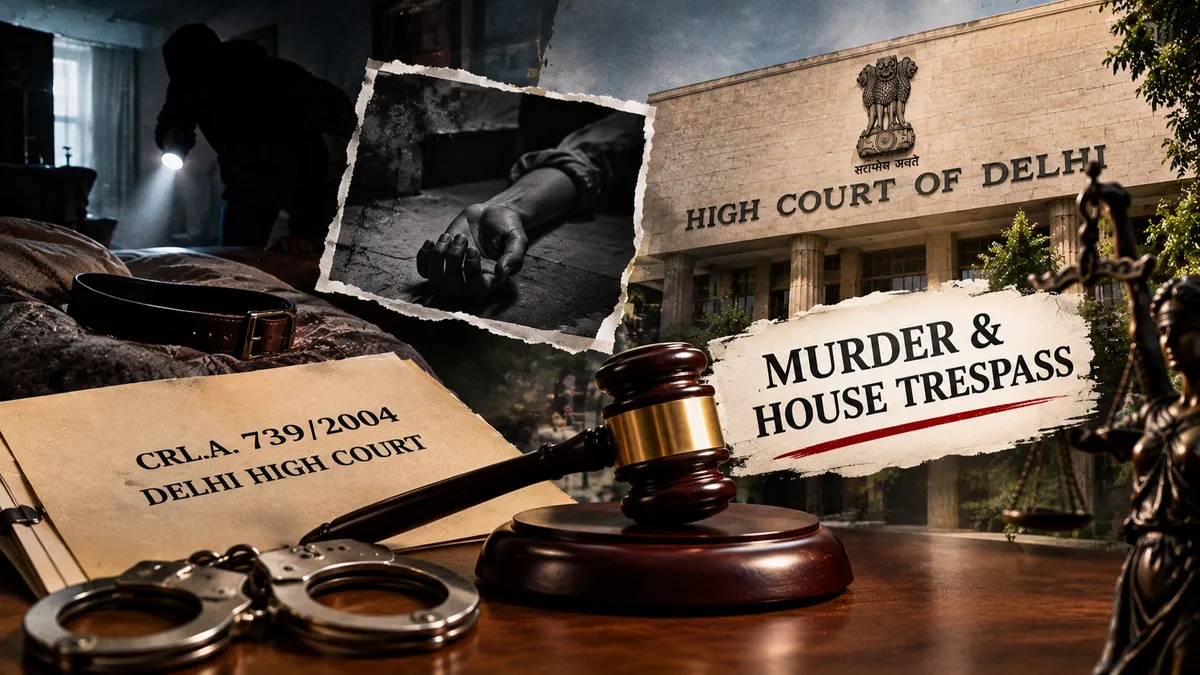
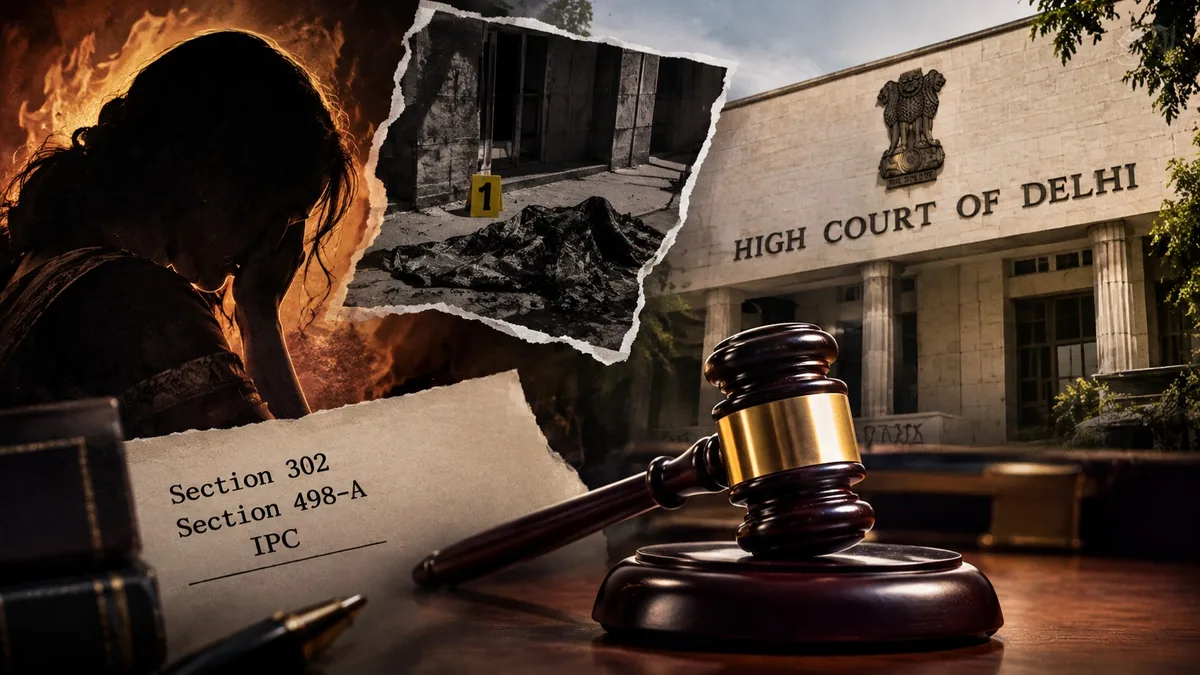
The appellant and a co-accused (since deceased) were convicted in 2004 under Sections 452 and 302 read with Section 34 of the Indian Penal Code, 1860 for the night-time trespass and murder of a man in July 2002, on circumstantial evidence resting chiefly on PW-4’s testimony that two boys struck against him near the house and his identification in a test identification parade. The issue was whether the chain of circumstances was complete. Applying Sharad Birdhichand Sarda and Laxman Prasad, the Division Bench held that the robbery motive and the alleged instruments of death were unproved (Paras 24–26), and that PW-4, who did not unequivocally say he saw them leave the house, could not alone sustain conviction (Paras 30–32). The Trial Court proceeded on assumptions and the appellant was acquitted (Paras 33–35).
Key Proposition: Where a conviction rests solely on circumstantial evidence, the fact that the accused were seen near the scene at about the time of death, with no proof of motive, no recovery, no link between the alleged instruments and the accused, and no other evidence, does not complete the chain of circumstances and a conviction based on such assumptions cannot stand.
- Indian Penal Code, 1860 – Sections 302/34, 452 – Circumstantial evidence – Five golden principles (Sharad Birdhichand Sarda; Laxman Prasad) – Whether the chain of circumstances was complete – Held, no; the only link was PW-4’s testimony that the accused struck against him near the house. (Paras 20–22, 30–33)
- Identification – Chance witness – Test Identification Parade held three days after formal arrest, more than five months after the incident – Witness not unequivocally saying he saw the accused coming out of the house – Held, unsafe to convict on that testimony alone. (Paras 28–32)
- Motive and recovery – Alleged robbery – No item stolen or recovered, ring and watch left on the body, no forced entry – Held, motive and the weapons of offence not proved; no evidence linking recovered items to the accused. (Paras 24–26)
- Appeal against conviction – Trial Court proceeded on assumptions – Held, conviction and sentence set aside; acquittal. (Paras 27, 33–35)
Background / Synopsis :
- The deceased, Bhim Prasad Shap Kota, was found dead at House No. K-207, Vijay Vihar, Phase-II, Delhi, on the night of 8–9 July 2002 after allegedly being strangulated with a leather belt and smothered with a pillow; FIR No. 424/2002, P.S. Rohini, was registered under Sections 452/302/34 IPC. (Paras 1, 4)
- The prosecution case was that thieves entered to search for valuables, strangled the deceased when he resisted and, while leaving, struck against Raj Kumar (PW-4), who later told police. (Para 4)
- The accused were arrested on 14.12.2002 in another case (FIR No. 1397/2002, P.S. Sultan Puri, Arms Act) and formally arrested in this case on 18.12.2002; a TIP on 21.12.2002 saw PW-4 identify both. (Para 28)
- Charges were framed on 02.05.2003 under Section 452 IPC and Section 302 read with Section 34 IPC; 26 prosecution witnesses were examined; the appellant’s statement under Section 313 of the Code of Criminal Procedure, 1973 (CrPC) was recorded on 15.05.2004, he denied the allegations and led no defence evidence. (Paras 5–8)
- 19.07.2004: conviction in Sessions Case No. 39/03 on a chain of fifteen circumstances. 24.07.2004: life imprisonment with fine of Rs.500 (default three months’ rigorous imprisonment) under Section 302 and three years’ rigorous imprisonment with fine of Rs.500 (default three months) under Section 452, to run concurrently. (Paras 1–2, 9–10)
- During the appeal the co-accused, Late Shri Joshim, died and the appeal against him abated by order dated 21.05.2026. (Para 3)
Issues For Consideration :
- Whether the circumstances proved by the prosecution formed a complete chain excluding every hypothesis except the guilt of the appellant, so as to sustain conviction under Sections 452 and 302 read with Section 34 IPC. (Paras 20–23)
Submissions Of Parties :
Appellant:
- There is no eye-witness; the conviction rests solely on PW-4, a chance witness who said the accused collided with him near the house, and that circumstance alone cannot sustain conviction. (Para 12)
- The Trial Court presumed facts: the pillow, quilt cover and belt were recovered but no medical opinion was taken that they caused death, and nothing connected them to the accused; there was no evidence of any theft or recovery from the accused despite the robbery motive alleged. (Paras 13–14)
Respondent (State):
- PW-4’s testimony and identification in the TIP suffice; PW-1 (Dr. Komal Singh) placed death at about 11 PM on 08.07.2002, the same time PW-4 saw the accused looking “distressed and disturbed”; PW-4 had given a complete description in his Section 161 CrPC statement and identified them in the TIP held in presence of PW-20 on 21.12.2002. (Paras 15–16)
- Recovery from the spot of a blood-stained towel, quilt, pillow and leather belt supports the prosecution, with the post-mortem showing asphyxia from ligature strangulation and smothering together; the conviction rests on cogent and complete circumstantial evidence. (Paras 17–18)
Court's Observations & Analysis :
Re: Issue (i): Whether the chain of circumstances was complete
- The case being wholly circumstantial, the prosecution must establish an unbroken chain leading only to guilt and ruling out other probabilities, per Sharad Birdhichand Sarda v. State of Maharashtra, (1984) 4 SCC 116 (five golden principles, or panchsheel) and Laxman Prasad v. State of Madhya Pradesh, (2023) 6 SCC 399. (Paras 20–22)
- Alleged robbery motive: no item was stolen or recovered from the accused, a ring was on the deceased’s body and a wrist watch lay near it (PW-15), and PW-3 saw no sign of forcible entry. (Paras 24–25)
- Cause of death and instruments: the doctor was never asked whether the pillow, quilt cover or leather belt caused death; PW-1 said only that death was by asphyxia from ligature strangulation and smothering together, homicidal; the items remained assertion and presumption, and nothing linked them to the accused. The Trial Court’s finding of trespass “after having made preparation to cause hurt” was “totally unsustainable” on this evidence. (Paras 26–27)
- Identification: the accused were arrested more than five months after the incident in another case, and PW-4’s identification at the TIP on 21.12.2002 is the entire foundation of the case. His testimony, at best, is that they struck against him outside the house around the time of death and looked distressed; it is a very important circumstance but cannot alone show they caused the death, and he does not unequivocally say he saw them coming out of the house, which the Trial Court read into his evidence. (Paras 28–30)
- Mere collision outside the house is not conclusive proof that the appellant and co-accused and no one else committed the murder; except PW-4’s testimony there was no other evidence linking them to the crime, making conviction on it alone very unsafe. (Paras 31–32)
- Held: The prosecution failed to prove its case beyond reasonable doubt and the Trial Court proceeded on assumptions. (Para 33)
Notable Observations:
- “In the present case, it would be very unsafe to convict the appellant only on the basis of the testimony of PW-4/Shri Raj Kumar.” (Para 32)
- “The learned Trial Court has proceeded on assumptions in convicting the appellant and the co-accused in the present case.” (Para 33)
Decision & Directions :
- Appeal allowed; the order of conviction dated 19.07.2004 and the order of sentence dated 24.07.2004 are set aside and the appellant is acquitted of all charges framed against him. (Paras 34–35)
- The bail bonds of the appellant shall remain valid for six weeks in terms of Section 481 of the Bharatiya Nagarik Suraksha Sanhita, 2023 (BNSS). (Para 36)
- A copy of the judgment is to be sent to the Trial Court and the concerned Jail Superintendent for information. (Para 37)
- Appeal against the co-accused stands abated (order of 21.05.2026). Costs: Not stated in judgment. Separate Opinions: None.
Legal Provisions Discussed & Precedents Cited :
- Indian Penal Code, 1860 – Section 302 read with Section 34 (murder in furtherance of common intention) ↔ Bharatiya Nyaya Sanhita, 2023 (BNS) – Sections 103(1) and 3(5); Section 452 (house trespass after preparation for hurt) ↔ BNS Section 333.
- Code of Criminal Procedure, 1973 – Section 313 (examination of accused) ↔ BNSS Section 351; Section 161 (police statement) ↔ BNSS Section 180.
- Bharatiya Nagarik Suraksha Sanhita, 2023 – Section 481 – Bail bonds of an acquitted accused to remain valid for six weeks.
- Arms Act, 1959 – Sections 25, 54, 59 – Other case (FIR No. 1397/2002) in which the accused were first arrested.
- Doctrines: Panchsheel of circumstantial evidence; proof beyond reasonable doubt; “may be” versus “must be” guilty (as quoted in Sarda from Shivaji Sahabrao Bobade).
- Sharad Birdhichand Sarda v. State of Maharashtra, (1984) 4 SCC 116 – Followed.
- Laxman Prasad v. State of Madhya Pradesh, (2023) 6 SCC 399 – Relied on (chain must be complete and exclude every hypothesis of innocence).
- Shivaji Sahabrao Bobade v. State of Maharashtra – Referred to (as quoted in Sarda; citation not given in the judgment).
Full Judgement / Attachment
Full Judgement
Frequently asked questions about Delhi High Court
- Where does the Delhi High Court sit and which areas does it cover?
- The Delhi High Court sits in New Delhi. It has jurisdiction over the National Capital Territory of Delhi. It was established on 31 October 1966 and is a leading forum for commercial, intellectual property, tax and arbitration matters.
- How do I check Delhi High Court case status and judgements?
- The official website, delhihighcourt.nic.in, provides case status, cause lists, e-filing and judgements searchable by party, judge or date. Orders are also mirrored on the eCourts Judgments portal (judgments.ecourts.gov.in).
- What are the Delhi High Court's Commercial and IP Divisions?
- Delhi High Court has original civil jurisdiction, so high-value suits in Delhi are filed directly before it. Its Commercial Division hears commercial disputes, and its Intellectual Property Division, set up in 2021 after the IPAB was abolished, hears patent, trademark and copyright cases. It is also a major forum for tax appeals from the ITAT Delhi Benches and for arbitration petitions.
- What is an LPA in the Delhi High Court?
- A Letters Patent Appeal (LPA) under Clause 10 of the Letters Patent lets a party challenge certain single-judge orders, typically in writ matters, before a Division Bench. In commercial cases, appeals lie under Section 13 of the Commercial Courts Act instead. Final judgements can be challenged by a Special Leave Petition under Article 136, ordinarily within 90 days.
- How can White Collar Professional help with a Delhi High Court matter?
- Post your requirement on White Collar Professional to receive proposals from verified Advocates, Chartered Accountants and Company Secretaries, compare them, and pay securely through the platform. This page also tracks the latest Delhi High Court judgements and legal updates as they are reported.