Delhi High Court Directs NMC to Treat Earlier MBBS Application as Subsisting for 2026-27 Where Delay Was the Regulator’s Own: “Due Process” Is Not Fresh Application
Court / Authority
Delhi High Court
Update / Judgement Date
13 Oct 2026
Date of Publication
16 Oct 2026
Case No.
W.P.(C) 14706/2026
Source
WCP News Bulletin
Author
Dipanshi Bansal — WCP Legal Desk
Reading Time
11 min read
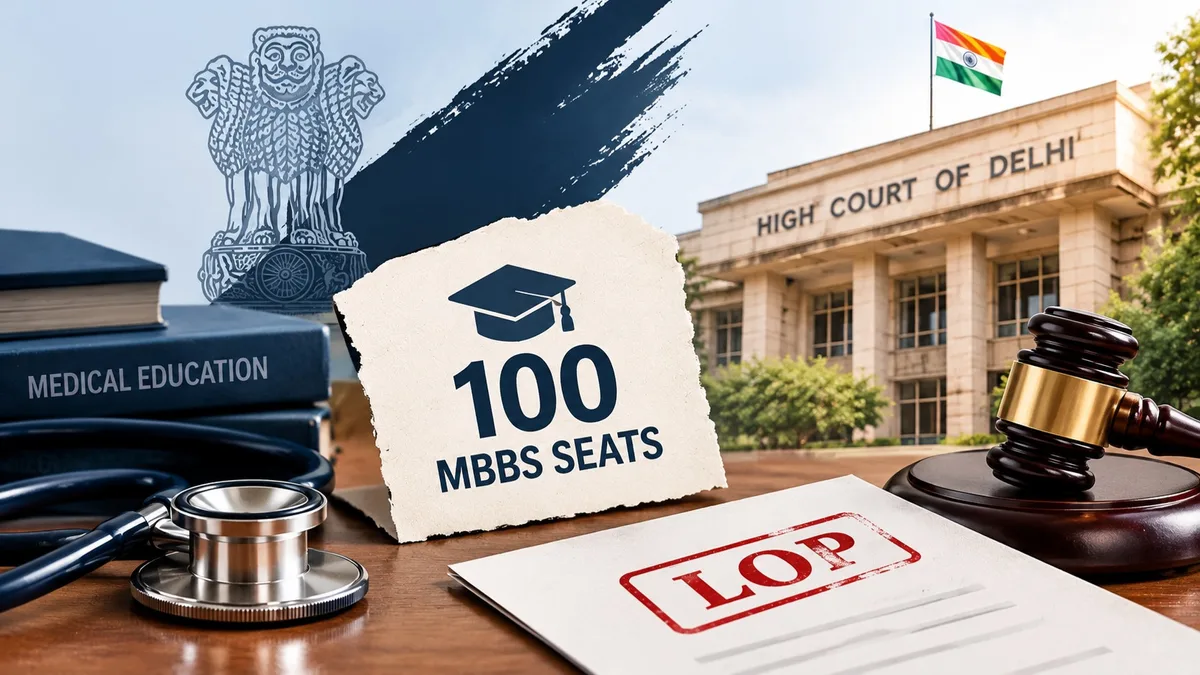
The petitioners’ January 2025 application for a 100-seat MBBS college was disapproved by the Medical Assessment and Rating Board about three months beyond the six-month limit in Section 28(3) of the National Medical Commission Act, 2019 (NMC Act); their second appeal was closed on 19.12.2025 as infructuous for 2025-26 with NMC to follow “due process” for 2026-27, although a court-directed inspection had found zero deficiencies. The issue was whether that direction preserved the earlier application or required a fresh one. The Court held that the second appeal was never decided on merits, so the application subsisted for 2026-27 (Paras 46–60), that the delay was not the petitioners’ (Paras 56–59), and that the order of 14.09.2026, which exceeded the Court’s remit and was arbitrary under Article 14, must be set aside (Paras 66–78); NMC may re-inspect (Paras 81–82).
Key Proposition: Where a statutory regulator’s own delay and a non-merits closure of an appeal denied a medical college consideration for one academic year, a direction to follow “due process” for the next year preserves the earlier application for decision on merits, and the applicant cannot be compelled to file afresh or wait another session.
- National Medical Commission Act, 2019 – Section 28(3), (5), (6) – Establishment of new medical college – Second appeal closed as infructuous for 2025-26 with direction to follow “due process” for 2026-27 – Whether earlier application must be treated as subsisting for 2026-27 – Held, yes, where delay is not attributable to the applicant and no merits adjudication occurred. (Paras 46–60)
- Establishment of New Medical Institutions … Assessment and Rating Regulations, 2023 – Regulation 9 (Explanation 2 and provisos) – Loss of chance to reapply after rejection – Held, the final proviso is tied to rejection of incomplete applications and does not apply where a revised Consent of Affiliation was already furnished. (Paras 72–73)
- Constitution of India – Article 14 – Compliance order under writ directions – Order adopting a position that leaves nothing to be considered and exceeds the remit of the Court’s order – Exclusion of institute despite “zero deficiency” inspection report – Held, arbitrary and disproportionate. (Paras 66–78)
Background / Synopsis :
- Petitioner No. 1, a society registered under the West Bengal Societies Registration Act, 1961, set up Mandakini Institute of Medical Sciences and Hospital at Aishtala, Ranaghat, District Nadia, West Bengal. (Para 2)
- 17.01.2025: Application No. NMC/UG/2025-26/000035 filed under Section 28 of the NMC Act for 100 MBBS seats, with an Essentiality Certificate dated 16.01.2025 and a Consent of Affiliation (CoA) dated 17.01.2025. (Para 4)
- 26.05.2025: Show Cause Notice; reply on 30.05.2025; West Bengal University of Health Sciences issued a revised CoA dated 11.09.2025, forwarded to NMC and MARB by email dated 21.09.2025. (Paras 5–6)
- 13.10.2025: MARB issued a Letter of Disapproval under Section 28(3) on two grounds – absence of a valid CoA and absence of ownership of the teaching hospital. 13.11.2025: First Appeal under Section 28(5) rejected by NMC for want of a valid CoA, so no physical inspection could be held. (Paras 7–8)
- 13.11.2025: Second Appeal under Section 28(6) filed before the Union of India; the petitioners also filed W.P.(C) 17509/2025. On 18.11.2025 this Court directed a physical inspection, held on 28.11.2025, which recorded no deficiencies. (Paras 9–10)
- 19.12.2025: Second Appeal disposed of as infructuous for 2025-26 in view of counselling timelines, with NMC directed to follow due process for 2026-27. 27.01.2026: this Court kept open whether the earlier application could be considered for 2026-27. 03.09.2026: W.P.(C) 17509/2025 disposed of, directing NMC to consider the second-appeal order, pass a speaking order and consider the 28.11.2025 report if required. (Paras 11–13)
- Impugned Order, 14.09.2026: MARB held the earlier application could not be treated as fresh or subsisting for 2026-27 without a fresh application; the inspection report could not substitute for assessment of a fresh application; petitioners at liberty to apply afresh. (Paras 14–15)
- Relief sought: quashing of the 14.09.2026 order, a mandamus to treat the application as live for 2026-27 and grant a Letter of Permission, or in the alternative a time-bound inspection and reasoned order without insisting on a de novo application. (Para 1)
Issues For Consideration :
- Whether the Impugned Order dated 14.09.2026 deserves to be set aside. (Para 39)
- Whether the application for 2025-26 should be treated as a valid and subsisting application for 2026-27. (Para 39)
- How the expression “due process for the Academic Year 2026-27” in the letter of 19.12.2025 is to be understood. (Paras 41–42)
- Whether the “Zero Deficiency” inspection report of 28.11.2025 could be considered for 2026-27. (Paras 61–63)
Submissions Of Parties :
Petitioners:
- The Impugned Order wrongly construes “due process for the Academic Year 2026-27”; the Second Appeal was never decided on merits. Reliance on Madhuri Sewa Nyas v. Union of India (Patna High Court, CWJC 16800/2024, 20.03.2025), whose directions were said to have been upheld by the Supreme Court. (Paras 17–18)
- The Letter of Disapproval came nearly three months after the six-month period in Section 28(3); a party should not suffer for the authority’s default. (Para 19)
- The order is self-contradictory in claiming to consider the 28.11.2025 report while giving it no weight; the report was prepared by NMC’s own inspectors and recorded zero deficiencies; Dr. M.K. Shah Medical College and Research Centre v. Union of India, 2022 SCC OnLine Del 938 relied on. (Paras 20–23)
- The finding that the petitioners wilfully did not apply afresh was reached without notice, and the question was kept sub judice by this Court; the order travels beyond the grounds of the earlier disapproval, ignores the revised CoA and misreads Explanation 2 to Regulation 9. (Paras 25–28)
- The consequence is disproportionate and violates Articles 14, 19(1)(g) and 21. (Para 30)
- Respondents (NMC, MARB, UGMEB and Union of India):
- Section 28 bars establishing a medical college without prior MARB permission, and Section 28(7) permits inspection at any time without notice; under the MARB Regulations a rejected applicant may reapply only when the next window opens. (Paras 31–32)
- No application was filed for 2026-27; the third counselling round was ongoing; no seats can be added in the stray round; no interim relief was sought while the window was open; and the earlier writ concerned 2025-26 only. (Paras 33–35)
- Madhuri Sewa Nyas is distinguishable since the petitioner there had filed a fresh application; the petition is hit by delay and laches; and the inspection of 28.11.2025 related to 2025-26. (Paras 35–37)
Court's Observations & Analysis :
Re: Issue (i) & (iii): Meaning of “due process for the Academic Year 2026-27” and whether the earlier application subsisted
- The letter of 19.12.2025 neither adjudicated the Second Appeal on merits nor required a fresh application; it “forwarded” the appeal to NMC for action, a word that would be meaningless if it only allowed applying afresh. (Paras 46–47)
- The paragraph shutting out further 2025-26 appeals applied to appeals not yet filed, while pending appeals were forwarded for action in the next session. (Para 48)
- With no merits finding, the only coherent reading was that the application would receive the examination on merits in the next session that the timelines had prevented; the order of 27.01.2026 kept this question open and the petitioners were litigating from that date. (Paras 49–53)
- The order of 03.09.2026 directed consideration of the 28.11.2025 report, which would serve no purpose if the application were deemed closed; the Impugned Order merely repeated the earlier position and defeated that direction. (Paras 54–55)
- The delay was not attributable to the petitioners: the Letter of Disapproval came about three months late, the Second Appeal was undecided when 2025-26 counselling closed, and NMC took no decision until this Court intervened. Madhuri Sewa Nyas applied for the principle that no party should suffer for procedural delay. (Paras 56–59)
- Held: The expression preserves the earlier application for consideration on merits by NMC for 2026-27 and does not merely record liberty to apply afresh. (Para 60)
Re: Issue (iv): The Zero Deficiency inspection report
- The report was prepared by the respondents’ own inspectors, pursuant to this Court’s direction, on faculty, infrastructure and other parameters. (Para 62)
- Substantial time has elapsed since 28.11.2025, so the respondents may, if they so desire, carry out a fresh inspection under extant rules, keeping the 2026-27 counselling timelines in view. (Para 63)
- Held: The report cannot be disregarded, but a fresh inspection is permissible. (Paras 62–63)
Re: Issue (i): Validity of the Impugned Order
- The order exceeded the remit of 03.09.2026: it reproduced the entire list of discrepancies from the 2025-26 scrutiny although the Letter of Disapproval rested on two grounds only and the first appeal on the CoA and inspection point. (Paras 69–70)
- It did not deal with the revised CoA of 11.09.2025, which, as per the proviso to Explanation 3 as stated in the judgment, has a life of three years from issuance. (Paras 71–72)
- The final proviso to Regulation 9 (loss of chance to reapply till the next window) is read in the context of the preceding proviso on incomplete applications and does not apply here. (Para 73)
- The finding of “wilful” failure to apply afresh is unsustainable because the very question was pending before this Court. (Paras 74–75)
- Excluding the Institute from 2026-27 flows not from an adverse merits finding but from the absence of a further application, and is disproportionate; in the face of NMC’s own zero-deficiency report, exclusion without reasoned examination is arbitrary and violates Article 14. (Paras 76–77)
- Held: The Impugned Order of 14.09.2026 cannot be sustained and is set aside. (Para 78)
Notable Observations:
- “In the face of a report of the respondents’ own inspectors recording no deficiency, the exclusion of the Institute without a reasoned examination on merits is arbitrary and violative of Article 14 of the Constitution.” (Para 77)
- “An order which, in the guise of compliance, adopts a position that already existed before the court’s express direction for consideration and passing of a speaking order, and thereby leaves nothing to be considered” (Para 66)
Decision & Directions :
- Writ petition allowed; Impugned Order dated 14.09.2026 set aside; petition and pending applications disposed of. (Paras 78, 81–82)
- The respondents shall treat the earlier application No. NMC/UG/2025-26/000035 as a valid and subsisting application for the academic year 2026-27.
- The respondents are at liberty to carry out a fresh inspection of the Institute in accordance with the NMC Act and the MARB Regulations, keeping in view the counselling timelines for 2026-27.
- If the Institute is found in order after the fresh inspection, the petitioners shall be entitled to participate in counselling for 2026-27 in the third (stray/spot) round or, if that has concluded, in the next available round, and the respondents shall take all consequential steps.
- The Court noted that the petitioners had already been denied consideration for the last session through timelines lost with the respondents and had incurred huge expenditure on infrastructure and salaries. (Paras 79–80)
- Costs: Not stated in judgment. Separate Opinions: None.
Legal Provisions Discussed & Precedents Cited :
- National Medical Commission Act, 2019 (NMC Act) – Section 28(1)–(7) – Prior permission, six-month decision period, proviso on opportunity to rectify, first and second appeals, and inspection without notice.
- NMC Act, 2019 – Sections 16(1)(a), 16(1)(c), 24 and 26 – Constitution of the respondent Boards (noted in Para 3).
- Establishment of New Medical Institutions, Starting of New Medical Colleges, Increase of Seats for Existing Courses & Assessment and Rating Regulations, 2023 (MARB Regulations) – Regulation 9, Explanations 1–3 and provisos – Documents required, validity of CoA, and loss of chance to reapply.
- Constitution of India – Article 226 (writ jurisdiction); Article 14 (arbitrariness, relied on for the holding); Articles 19(1)(g) and 21 (argued by petitioners, Para 30).
- Doctrines: actus curiae neminem gravabit (an act of the court – or authority – shall prejudice no one) and ex debito justitiae (as of right) as applied in Madhuri Sewa Nyas; Proportionality; Reasoned decision-making.
- Madhuri Sewa Nyas v. Union of India, CWJC 16800/2024 (Patna High Court, 20.03.2025) – Relied on.
- State of Uttaranchal v. Sunil Kumar Vaish, (2011) 8 SCC 670 – Relied on (need for reasoned determination on a proper material foundation).
Full Judgement / Attachment
Full Judgement
Frequently asked questions about Delhi High Court
- Where does the Delhi High Court sit and which areas does it cover?
- The Delhi High Court sits in New Delhi. It has jurisdiction over the National Capital Territory of Delhi. It was established on 31 October 1966 and is a leading forum for commercial, intellectual property, tax and arbitration matters.
- How do I check Delhi High Court case status and judgements?
- The official website, delhihighcourt.nic.in, provides case status, cause lists, e-filing and judgements searchable by party, judge or date. Orders are also mirrored on the eCourts Judgments portal (judgments.ecourts.gov.in).
- What are the Delhi High Court's Commercial and IP Divisions?
- Delhi High Court has original civil jurisdiction, so high-value suits in Delhi are filed directly before it. Its Commercial Division hears commercial disputes, and its Intellectual Property Division, set up in 2021 after the IPAB was abolished, hears patent, trademark and copyright cases. It is also a major forum for tax appeals from the ITAT Delhi Benches and for arbitration petitions.
- What is an LPA in the Delhi High Court?
- A Letters Patent Appeal (LPA) under Clause 10 of the Letters Patent lets a party challenge certain single-judge orders, typically in writ matters, before a Division Bench. In commercial cases, appeals lie under Section 13 of the Commercial Courts Act instead. Final judgements can be challenged by a Special Leave Petition under Article 136, ordinarily within 90 days.
- How can White Collar Professional help with a Delhi High Court matter?
- Post your requirement on White Collar Professional to receive proposals from verified Advocates, Chartered Accountants and Company Secretaries, compare them, and pay securely through the platform. This page also tracks the latest Delhi High Court judgements and legal updates as they are reported.