Delhi High Court: Missing Minority Status Certificate Is Not Conclusive Against a Linguistic Minority School, but Unapproved Suspension Under Section 8(4) DSE Act Still Lapses
Court / Authority
Delhi High Court
Update / Judgement Date
12 Oct 2026
Date of Publication
16 Oct 2026
Case No.
W.P.(C) 1101/2018
Source
WCP News Bulletin
Author
Dipanshi Bansal — WCP Legal Desk
Reading Time
13 min read
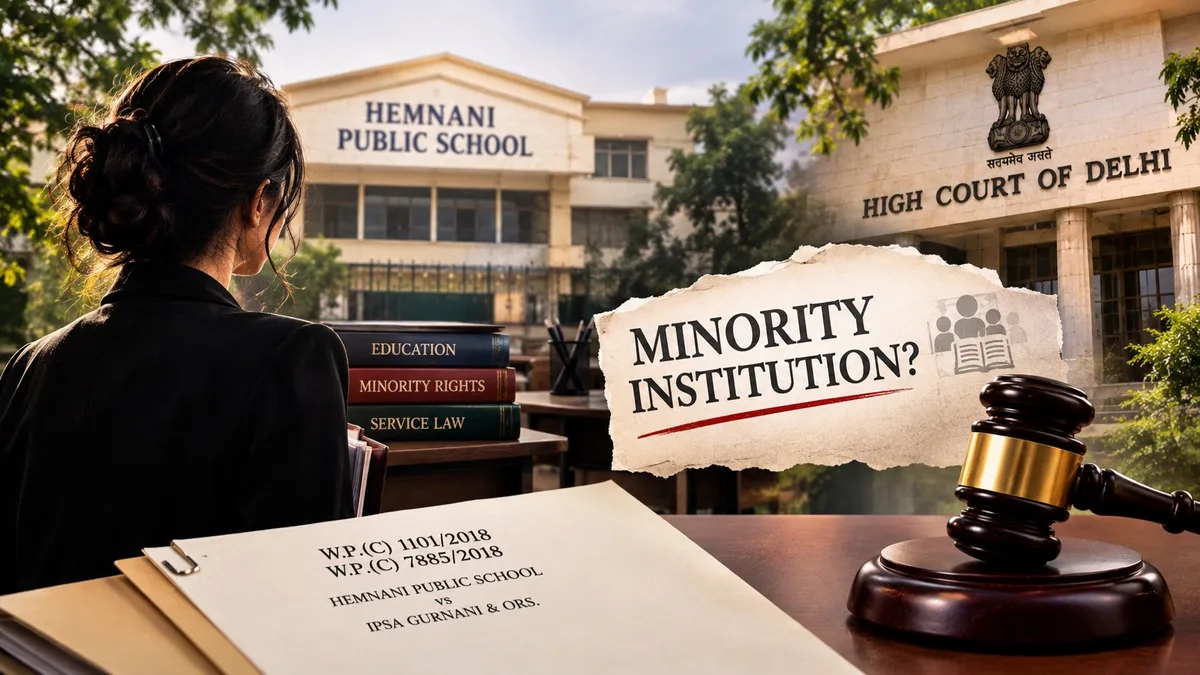
Directorate of Education (DoE) had separately held her suspension void under Section 8(4). The Court held that the School is an unaided linguistic minority institution, a certificate being only declaratory (Paras 28–35); following Frank Anthony, G. Vallikumari and C.S. Clarke, Section 8(2) and Rules 118 and 120 do not apply (Paras 36–42); fairness questions were left to the Tribunal on limited remand (Paras 43–48); and the unapproved suspension lapsed, so the DoE’s financial directions must be implemented (Paras 49–54). W.P.(C) 1101/2018 was allowed in part and W.P.(C) 7885/2018 allowed (Paras 55–61).
Key Proposition: A Minority Status Certificate only declares an existing status and its absence is not conclusive against an institution’s linguistic minority character, which is tested under Section 2(o) of the DSE Act and Article 30(1); such an unaided school is outside Section 8(2) approval and Rules 118 and 120, but remains bound by Sections 8(4) and 8(5), under which a suspension not approved within fifteen days lapses.
- Delhi School Education Act, 1973 – Section 2(o) – Constitution of India – Article 30(1) – Whether a school without a Minority Status Certificate can be a linguistic minority institution – Held, yes; the test is establishment and administration by a minority, and a certificate is declaratory only. (Paras 28–35)
- DSE Act – Section 8(2); DSE Rules – Rules 118, 120 – Termination of employee of unaided minority school – Prior DoE approval, government nominee in the Disciplinary Committee – Held, not required (Frank Anthony, G. Vallikumari, C.S. Clarke followed; plea that C.S. Clarke is per incuriam rejected). (Paras 36–42)
- Disciplinary enquiry – Natural justice – Witnesses participating in disciplinary decision; furnishing of enquiry report – Held, matters left open and remanded to the DST under Section 8(3), to be decided within four months. (Paras 43–48, 57–58)
- DSE Act – Sections 8(4), 8(5) – Suspension of employee of minority school – Approval within fifteen days – Held, suspension lapsed for want of approval; DoE order of 28.03.2017 (unchallenged) to be implemented. (Paras 49–54, 59)
Background / Synopsis :
- Ms. Gurnani joined the School in 1996 as Assistant Trained Teacher, resigned on 31.08.2004, was later recruited as PGT (History), confirmed from 01.04.2010, promoted Vice-Principal on 21.06.2013 and confirmed on 15.07.2014. (Para 5)
- Disputes began in 2015 with show-cause notices (06.11.2015 and 18.11.2015) and her complaints against the Principal and Managing Committee members; FIR No. 968/2015 was registered at P.S. Lajpat Nagar under Section 509 IPC on her complaint. (Para 6)
- 23.07.2016: suspension, first challenged in W.P.(C) 7573/2016, treated as a representation before the DoE on 29.08.2016. Memorandum of charges 22.08.2016; Inquiry Officer and Presenting Officer appointed 16.09.2016; the School says the enquiry proceeded ex parte when she did not participate, which she disputes. (Paras 7–8)
- 10.02.2017: services terminated; her appeal under Section 8(3) of the DSE Act went to the DST. 28.03.2017: DoE held the suspension void for want of approval under Sections 8(4) and 8(5), directed her to be allowed to join duty and paid full salary and benefits, and treated the suspension period as “Spent on Duty”; the School did not challenge this, calling it infructuous after termination. (Paras 9–11)
- 22.12.2017: DST (Appeal No. 42/2017) set aside the termination, holding the School was not a minority institution because no Minority Status Certificate existed; Section 8(2), Rule 118 (constitution of Disciplinary Authority) and Rule 120 were not complied with. This Court stayed that order on 06.02.2018 in W.P.(C) 1101/2018; she filed W.P.(C) 7885/2018 to enforce the DoE order. (Paras 12–13)
- The DoE, which had taken a non-minority stand before the DST, later said the School was a minority school, relying on the Scheme of Management approved in 1991 and the judgment of 14.07.1982 in Civil Writ No. 940/1975 (Sindhi Education Society v. Director of Education), and clarified that no statutory authority in Delhi issues Minority Status Certificates to linguistic minority institutions. (Paras 14–20)
Issues For Consideration :
- Whether Hemnani Public School is an unaided linguistic minority institution, and whether the absence of a Minority Status Certificate defeats that claim.
- Whether the termination could be set aside for want of Section 8(2) approval and non-compliance with Rules 118 and 120 of the DSE Rules, and whether C.S. Clarke is per incuriam.
- Whether the disciplinary proceedings were fair, so as to call for remand to the DST.
- Whether the suspension was valid and the DoE’s order of 28.03.2017 enforceable (W.P.(C) 7885/2018).
Submissions Of Parties :
Petitioner School (Mr. Dinesh Agnani, Senior Advocate):
- The DST’s premise fails on the material now on record: the 1982 Sindhi Education Society judgment, Sindhi Education Society v. Chief Secretary, GNCTD, (2010) 8 SCC 49, the approved Scheme of Management and the DoE’s own affidavits. Once minority status is accepted, Section 8(2) does not apply and non-participation of the Rule 118 nominee or absence of Rule 120 approval cannot vitiate termination; reliance on Frank Anthony and C.S. Clarke v. Managing Committee of Frank Anthony Public School (LPA 177/2022, 14.09.2023). A government nominee was initially in the disciplinary body and attended the meeting of 22.04.2016. (Paras 21–22)
- The charges (misappropriation, examination irregularities, disobedience) were serious and unrebutted; she was given repeated opportunities to participate but did not, so the Inquiry Officer proceeded ex parte. (Para 23)
Respondent No. 1 / Petitioner in W.P.(C) 7885/2018 (Ms. Ipsa Gurnani):
- The 1982 judgment concerned the Society and Baba Nebhraj Senior Secondary School; the School was not a party nor in existence, and a society and a school are distinct; there is no NCMEI Minority Status Certificate and the DoE earlier treated the School as non-minority. (Para 24)
- Irrespective of minority status the proceedings violated natural justice because Ms. Prabha Aggarwal, Ms. Kavita Wadhwani and Mr. K.R. Manjani were in the disciplinary body yet also prosecution witnesses; the School gave inconsistent accounts of the body’s composition. (Para 25)
- C.S. Clarke is per incuriam, being inconsistent with G. Vallikumari v. Andhra Education Society, (2010) 2 SCC 497, Management Committee of Montfort Senior Secondary School v. Vijay Kumar, (2005) 7 SCC 472 and Guru Harkishan Public School v. Directorate of Education (Full Bench); reliance on the reference in Government of NCT of Delhi v. Raisina Bengali School (LPA 372/2025). (Para 26)
- In W.P.(C) 7885/2018, suspension remained subject to Sections 8(4) and 8(5), and the unchallenged DoE order of 28.03.2017 must be implemented. (Para 27)
Court's Observations & Analysis :
Re: Issue (i): Whether the School is an unaided linguistic minority institution
- • The respondent was right that the School was not the institution in issue in Civil Writ No. 940/1975, so the 1982 judgment is not an adjudication of its status; yet it recognised that the Sindhi community in Delhi is a linguistic minority and that a school meeting Section 2(o) is entitled to minority status, as noted in Sindhi Education Society (2010). (Paras 28–29)
- Status cannot be inferred merely from common management; it must be shown from the School’s own record: the 1991 Scheme of Management names the Society as parent body, the DoE lists the School as minority, and the DoE, on specific examination, accepted the claim. The DST lacked the later affidavits. (Paras 30–31)
- Section 2(o) turns on establishment and administration by a minority with Article 30(1) rights; a certificate may evidence the status but does not create the right. Sisters of St. Joseph of Cluny v. State of West Bengal, (2018) 6 SCC 772 (concurring with James Mathew that a certificate is “only a declaration of an existing status”) does not suggest otherwise. The Court declined to endorse the DoE’s statement on the NCMEI’s jurisdiction as exhaustive. (Paras 32–34)
- Held: The School is an unaided linguistic minority educational institution; absence of a certificate is not the end of the enquiry. (Paras 34–35)
Re: Issue (ii): Effect on the termination; C.S. Clarke
- Minority status does not place the School beyond the DSE Act; Frank Anthony held Section 8(2) inapplicable to minority institutions but upheld Sections 8(1), 8(3), 8(4) and 8(5), and G. Vallikumari held Chapter IV (except Section 8(2)) applies to minority institutions, aided or unaided. (Paras 36–37)
- C.S. Clarke held that Rule 118’s nominee and Rule 120’s DoE approval do not apply to unaided minority schools; the distinction between religious schools with certificates and linguistic schools without them does not alter this. (Paras 38–39)
- The per incuriam plea fails as C.S. Clarke considered Frank Anthony and the Full Bench in Guru Harkishan; the Raisina Bengali School reference concerns Chapter VIII, Rule 96 recruitment and aided schools, does not overrule C.S. Clarke, and no contrary larger bench ruling was shown. (Paras 41–42)
- Held: Termination cannot be set aside for want of Section 8(2) approval, the Rule 118 nominee or Rule 120 approval. (Para 40)
Re: Issue (iii): Fairness of the disciplinary proceedings
- The State may regulate procedure for disciplinary action but cannot vest core decision-making outside the management, and the management’s right does not extend to denying a fair procedure or reasonable opportunity. (Para 43)
- The record shows Ms. Wadhwani (PW-03), Mr. Manjani (PW-18) and Ms. Aggarwal (PW-13) deposed as witnesses, and the School described them before the DST as the Disciplinary Authority, though material before the Court shows a different composition; the question is whether any participated in the decision after the report, including the recommendation of 04.02.2017. (Para 44)
- Whether the enquiry report was furnished, whether she had an effective opportunity and whether she chose not to participate are open; the seriousness of charges cannot cure a defect, and she cannot rely on her own non-participation if she had a fair opportunity. The DST did not examine these issues, so a limited remand under Section 8(3) is warranted given the age of the dispute. (Paras 45–48)
- Held: DST order set aside; Appeal No. 42/2017 restored on remaining grounds. (Para 48)
Re: Issue (iv): Suspension (W.P.(C) 7885/2018)
- The DoE rightly held Sections 8(4) and 8(5) continued to apply; Frank Anthony upheld the fifteen-day approval safeguard, and Delhi Public School Dwarka v. Sarika Prasad, 2022 SCC OnLine Del 3374 and the Full Bench in Hema Bajaj v. Rao Mehar Chand Saraswati Vidya Mandir School (W.P.(C) 12327/2021, 03.07.2026) hold that an unapproved suspension lapses after fifteen days and cannot be revived by later approval. (Paras 49–50)
- Mere communication of the suspension is not approval. The School never challenged the DoE order, and its plea of infructuousness after termination cannot cure the missing approval or displace the financial directions. (Paras 51–53)
- Held: The DoE order of 28.03.2017 must be implemented for the suspension period; post-termination wages abide the restored appeal. (Para 54)
Notable Observations:
- “absence of a Minority Status Certificate is not, by itself, conclusive against minority status.” (Para 32)
- “A certificate may formally declare or evidence that status; it does not create the right under Article 30(1).” (Para 32)
Decision & Directions :
- W.P.(C) 1101/2018 is allowed in part; the DST’s order of 22.12.2017 in Appeal No. 42/2017 is set aside and the appeal restored for fresh decision. (Para 55)
- The DST shall proceed on the basis that Hemnani Public School is an unaided linguistic minority institution and shall not invalidate the termination for want of prior approval under Section 8(2) of the DSE Act, absence of the nominee under Rule 118, or want of DoE approval under Rule 120. (Para 56)
- The DST shall independently decide the remaining grounds – natural justice, alleged participation of witnesses in disciplinary decision-making, furnishing of the enquiry report and opportunity to respond, conduct of the enquiry, the Inquiry Officer’s findings and the punishment – within the scope of Section 8(3), without treating the judgment as an opinion on their merits, and may call for the original disciplinary record including the recommendation dated 04.02.2017. (Para 57)
- The restored appeal shall be taken up on priority and, as far as practicable, decided within four months from the date the DST receives the record; parties shall cooperate and not seek avoidable adjournments. (Para 58)
- W.P.(C) 7885/2018 is allowed: the School and its management shall implement the DoE order of 28.03.2017 for the suspension period, computed after giving credit for subsistence allowance and other amounts already paid, and release the balance to Ms. Gurnani within eight weeks of the judgment. (Para 59)
- No opinion is expressed on wages or benefits after 10.02.2017, which shall abide by the DST’s decision. Petitions and pending applications disposed of. (Paras 60–61)
- Costs: Not stated in judgment. Separate Opinions: None.
Legal Provisions Discussed & Precedents Cited :
- Delhi School Education Act, 1973 (DSE Act) – Section 2(o) – Definition of minority school; Section 8(2) – Prior DoE approval for dismissal (inapplicable to minority institutions); Section 8(3) – Appeal to the DST; Sections 8(4) and 8(5) – Suspension and fifteen-day approval (applicable to minority institutions); Section 12 – Exemption of minority institutions (noted in the Raisina Bengali School reference).
- Delhi School Education Rules, 1973 (DSE Rules) – Rule 118 (Disciplinary Authority and nominee), Rule 120 (approval for major penalty), Rule 96 and Chapter VIII (noted in the reference).
- Constitution of India – Article 30(1) (right of minorities to establish and administer institutions); Article 30(2) (State regulatory authority, noted in the reference).
- National Commission for Minority Educational Institutions Act, 2004 – Section 10 (Competent Authority for No Objection Certificates), Section 11(f) (jurisdiction over minority status).
- Indian Penal Code, 1860 – Section 509 (FIR No. 968/2015) ↔ Bharatiya Nyaya Sanhita, 2023 – Section 79.
- Doctrines: Minority status is determined by establishment and administration, a certificate being declaratory only; regulation of conditions of service versus interference with administration; per incuriam; fair opportunity in disciplinary proceedings.
- Frank Anthony Public School Employees’ Association v. Union of India, (1986) 4 SCC 707 – Followed.
- G. Vallikumari v. Andhra Education Society, (2010) 2 SCC 497 – Followed.
- C.S. Clarke v. Managing Committee of the Frank Anthony Public School, LPA 177/2022 (Del, 14.09.2023, Division Bench) – Followed; per incuriam plea rejected.
- Sindhi Education Society v. Chief Secretary, GNCTD, (2010) 8 SCC 49 and judgment of 14.07.1982 in Civil Writ No. 940/1975 – Relied on (Sindhi community a linguistic minority; Section 2(o) test).
- Sisters of St. Joseph of Cluny v. State of West Bengal, (2018) 6 SCC 772 (with Manager, Corporate Educational Agency v. James Mathew, (2017) 15 SCC 595) – Relied on (certificate only declaratory).
- Delhi Public School Dwarka v. Sarika Prasad, 2022 SCC OnLine Del 3374 (Division Bench) – Followed; Hema Bajaj v. Rao Mehar Chand Saraswati Vidya Mandir School, W.P.(C) 12327/2021 (Full Bench, 03.07.2026) – Followed (unapproved suspension lapses after fifteen days).
- Guru Harkishan Public School v. Directorate of Education, 2015 SCC OnLine Del 9530 (Full Bench) – Referred to; Government of NCT of Delhi v. Raisina Bengali School, LPA 372/2025 (03.02.2026) – Distinguished (reference does not overrule C.S. Clarke).
Full Judgement / Attachment
Full Judgement
Frequently asked questions about Delhi High Court
- Where does the Delhi High Court sit and which areas does it cover?
- The Delhi High Court sits in New Delhi. It has jurisdiction over the National Capital Territory of Delhi. It was established on 31 October 1966 and is a leading forum for commercial, intellectual property, tax and arbitration matters.
- How do I check Delhi High Court case status and judgements?
- The official website, delhihighcourt.nic.in, provides case status, cause lists, e-filing and judgements searchable by party, judge or date. Orders are also mirrored on the eCourts Judgments portal (judgments.ecourts.gov.in).
- What are the Delhi High Court's Commercial and IP Divisions?
- Delhi High Court has original civil jurisdiction, so high-value suits in Delhi are filed directly before it. Its Commercial Division hears commercial disputes, and its Intellectual Property Division, set up in 2021 after the IPAB was abolished, hears patent, trademark and copyright cases. It is also a major forum for tax appeals from the ITAT Delhi Benches and for arbitration petitions.
- What is an LPA in the Delhi High Court?
- A Letters Patent Appeal (LPA) under Clause 10 of the Letters Patent lets a party challenge certain single-judge orders, typically in writ matters, before a Division Bench. In commercial cases, appeals lie under Section 13 of the Commercial Courts Act instead. Final judgements can be challenged by a Special Leave Petition under Article 136, ordinarily within 90 days.
- How can White Collar Professional help with a Delhi High Court matter?
- Post your requirement on White Collar Professional to receive proposals from verified Advocates, Chartered Accountants and Company Secretaries, compare them, and pay securely through the platform. This page also tracks the latest Delhi High Court judgements and legal updates as they are reported.