← back
Must-ReadDelhi High Court
Delhi High Court Upholds Setting Aside of FERA Penalty: Section 72 Presumption Cannot Rescue Inadmissible Loose Sheets, and Section 71 Burden Arises Only After the Department Proves the Act
Court / Authority
Delhi High Court
Update / Judgement Date
13 Oct 2026
Date of Publication
16 Oct 2026
Case No.
MISC. APPEAL (FEMA) 9/2026
Source
WCP News Bulletin
Author
Dipanshi Bansal — WCP Legal Desk
Reading Time
9 min read
Appeal Against OrderFEMA & FCRA
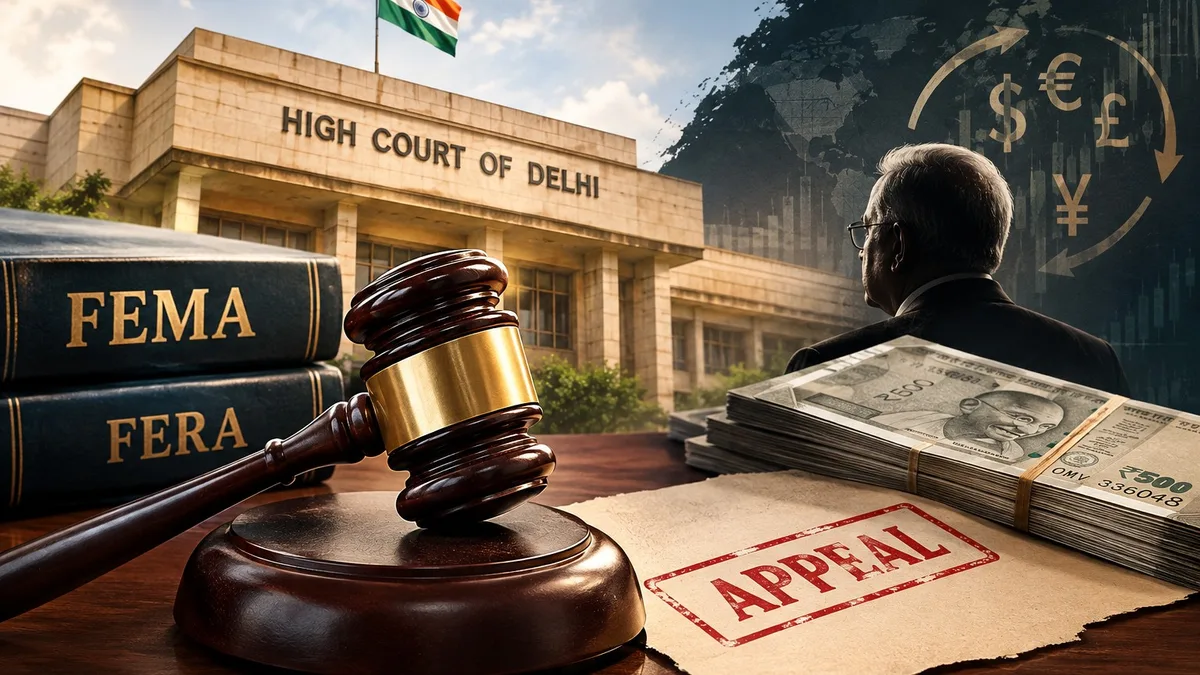
Searches in April 1985 allegedly yielded Rs.1,75,000 and loose sheets, and the respondent’s statements were retracted three days later; two penalties of Rs.10,00,000 each under Sections 8(1) and 8(2) of the Foreign Exchange Regulation Act, 1973 (FERA) were set aside by the Appellate Tribunal in 2010. The issue was whether the retracted statement, the loose sheets and Sections 71 and 72 of FERA could sustain the penalties. The Court held that the recovery was unproved as the panch witnesses were never examined (Para 18), that Section 72 cannot admit loose sheets inadmissible under Section 34 of the Evidence Act, 1872 (Para 22), that a retracted statement needs a voluntariness finding and corroboration (Paras 25–26), and that Section 71 shifts the burden only after the Department proves the act (Para 28). The appeal was dismissed (Paras 29–31).
Respondent (Shri Laxman T. Advani):
Court's Observations & Analysis :
Re: Issue (i): Recovery, possession of cash and the loose sheets
Re: Issue (ii): Burden of proof under Section 71 of FERA
Notable Observations:
Decision & Directions :
Legal Provisions Discussed & Precedents Cited :
Key Proposition: A retracted statement before FERA authorities requires the adjudicating authority to be satisfied of its voluntariness and needs corroboration, loose sheets inadmissible under Section 34 of the Evidence Act do not become admissible through the Section 72 FERA presumption, and the burden under Section 71 FERA shifts to the person proceeded against only after the Department proves that he committed an act requiring permission.
- Foreign Exchange Regulation Act, 1973 – Sections 8(1), 8(2), 71 – Burden of proof – Whether respondent had to prove no contravention – Held, no; the Department bears the initial burden of proving that the person committed an act requiring permission, after which the burden under Section 71 shifts. (Paras 27–28)
- FERA – Section 72 – Evidence Act, 1872 – Section 34 – Loose sheets seized from the custody of a person – Whether Section 72 makes them admissible – Held, no; Section 72 operates only where the document is otherwise admissible, and loose sheets are not “books” under Section 34 (V.C. Shukla followed). (Paras 20–22)
- Retracted statement recorded by Enforcement Directorate – Reliance on retracted inculpatory statement – Held, such a statement may be relied on only if the authority applies its mind to the retraction, is satisfied it was voluntary, and finds corroboration; neither was present. (Paras 23–26)
- Seizure/panchnama – Panch witnesses not examined – Recovery of currency not proved – Possession of cash explained by bank statement and cash book – Held, the foundation of the Department’s case failed. (Paras 18–19)
Background / Synopsis :
- 23.04.1985: Residential and business premises of the respondent were searched under Section 37 of FERA by Enforcement Directorate officers. Indian currency of Rs.1,75,000 and loose sheets were allegedly recovered; statements of the respondent were recorded on 23.04.1985 and 24.04.1985 in which he allegedly admitted buying and selling foreign exchange at non-RBI rates; he retracted them at the first opportunity, on 26.04.1985. (Para 2)
- 25.06.1986: Show Cause Notice alleging violation of Sections 8(1) and 8(2) of FERA; reply dated 19.07.1986 denied the charges and explained the cash as cash-in-hand, supported by books of account and bank statements. (Para 3)
- 24.09.1990: Adjudicating Authority (Special Director, Enforcement Directorate) found contravention of Sections 8(1) and 8(2), imposed Rs.10,00,000 on each count and ordered confiscation of Rs.1,75,000. (Para 4)The respondent’s Appeal No. 841/1990 before the Appellate Tribunal for Foreign Exchange was allowed on 03.12.2010 on the grounds that no evidence showed the statement was voluntary, recovery was doubtful as no attesting witness was examined, the respondent’s bank and cash-book records explained the cash, and the loose sheets were inadmissible under Section 34 of the Evidence Act per V.C. Shukla. (Paras 5–6)
- The Union of India appealed to this Court under Section 35 of the Foreign Exchange Management Act, 1999 (FEMA) read with Section 54 of FERA. (Paras 1, 7)
Issues For Consideration :
- Whether the Tribunal erred in disregarding the retracted statement of the respondent and the loose sheets recovered during the search. (Paras 8, 17–26)
- Whether, under Sections 71 and 72 of FERA, the burden lay on the respondent and the loose sheets were admissible. (Paras 9–10, 20–22, 27–28)
Submissions Of Parties :
Appellant (Union of India):
- The Tribunal wrongly disregarded the respondent’s statements explaining the loose sheets; they were corroborated by the recovery of currency and sheets. Reliance on Surjeet Singh Chhabra v. Union of India, (1997) 1 SCC 508; Telstar Travels Private Limited v. Enforcement Directorate, (2013) 9 SCC 549; K.I. Pavunny v. Assistant Collector, (1997) 3 SCC 721; and Naresh J. Sukhawani v. Union of India, 1995 Supp (4) SCC 663 for the proposition that a retracted statement is admissible and substantive evidence when corroborated. (Para 8)
- Under Section 71 of FERA the onus of proving that there was no violation and that dealings were with RBI permission lay on the respondent, who failed to discharge it; reliance on Collector of Customs, Madras v. D. Bhoormall, (1974) 2 SCC 544 and Assistant Director, Enforcement Directorate v. N.P.V. Ramasamy Udayar, 1996 SCC OnLine Mad 310. (Para 9)
- Under Section 72 of FERA the loose sheets seized from the respondent’s residence and office were admissible and rightly relied on by the Adjudicating Authority. (Para 10)
Respondent (Shri Laxman T. Advani):
- Recovery of the loose sheets and currency was never proved; per the appellant’s own panchnama one panch witness threw the briefcase from the second floor and tried to run away with the money, another also ran away, and neither was examined or offered for cross-examination. (Para 11)
- The statement, recorded in custody, was retracted and uncorroborated; reliance on Noor Aga v. State of Punjab, (2008) 16 SCC 417; Union of India v. Bal Mukund, (2009) 12 SCC 161; and Vinod Solanki v. Union of India, (2008) 16 SCC 537. (Para 12)
- Loose sheets are inadmissible per CBI v. V.C. Shukla, (1998) 3 SCC 410; and bank withdrawals of Rs.2,00,000 and a cash book showing Rs.1,99,000 explained the currency, making this a case of no evidence. (Paras 13–15)
Court's Observations & Analysis :
Re: Issue (i): Recovery, possession of cash and the loose sheets
- The Department failed to produce the panch witnesses despite summons, and the panchnama itself, recording the conduct of the panch witnesses, raised serious doubts about how the recovery was effected; the very inception of the Department’s case was not proved. (Para 18)
- Even assuming recovery, possession of Rs.1,75,000 did not establish that it was proceeds of foreign exchange sales, especially as the respondent produced a Rs.2,00,000 bank withdrawal in the preceding six months and a cash book showing Rs.1,99,000; he furnished a reasonable explanation. (Para 19)
- Section 72 of FERA presumes handwriting and truth of contents of seized documents and admits them “if such document is otherwise admissible in evidence”; as V.C. Shukla holds that loose sheets are not books and entries on them are inadmissible under Section 34 of the Evidence Act, no reliance can be placed on them even if presumed to be in the respondent’s handwriting, and Section 72 has no application. (Paras 20–22)
- Held: The loose sheets and recovery could not sustain the penalty. (Paras 18–22)
- The submission that the retracted statement explaining the loose-sheet entries could be relied on was not accepted. (Para 23)
- The Tribunal had opined that the burden of showing voluntariness lay on the prosecution; the Court, citing Telstar Travels, stated that although the burden of showing inducement, threat or promise is on the maker, the authority must apply its mind to the retraction, satisfy itself that the statement was voluntary, and find corroboration. The appellant failed on both counts. (Paras 24–25)
- No material contradicted the Tribunal’s view that the statement was not voluntary, and apart from the statement there was no corroborating evidence. (Para 26)
- Held: The retracted statement could not be relied upon. (Paras 25–26)
Re: Issue (ii): Burden of proof under Section 71 of FERA
- The submission that the burden of proving no contravention lay on the respondent was “too broadly stated”. (Para 27)
- Section 71 applies where the Department alleges breach of a provision prohibiting an act without permission; the person must then prove permission, but the initial burden of proving that the person committed an act requiring permission lies on the Department. Here the Department failed to prove that the respondent dealt in foreign currency, so Section 71 did not help it. (Para 28)
- Held: Section 71 was not attracted; no infirmity in the Tribunal’s order. (Paras 28–29)
Notable Observations:
- “to attract the said provision, the initial burden of proving that such person has committed an act which requires the permission of the Department lies on the Department itself.” (Para 28)
- “the mere possession of the said money would not, by itself, establish that it represented proceeds of sale of foreign exchange.” (Para 19)
Decision & Directions :
- No infirmity found in the Tribunal’s order dated 03.12.2010; the appeal is dismissed. (Paras 29–30)
- No order as to costs. (Para 31)
- Separate Opinions: None (judgment authored by Navin Chawla, J., with Ravinder Dudeja, J. signing).
Legal Provisions Discussed & Precedents Cited :
- Foreign Exchange Regulation Act, 1973 (FERA) – Sections 8(1), 8(2) – Alleged dealing in foreign exchange without RBI permission; basis of the penalties.
- FERA – Section 37 – Power of search (the search of 23.04.1985).
- FERA – Section 54 read with Foreign Exchange Management Act, 1999 (FEMA) – Section 35 – Appeal to the High Court from the Appellate Tribunal.
- FERA – Section 71 – Burden of proof; shifts to the person only after the Department proves an act requiring permission.
- FERA – Section 72 – Presumption as to documents; does not displace the requirement that the document be otherwise admissible.
- Indian Evidence Act, 1872 – Section 34 – Entries in books of account; loose sheets not covered (corresponding provision in the Bharatiya Sakshya Adhiniyam, 2023: Section 28).
- Doctrines: Retracted confession/statement requires voluntariness finding and corroboration; burden of proof and its shifting.
- CBI v. V.C. Shukla, (1998) 3 SCC 410 – Followed (loose sheets are not books under Section 34).
- Telstar Travels Private Limited v. Enforcement Directorate, (2013) 9 SCC 549 – Relied on (retracted statement; voluntariness and corroboration).
- Surjeet Singh Chhabra, K.I. Pavunny, Naresh J. Sukhawani, Collector of Customs v. D. Bhoormall, N.P.V. Ramasamy Udayar (cited by appellant); Noor Aga, Bal Mukund, Vinod Solanki (cited by respondent) – Referred to (cited by the parties; not separately discussed).
Full Judgement / Attachment
Full Judgement
Frequently asked questions about Delhi High Court
- Where does the Delhi High Court sit and which areas does it cover?
- The Delhi High Court sits in New Delhi. It has jurisdiction over the National Capital Territory of Delhi. It was established on 31 October 1966 and is a leading forum for commercial, intellectual property, tax and arbitration matters.
- How do I check Delhi High Court case status and judgements?
- The official website, delhihighcourt.nic.in, provides case status, cause lists, e-filing and judgements searchable by party, judge or date. Orders are also mirrored on the eCourts Judgments portal (judgments.ecourts.gov.in).
- What are the Delhi High Court's Commercial and IP Divisions?
- Delhi High Court has original civil jurisdiction, so high-value suits in Delhi are filed directly before it. Its Commercial Division hears commercial disputes, and its Intellectual Property Division, set up in 2021 after the IPAB was abolished, hears patent, trademark and copyright cases. It is also a major forum for tax appeals from the ITAT Delhi Benches and for arbitration petitions.
- What is an LPA in the Delhi High Court?
- A Letters Patent Appeal (LPA) under Clause 10 of the Letters Patent lets a party challenge certain single-judge orders, typically in writ matters, before a Division Bench. In commercial cases, appeals lie under Section 13 of the Commercial Courts Act instead. Final judgements can be challenged by a Special Leave Petition under Article 136, ordinarily within 90 days.
- How can White Collar Professional help with a Delhi High Court matter?
- Post your requirement on White Collar Professional to receive proposals from verified Advocates, Chartered Accountants and Company Secretaries, compare them, and pay securely through the platform. This page also tracks the latest Delhi High Court judgements and legal updates as they are reported.