← back
InformativeDelhi High Court
Pre-2015 Arbitrator Appointment Tested Under the Law Then in Force; Saved Dealership Dues Remain Arbitrable
Court / Authority
Delhi High Court
Update / Judgement Date
29 Oct 2026
Date of Publication
02 Nov 2026
Case No.
O.M.P. (COMM) 51/2020
Source
WCP News Bulletin
Author
Dipanshi Bansal — WCP Legal Desk
Reading Time
10 min read
View Count
Civil LawAlternate Dispute Resolution
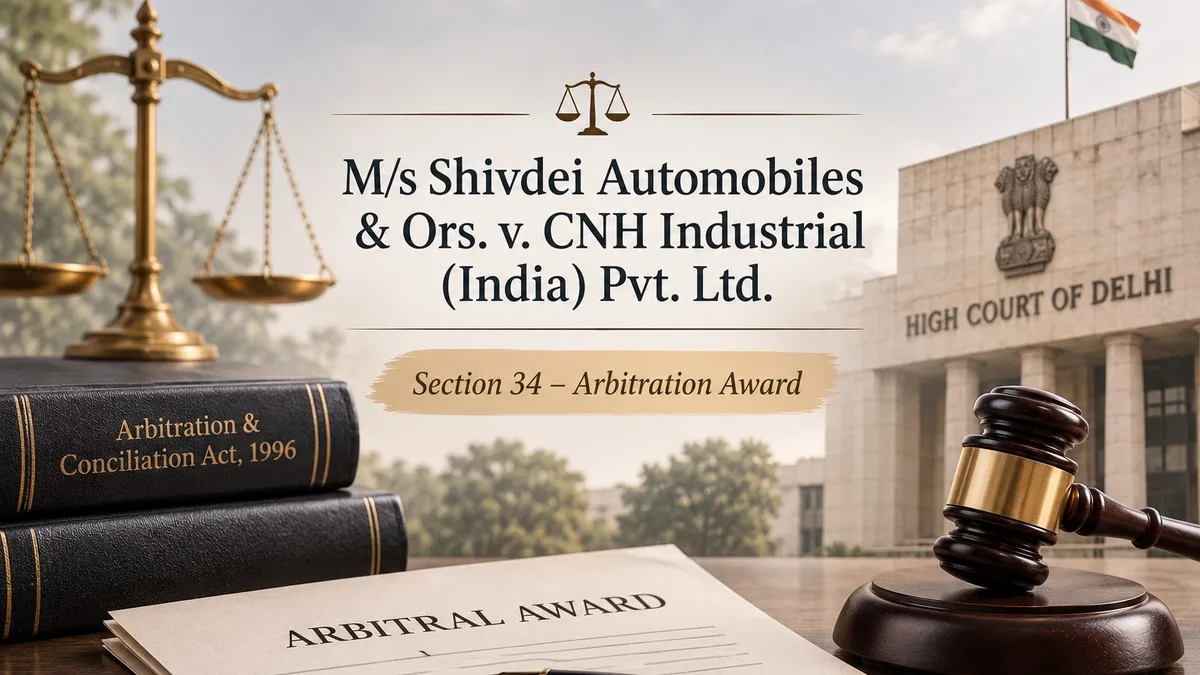
The Delhi High Court dismissed a petition under Section 34 of the Arbitration and Conciliation Act, 1996 challenging an arbitral award arising from a dealership arrangement. It held that Section 12(5), introduced with effect from 23.10.2015, could not retrospectively invalidate an arbitrator appointed and proceedings commenced in 2004. The appointment had followed the procedure expressly agreed in Clause 25. The absence of a separate notice under Section 21 did not, without limitation prejudice or other invalidity, nullify the proceedings. The Court also upheld the Arbitrator’s plausible construction that Clause 1.4 preserved specified financial liabilities from the earlier commercial arrangement and that disputes concerning those liabilities fell within the arbitration mechanism in Clause 25. (Paras 20–53)
Key Proposition: The validity of an arbitrator’s appointment must be assessed under the law in force when the appointment was made; Section 12(5) of the 2015 Amendment cannot retrospectively invalidate a pre-amendment appointment expressly authorised by the parties’ arbitration agreement.
- Arbitration and Conciliation Act, 1996 – Section 12(5) – Temporal application – Whether the 2015 statutory ineligibility rule invalidates an appointment made in 2004? – Held, no. (Paras 20–30)
- Arbitration and Conciliation Act, 1996 – Section 21 – Commencement of arbitration – Whether absence of a separate notice is fatal? – Held, no, absent limitation prejudice or other demonstrated invalidity. (Paras 37–40)
- Arbitration and Conciliation Act, 1996 – Sections 7 and 34 – Scope of arbitration agreement – Whether saved earlier financial liabilities were arbitrable under the later dealership agreement? – Held, yes, to the extent preserved by Clause 1.4 and covered by Clause 25. (Paras 41–52)
Background / Synopsis :
- The petition was filed under Section 34 of the Arbitration and Conciliation Act, 1996 to set aside an arbitral award dated 09.01.2006 arising from a Dealership Agreement dated 01.01.2002 between M/s Shivdei Automobiles and CNH Industrial (India) Pvt. Ltd.
- The respondent had appointed Shivdei Automobiles as its dealer for Sirsa and Fatehabad, Haryana. The respondent supplied tractors, spare parts and other products on credit. It claimed outstanding dues, including interest, and amounts relating to C-Forms.
- After exchange of accounts and correspondence, the respondent issued a legal notice dated 15.04.2004. The petitioners disputed the claim. By letter dated 01.06.2004, the respondent invoked Clause 25 and appointed a retired judge as Sole Arbitrator.
- The respondent claimed Rs. 1,29,68,643 towards outstanding dues, in addition to C-Forms, compensation, costs and interest. The petitioners disputed liability, raised counterclaims and objected that the arbitrator had been unilaterally appointed, no separate Section 21 notice had been issued, and transactions from 24.03.1999 to 31.12.2001 fell outside the arbitration agreement.
- The Arbitrator awarded Rs. 1,29,68,643 with interest at 12% per annum from 01.08.2004 until payment. The petitioners sought setting aside of that award.
Issues For Consideration :
- Whether Section 12(5) of the Arbitration and Conciliation Act, 1996, inserted by the 2015 Amendment, applied retrospectively to an arbitrator appointed and proceedings commenced in 2004, with the award rendered in 2006.
- Whether the arbitrator’s appointment by the respondent was invalid under the law applicable at the time, despite Clause 25 expressly providing for appointment by the respondent’s Managing Director.
- Whether the absence of a separate notice under Section 21 invalidated the arbitral proceedings.
- Whether financial liabilities arising from dealings between 24.03.1999 and 31.12.2001 were preserved by Clause 1.4 of the 2002 Dealership Agreement and fell within the scope of its arbitration clause.
Submissions Of Parties :
- Petitioners: The Sole Arbitrator was appointed unilaterally and without their consent, contrary to Section 12 of the Act. They contended that no notice under Section 21 had been issued, so the proceedings had not validly commenced. They also argued that no agreement subsisted during 24.03.1999–31.12.2001 and that Clause 3.1 made the Dealership Agreement effective only from 01.01.2002. Clause 1.4, they submitted, merely saved existing financial liabilities and could not create an arbitration agreement for an earlier period.
- Respondent: Section 12(5) was introduced only in 2015 and could not apply to proceedings commenced in 2004 or an award made in 2006. Clause 1.4 preserved accrued and outstanding financial liabilities under the earlier arrangement. The petitioners’ own counterclaim for user charges for the intervening period supported the existence of continuing commercial dealings.
Court's Observations & Analysis :
Re: Temporal application of Section 12(5)
- The arbitral proceedings commenced in 2004 and the award was passed in 2006, both before Section 12(5) came into force on 23.10.2015.
- The Court applied the settled position that the 2015 Amendment was prospective. The validity of the appointment had to be examined under the statutory regime prevailing when the appointment was made; a later statutory disqualification could not retrospectively alter the legal character of a completed appointment.
- Held: Section 12(5), read with the Seventh Schedule, could not be applied retrospectively to invalidate the 2004 appointment. (Paras 20–24)
Re: Contractual appointment procedure
- Clause 25 provided for a Sole Arbitrator who was a retired Court Judge, appointed by the respondent’s Managing Director. It also recorded the dealer’s agreement not to object to the appointment on the ground that the appointing Managing Director was connected with the respondent.
- The appointment was made by letter dated 01.06.2004 in accordance with the agreed procedure. The petitioners did not identify an independent circumstance establishing justifiable doubts as to the arbitrator’s independence or impartiality under the law then in force.
- The Court distinguished cases involving appointments not authorised by the arbitration agreement. It emphasised that pre-2015 party autonomy did not validate every unilateral appointment; the decisive distinction was whether the agreement itself authorised the appointment procedure.
- Held: On the facts and under the pre-2015 statutory regime, the appointment was not invalid merely because it was made by the respondent. (Paras 24–36)
Re: Notice under Section 21
- The purpose of Section 21 is to determine the commencement of arbitral proceedings, principally for limitation. The Supreme Court had clarified that a separate Section 21 notice is not an indispensable prerequisite where the claim is otherwise valid and arbitrable.
- The record contained a legal notice dated 15.04.2004, a reply dated 04.05.2004 and a letter dated 01.06.2004 invoking Clause 25 and communicating the appointment. The petitioners did not contend that the claims were time-barred or demonstrate procedural prejudice from the absence of a separate Section 21 notice.
- Held: The objection based solely on non-issuance of a separate Section 21 notice was rejected; limitation requirements remained unaffected. (Paras 37–40)
Re: Pre-2002 transactions and scope of arbitration
- The Court accepted the Arbitrator’s view that the commercial relationship continued after the stated validity date of the 1998 Letter of Intent. The respondent continued supplying tractors and the petitioners continued accepting supplies and making payments until the 2002 Dealership Agreement.
- The petitioners’ delayed objection to the inclusion of the intervening-period dues in account statements and their own counterclaim for user charges were relevant circumstances, though neither alone created an arbitration agreement.
- Clause 1.4 of the Dealership Agreement expressly preserved accrued and outstanding payment and other financial obligations under earlier arrangements. Clause 25 supplied the arbitration mechanism for disputes arising under or in connection with the Dealership Agreement. Read together, the clauses preserved the identified financial liabilities and allowed disputes concerning them to be referred to arbitration, but did not extend the arbitration clause to every unrelated pre-2002 claim.
- Under Section 34, the Court could not substitute its own interpretation merely because another view was possible where the Arbitrator’s interpretation was a plausible view of the evidence and contract.
- Held: The preserved financial liabilities for the intervening period fell within the arbitration clause to the extent covered by Clauses 1.4 and 25; no ground for interference was made out. (Paras 41–51)
Notable Observations: None.
Decision & Directions :
- The petition under Section 34 was dismissed and the arbitral award dated 09.01.2006 was upheld.
- The award of Rs. 1,29,68,643 with interest at 12% per annum from 01.08.2004 until payment remained undisturbed.
- There was no order as to costs.
- Separate Opinions: None.
Legal Provisions Discussed & Precedents Cited :
- Arbitration and Conciliation Act, 1996 – Section 34: grounds for setting aside an arbitral award.
- Arbitration and Conciliation Act, 1996 – Section 12(5) and Seventh Schedule: statutory ineligibility of arbitrators; introduced with effect from 23.10.2015.
- Arbitration and Conciliation Act, 1996 – Section 21: commencement of arbitral proceedings, particularly for limitation.
- Arbitration and Conciliation Act, 1996 – Section 7: requirement of an arbitration agreement.
- Arbitration and Conciliation Act, 1996 – Section 11(2): party autonomy in agreeing on the procedure for appointment of arbitrators under the pre-amendment regime.
- Board of Control for Cricket in India v. Kochi Cricket Pvt. Ltd., (2018) 6 SCC 287 – Relied on; prospective operation of the 2015 Amendment.
- Kamal Kumar v. Municipal Corporation of Delhi, 2023 SCC OnLine Del 6515 – Referred to; prospective application of the 2015 Amendment.
- Rajasthan Small Industries Corporation Ltd. v. Ganesh Containers Movers Syndicate, (2019) 3 SCC 282 – Referred to; temporal application of the 2015 Amendment.
- D.V. Anand v. Hindustan Petroleum Corporation Ltd., FAO(OS) (COMM) 139/2018 – Referred to; temporal application of the 2015 Amendment.
- Hanson Agro Ltd. v. GAIL (India) Ltd., 2026 SCC OnLine Del 6894 – Relied on; validity of pre-2015 arbitrator appointments tested under the law applicable on the appointment date.
- DMRC Ltd. v. Pankaj, 2026 SCC OnLine Del 7513 – Relied on; pre-2015 party autonomy and contractual appointment procedures.
- Datar Switchgears Ltd. v. Tata Finance Ltd., (2000) 8 SCC 151 – Relied on; significance of the appointment procedure agreed by parties.
- Dharma Prathishthanam v. Madhok Construction (P) Ltd., (2005) 9 SCC 686 – Distinguished on facts; unilateral appointment not authorised by the arbitration clause.Bhagheeratha Engg. Ltd. v. State of Kerala, (2026) 5 SCC 758 – Relied on; purpose of Section 21 and non-fatal nature of absence of a separate notice.
- Bhadra International (India) (P) Ltd. v. Airports Authority of India, 2026 SCC OnLine SC 7 – Distinguished in its context; did not govern the temporal issue presented.
- ABL Biotechnologies Ltd. v. Technology Development Board & Anr., O.M.P. 607/2010 – Distinguished; appointment clause materially differed.
- Bharat Forge Ltd. v. Tarsem Jain & Anr., O.M.P. (COMM) 378/2019 – Distinguished; issue concerned consent to appointment.
- Mahavir Prasad Gupta and Sons v. Government of NCT of Delhi, FAO (COMM) 170/2023 – Distinguished; proceedings commenced after the 2015 Amendment.
- Supreme Infrastructure India Ltd. v. Freyssinet Menard India Pvt. Ltd., O.M.P. (COMM) 395/2024 – Distinguished; ex parte proceedings without notice or information regarding appointment.
Case Details :
- Case / Party Name: M/s Shivdei Automobiles & Ors. v. CNH Industrial (India) Pvt. Ltd.
- Case Number(s: O.M.P. (COMM) 51/2020; CNR No. DLHC010099092020
- Coram / Judges: Om Prakash Shukla, J. – Single Judge; judgment authored by Om Prakash Shukla, J.
- Counsel Appearances: For the petitioners: Mr. R.K. Jain, Mr. Ayush Behl and Mr. Anirudh Kumar. For the respondent: Mr. Yamandeep Kumar and Ms. Samiksha Goel.
Disclaimer: This summary is an editorial aid and does not form part of the judgment. Refer to the original judgment before citing.
Full Judgement / Attachment
Full Judgement
Frequently asked questions about Delhi High Court
- Where does the Delhi High Court sit and which areas does it cover?
- The Delhi High Court sits in New Delhi. It has jurisdiction over the National Capital Territory of Delhi. It was established on 31 October 1966 and is a leading forum for commercial, intellectual property, tax and arbitration matters.
- How do I check Delhi High Court case status and judgements?
- The official website, delhihighcourt.nic.in, provides case status, cause lists, e-filing and judgements searchable by party, judge or date. Orders are also mirrored on the eCourts Judgments portal (judgments.ecourts.gov.in).
- What are the Delhi High Court's Commercial and IP Divisions?
- Delhi High Court has original civil jurisdiction, so high-value suits in Delhi are filed directly before it. Its Commercial Division hears commercial disputes, and its Intellectual Property Division, set up in 2021 after the IPAB was abolished, hears patent, trademark and copyright cases. It is also a major forum for tax appeals from the ITAT Delhi Benches and for arbitration petitions.
- What is an LPA in the Delhi High Court?
- A Letters Patent Appeal (LPA) under Clause 10 of the Letters Patent lets a party challenge certain single-judge orders, typically in writ matters, before a Division Bench. In commercial cases, appeals lie under Section 13 of the Commercial Courts Act instead. Final judgements can be challenged by a Special Leave Petition under Article 136, ordinarily within 90 days.
- How can White Collar Professional help with a Delhi High Court matter?
- Post your requirement on White Collar Professional to receive proposals from verified Advocates, Chartered Accountants and Company Secretaries, compare them, and pay securely through the platform. This page also tracks the latest Delhi High Court judgements and legal updates as they are reported.