15-Year Age Cap on School Vehicles Upheld: Himachal Pradesh High Court Says Child Safety Outweighs Cost, Rule Binds All Educational Institutions
Court / Authority
Himachal Pradesh High Court
Update / Judgement Date
31 Oct 2026
Date of Publication
03 Nov 2026
Case No.
CWP No. 11377 of 2025
Source
WCP News Bulletin
Author
Arshee Saifi — WCP Legal Desk
Reading Time
8 min read
View Count
1
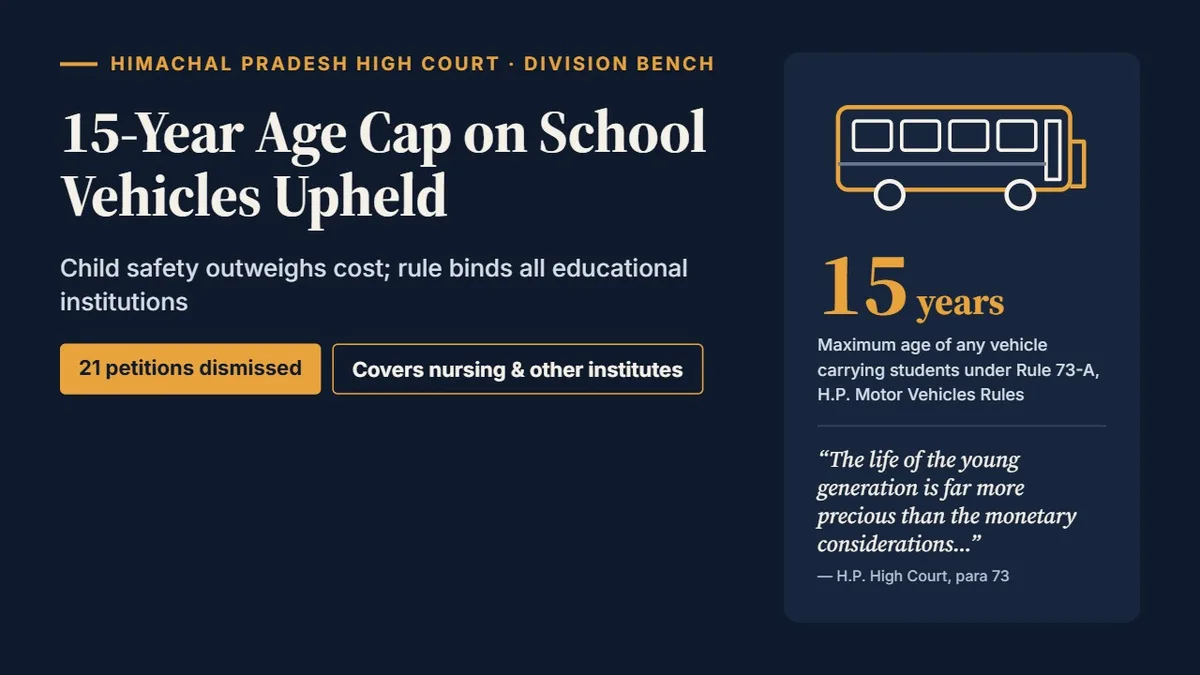
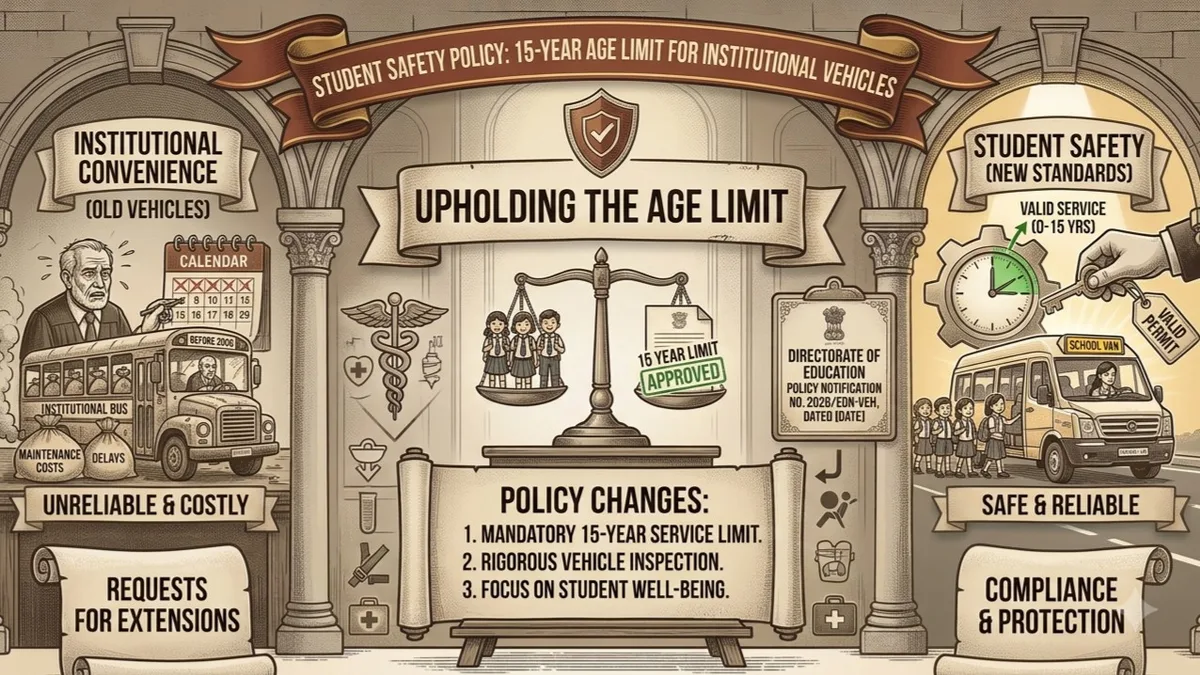
Twenty-one schools, nursing institutes and educational societies challenged Clause (xi) of Rule 73-A(1)A of the Himachal Pradesh Motor Vehicles Rules, 1999, inserted on 12.10.2018 after the Nurpur school-bus accident, which bars vehicles older than 15 years from providing transport to schools (Paras 2–5, 17, 36–37). The Division Bench held that the clause does not fix the 'life of a motor vehicle' – a power reserved to the Centre under Section 59 of the Motor Vehicles Act, 1988 – but only limits the period for which a vehicle may serve schools, and that it falls within the State's power under Section 96 to make rules carrying Chapter V (including permits under Section 76) into effect (Paras 41–58, 61–65). The 15-year limit is not arbitrary: it matches or is more lenient than the rules of Chhattisgarh (12 years), Uttar Pradesh and Haryana (15 years), and financial hardship cannot outweigh the safety of students (Paras 66–73). Read harmoniously, 'School' in Rule 73-A covers every educational institution bound by its other conditions, including nursing and pharmacy institutes (Para 80). All petitions were dismissed and interim orders vacated (Para 81).
Key Proposition: A State rule under Section 96 of the Motor Vehicles Act, 1988 limiting vehicles that transport students to 15 years from manufacture is a valid permit condition that does not trench on the Centre's power under Section 59 to specify the life of a motor vehicle, and it applies to every educational institution bound by the school-transport conditions, not only to schools up to Class 10 or 10+2.
A. Background / Synopsis :
- On 09.04.2018 a school bus fell into a gorge near Nurpur, District Kangra, killing 27 people including 23 children; the High Court took suo motu notice in CWP No. 73 of 2018. (Paras 17, 36)
- A High Level Committee was constituted on 10.04.2018, draft guidelines were published for public comment on 17.04.2018, and on 05.05.2018 the Committee recommended a 15-year limit, among other safety measures. (Para 17)
- Notification dated 12.10.2018 inserted Rule 73-A in the H.P. Motor Vehicles Rules, 1999; Clause (xi) of Rule 73-A(1)A provides that vehicles providing transport to schools will not be more than 15 years old. (Paras 2, 4, 37–38)
- The petitioners, holding private service vehicle permits, were refused permit renewals for vehicles older than 15 years and sought a mandamus against applying, or quashing of, Clause (xi). (Paras 3–9)
B. Issues For Consideration :
- Whether Rule 73-A and Clause (xi) were beyond the State's rule-making competence in view of Section 59 of the Motor Vehicles Act.
- Whether the 15-year limit is arbitrary and violative of Article 14.
- Whether Clause (xi) applies to nursing, pharmacy and other institutions that are not 'schools' in the ordinary sense.
C. Submissions Of Parties :
- Petitioners:
Only the Central Government can fix a vehicle's life under Section 59; the State's residuary power under Section 96(2)(xxxiii) cannot create an age-based disability with the same effect (relied on Naresh Chandra Agrawal v. ICAI). (Paras 11, 13–14)
Roadworthiness, certified by transport officers, and not age should be the test; institutional buses run very few kilometres; replacement costs will pass to students. (Paras 11–12)
Nursing and pharmacy institutes are not 'schools' within Clause (xi). (Para 11)
- Respondent-State (Advocate General):
Section 96 empowers the State to frame such rules; the rule followed a consultative process after the Nurpur tragedy and forms part of a road-safety policy under the Supreme Court-appointed Committee on Road Safety. (Paras 16–18)
Older vehicles suffer structural fatigue and failure risks that periodic fitness checks cannot detect; Government vehicles too are scrapped after 15 years (Notification dated 07.02.2024). (Para 18)
Chhattisgarh (12 years), Uttar Pradesh and Haryana (15 years) have similar rules, and a Three-Judge Bench of the Chhattisgarh High Court upheld the Chhattisgarh rule. (Paras 19–22)
D. Court's Observations & Analysis :
- Re: Issue (i): Legislative competence – Sections 59 and 96
Section 59 lets the Centre specify a vehicle's life, after which it cannot be used at all; Clause (xi) only limits how long a vehicle may serve schools and leaves it free for other lawful use. (Paras 42–46)
Section 96 empowers the State to make rules carrying Chapter V into effect, including Section 76 permits, and the matters in Section 96(2) do not limit that general power. (Paras 51–55)
The State cannot alter the life fixed by the Centre: if the Centre fixes 10 years, a vehicle cannot serve schools for 15. (Paras 57–58)
Applying the three-step test from P. Krishnamurthy and Naresh Chandra Agrawal (source of power, meaning of the rule, consistency with the delegated power), the rule is intra vires. (Paras 59–65)
Held: Rule 73-A and Clause (xi) are within the State's competence. (Paras 65, 68)
- Re: Issue (ii): Arbitrariness
Financial viability cannot be weighed against children's safety; vehicles over 15 years may still be used for other purposes. (Para 69)
That students also travel in older public or private vehicles does not invalidate a rule for identified school vehicles. (Para 70)
Roadworthiness cannot be the sole criterion; in a hilly State the 15-year limit is, if anything, lenient compared with Chhattisgarh's 12. (Paras 71–72)
Held: the 15-year limit is not arbitrary. (Paras 69–73)
- Re: Issue (iii): Meaning of 'School'
Rule 73-A's heading and opening paragraph cover 'School/Educational Institutions'; Clause (xi) sits among general conditions (yellow paint, signage, first aid and others) that the petitioners accept they must follow. (Paras 74–77, 80)
Held: whichever institution is bound by Clauses (i) to (x) and (xii) to (xx) of Rule 73-A(1)A is also bound by Clause (xi). (Para 80)
Notable Observations: “The life of the young generation is far more precious than the monetary considerations of the petitioners.” (Para 73); “One fatal incident on account of an aged vehicle can ruin and shatter the lives of families forever.” (Para 73)
E. Decision & Directions :
All writ petitions dismissed; Notification dated 12.10.2018 and Clause (xi) of Rule 73-A(1)A upheld. (Para 81)
Clause (xi) applies to all educational institutions to which the general conditions in Rule 73-A(1)A apply, and is not restricted to schools teaching up to Class 10 or 10+2. (Para 81)
Interim orders vacated forthwith; no order as to costs. (Para 81)
F. Legal Provisions Discussed & Precedents Cited :
- Motor Vehicles Act, 1988 – Section 2(11) – 'educational institution bus'.
- Motor Vehicles Act, 1988 – Sections 2(31), 2(33) and 76 – permits and private service vehicle permits.
- Motor Vehicles Act, 1988 – Section 59 – Central Government's power to specify the life of a motor vehicle.
- Motor Vehicles Act, 1988 – Section 96(1) and 96(2)(xxxiii), read with Section 212 – State rule-making power for Chapter V.
- Himachal Pradesh Motor Vehicles Rules, 1999 – Rule 73-A(1)A, Clause (xi) – 15-year limit for vehicles providing transport to schools.
- Constitution of India – Article 14 – challenge on arbitrariness.
- Comparative rules: Chhattisgarh Motor Vehicles Rules, 1994, Rule 76-B(16) (12 years); U.P. Motor Vehicles Rules, 1998, Rule 222-D (15 years); Haryana Motor Vehicles Rules, 1993, Rule 67A (15 years).
- Doctrines applied: test for ultra vires subordinate legislation; harmonious construction.
- State of T.N. v. P. Krishnamurthy, (2006) 4 SCC 517 – Relied on.
- Naresh Chandra Agrawal v. Institute of Chartered Accountants of India, (2024) 13 SCC 241 – Relied on (cited by the petitioners).
- Ghanshyam Das Rungta Foundation v. Union of India, WPC No. 3191 of 2022 (Chhattisgarh High Court, Three-Judge Bench) – Relied on.
- Suo motu order in CWP No. 73 of 2018 dated 10.04.2018 (Division Bench, H.P. High Court) – Referred to.
G. Case Details :
- Case / Party Name: Shivalik Institute of Nursing, through its President Shri Khushi Ram Thakur v. State of Himachal Pradesh & Anr., with 20 connected petitions by schools and educational societies
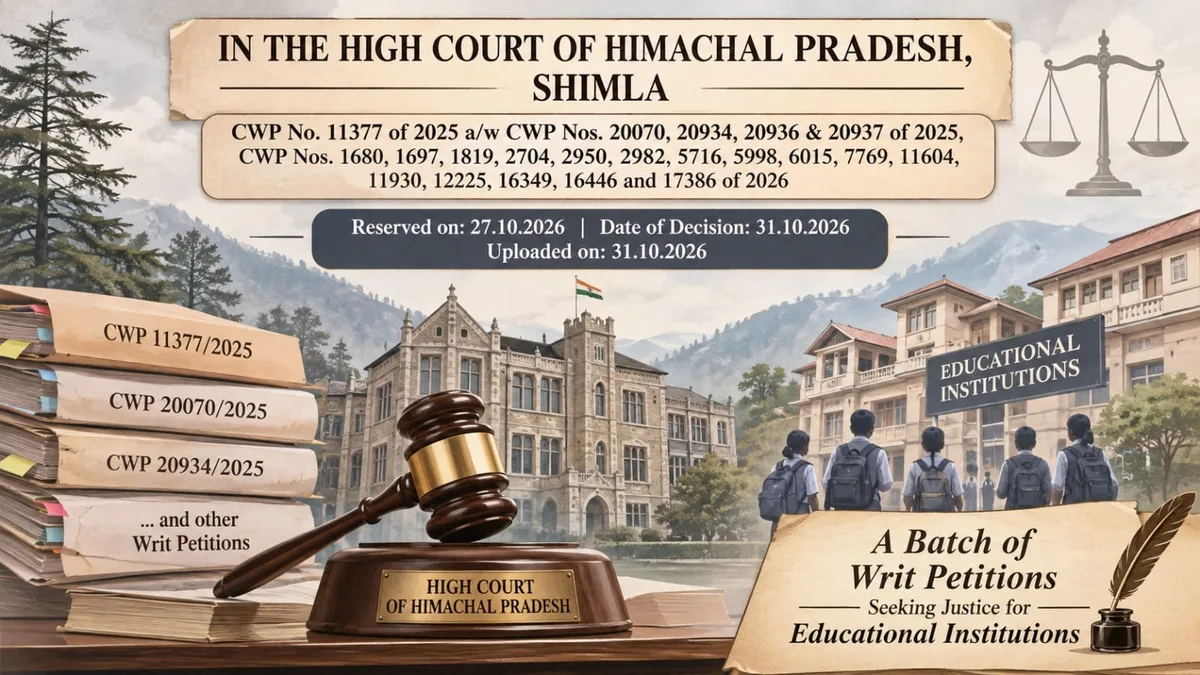
- Case Number(s): CWP No. 11377 of 2025 (lead) a/w CWP Nos. 20070, 20934, 20936 & 20937 of 2025 and CWP Nos. 1680, 1697, 1819, 2704, 2950, 2982, 5716, 5998, 6015, 7769, 11604, 11930, 12225, 16349, 16446 & 17386 of 2026; Neutral Citation 2026:HHC:47922
- Coram / Judges: Hon'ble Mr. Justice Ajay Mohan Goel and Hon'ble Mr. Justice Yogesh Jaswal – Division Bench; authored by Ajay Mohan Goel, J.
- Counsel Appearances: For the Petitioners: M/s Nitin Thakur, Mohit Thakur, K.B. Khajuria, Vijender Katoch, Gaurav Thakur (vice Dr. Rajesh Kumar Parmar), Ajay Sharma, Shubham Singh Guleria and Vishal Thakur, Advocates. For the Respondents: Mr. Anup Rattan, Advocate General, with M/s Ramakant Sharma and Sushant Keprate, Additional Advocates General, and Mr. Rajat Chauhan, Assistant Advocate General.
Disclaimer: This summary is an editorial aid and does not form part of the judgment. Refer to the original judgment before citing.
Full Judgement / Attachment
Full Judgement
Frequently asked questions about Himachal Pradesh High Court
- Where does the Himachal Pradesh High Court sit and which areas does it cover?
- The Himachal Pradesh High Court sits in Shimla. It has jurisdiction over the State of Himachal Pradesh. It became a full High Court for the State of Himachal Pradesh in 1971.
- Where can I check HP High Court case status and orders?
- The official website, hphighcourt.nic.in, publishes cause lists, case status and judgements of the High Court at Shimla. Orders are also available on the eCourts High Court Services portal (hcservices.ecourts.gov.in) and the eCourts Judgments portal (judgments.ecourts.gov.in).
- Does the HP High Court hear civil suits directly?
- Yes. Unusually for a newer High Court, it has original civil jurisdiction over high-value suits, so such suits are filed directly before it. It also hears writs on service, forest and land matters, and tax appeals arising from the ITAT Chandigarh Bench, which covers Himachal Pradesh.
- How is a single-judge order of the HP High Court appealed?
- Certain single-judge orders can be challenged before a Division Bench by a Letters Patent Appeal. In commercial disputes, the Commercial Courts Act route applies instead. Final judgements can be taken to the Supreme Court by a Special Leave Petition under Article 136, ordinarily within 90 days.
- How can White Collar Professional help with a HP High Court matter?
- Post your requirement on White Collar Professional to receive proposals from verified Advocates, Chartered Accountants and Company Secretaries, compare them, and pay securely through the platform. This page also tracks the latest HP High Court judgements and legal updates as they are reported.