Motor Accident Compensation: Independent Eyewitness Evidence Prevails Over Police Closure Report
Court / Authority
Himachal Pradesh High Court
Update / Judgement Date
31 Oct 2026
Date of Publication
03 Nov 2026
Case No.
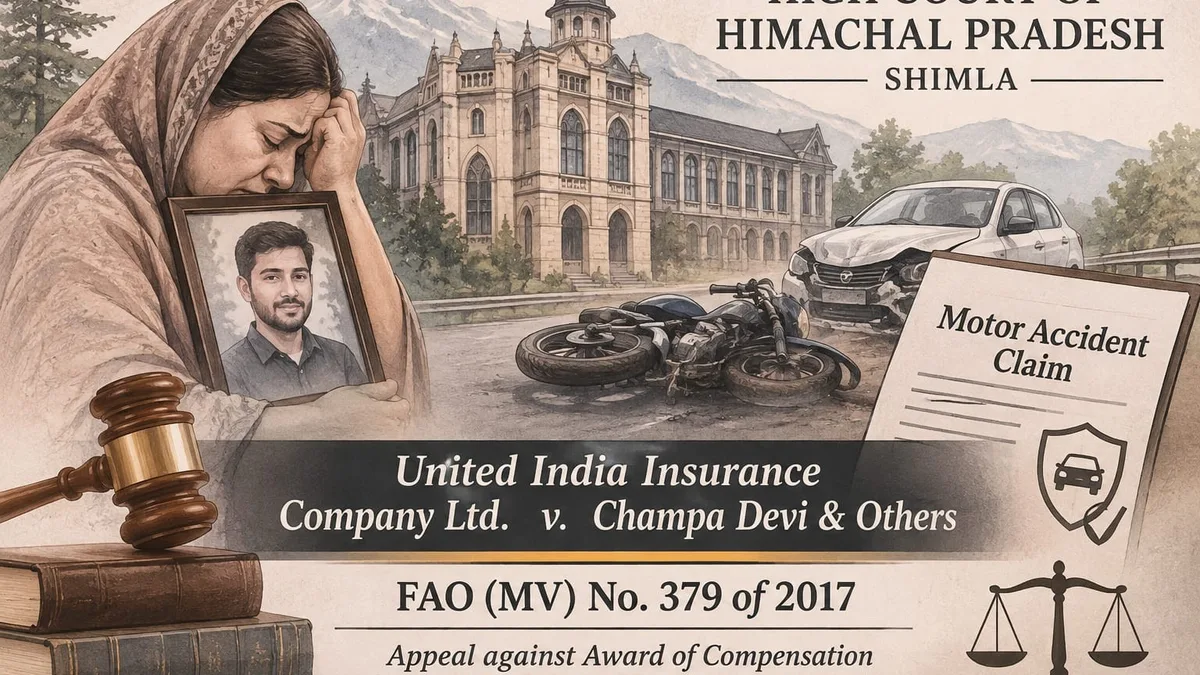
FAO (MV) No. 379 of 2017
Source
WCP News Bulletin
Author
Dipanshi Bansal — WCP Legal Desk
Reading Time
7 min read
View Count
The High Court held that in a motor accident claim, which is decided on the standard of preponderance of probabilities, a credible eyewitness account given on oath before the Tribunal cannot be discarded merely because the police subsequently filed a cancellation report. The Court upheld the finding of negligence against the insured vehicle’s driver, while recalculating compensation in accordance with the principles in Pranay Sethi and Sarla Verma. (Paras 25–31, 34–43).
Key Proposition: In a claim under the Motor Vehicles Act, the Tribunal may rely on credible direct testimony notwithstanding a police cancellation report, where the evidence is assessed on a preponderance of probabilities and the contrary conclusion in the police report is not independently established.
- Motor Vehicles Act, 1988 – Section 166 – Motor accident compensation – Evidentiary standard – Whether a police cancellation report displaces sworn eyewitness testimony? – Held, no. (Paras 25–31)
- Motor Vehicles Act, 1988 – Section 173 – Appeal against compensation award – Whether the insurer established that the deceased motorcyclist caused the accident? – Held, no. (Paras 25–31)
- Motor Vehicles Act, 1988 – Section 166 – Assessment of compensation – Whether future prospects and conventional heads required recalculation? – Held, yes. (Paras 34–41)
Background / Synopsis :
- Champa Devi instituted a claim under Section 166 of the Motor Vehicles Act following the death of her 26-year-old son, Gurbaksh Singh, in a road accident on 10 February 2016. The deceased was riding a motorcycle when it was struck by a vehicle owned by Pritika Autocost Ltd., driven by Ashwani Kumar and insured with United India Insurance Company Ltd.
- The claimant’s case was that the offending vehicle was driven rashly and negligently near Swan Bridge on the Santokhgarh–Tahliwal Road. FIR No. 23/2016 was registered at Police Station Haroli under Sections 279, 337 and 304-A of the Indian Penal Code.
- The Motor Accident Claims Tribunal, by award dated 1 April 2017, allowed the claim and awarded Rs.10,68,000 with interest at 9% per annum, fastening liability on the insurer.
- The insurer appealed under Section 173 of the Motor Vehicles Act, seeking exoneration or reduction. It relied, inter alia, on the police cancellation report and disputed the deceased’s negligence, income and future prospects.
- Issues For Consideration :
- Whether the cancellation report filed by the police undermined the claimant’s evidence that the accident occurred due to the rash and negligent driving of the insured vehicle.
- Whether the insurer had established that the deceased motorcyclist was himself responsible for the accident.
- Whether the Tribunal correctly assessed the deceased’s income, future prospects, personal expenses, multiplier and conventional heads of compensation.
- Whether the rate of interest awarded by the Tribunal required modification.
Submissions Of Parties :
Appellant – United India Insurance Company Ltd.:
- The insurer contended that the police had filed a cancellation report after investigation and that the FIR had been wrongly registered against the driver of the insured vehicle.
- It argued that the deceased was himself driving rashly and negligently and was therefore the tortfeasor; consequently, the claimant could not recover compensation from the insurer.
- It challenged the Tribunal’s assessment of monthly income at Rs.6,000, the addition towards future prospects and the overall quantum. It also disputed the use of a 50% addition for future prospects for a person working in the unorganised sector.
Respondent – Claimant:
The claimant supported the Tribunal’s finding on negligence and the award of compensation.
Counsel for the claimant sought enhancement so that the amount would constitute just compensation.
Court's Observations & Analysis :
Re: Evidentiary value of the police cancellation report
- Proceedings under the Motor Vehicles Act are summary in nature. Negligence and liability are assessed on the basis of preponderance of probabilities, rather than the criminal standard of proof. (Para 25)
- Sanjeev Kumar, an independent eyewitness who had also lodged the FIR, gave a direct account of the accident and withstood cross-examination. The insurer did not establish any motive for him to falsely implicate the driver. (Paras 15–16, 25–26)
- The statements relied upon by the police while submitting the cancellation report had not been recorded on oath. The cancellation report did not disclose the evidentiary basis for concluding that the motorcyclist was responsible. The insurer did not examine the other persons named as witnesses in the investigation. (Paras 26–27)
- The insurer did not confront Sanjeev Kumar with his subsequent statement before the Magistrate, nor seek his recall for that purpose. The Court also considered the timing of his Tribunal testimony and the later statement before the Magistrate. (Paras 28–30)
- Held: The cancellation report did not displace the sworn testimony of the eyewitness. The Tribunal had correctly found that the accident occurred due to the rash and negligent driving of the insured vehicle. The insurer’s challenge on negligence was rejected. (Paras 30–31)
Re: Assessment of compensation
- The deceased was 26 years old. In the absence of contrary evidence, the Tribunal’s assessment of age was sustained. His income was reasonably assessed at Rs.6,000 per month as a daily wager, notwithstanding the absence of formal proof of regular employment. (Paras 33–34)
- Applying National Insurance Co. Ltd. v. Pranay Sethi, the Court held that a 40% addition, rather than 50%, was appropriate towards future prospects for a person below 40 years working in the unorganised sector. The monthly income with future prospects was therefore Rs.8,400. (Paras 34–35)
- As the deceased was unmarried, 50% was deducted towards personal expenses. The monthly contribution was assessed at Rs.4,200. Applying the multiplier of 17 in terms of Sarla Verma, the loss of dependency was calculated at Rs.8,56,800. (Paras 36–37)
- The amounts awarded under loss of love and affection and the combined head of funeral expenses and litigation costs were not retained. The Court applied the conventional amounts recognised in Pranay Sethi: Rs.15,000 for loss of estate, Rs.15,000 for funeral expenses and Rs.40,000 for loss of consortium. (Paras 38–40)
- Held: The total compensation was recalculated at Rs.9,26,800. (Para 40)
Notable Observations: None.
Decision & Directions :
- The insurer’s appeal was partly allowed. The compensation was reduced from Rs.10,68,000 to Rs.9,26,800.
- The rate of interest was reduced from 9% to 7.5% per annum, payable from the date of filing of the claim petition until deposit of the award amount.
- The ultimate liability to pay the compensation remained with the Insurance Company. The Tribunal’s award was modified accordingly.
- Parties were left to bear their own costs. The record was directed to be sent back.
Legal Provisions Discussed & Precedents Cited :
- Motor Vehicles Act, 1988 – Section 166: Statutory basis for the claim petition seeking compensation arising from a motor accident.
- Motor Vehicles Act, 1988 – Section 173: Provides the appellate remedy against the award of the Claims Tribunal.
- Indian Penal Code, 1860 – Sections 279, 337 and 304-A: Provisions under which the FIR relating to the accident was registered.
- National Insurance Co. Ltd. v. Pranay Sethi, (2017) 16 SCC 680 – Relied on: Governs addition for future prospects and conventional heads of compensation.
- Sarla Verma v. Delhi Transport Corporation, (2009) 6 SCC 121 – Relied on: Governs deduction for personal expenses and selection of multiplier.
Case Details :
- Case / Party Name: United India Insurance Company Ltd. v. Champa Devi & Others
- Case Number(s): FAO (MV) No. 379 of 2017
- Coram / Judges: Justice Virender Singh – Single Judge
- Counsel Appearances: For the appellant: Mr. P.S. Chandel, Advocate. For respondent No.1: Mr. Gaurav Sharma, Advocate. None appeared for the remaining respondents.
Disclaimer: This summary is an editorial aid and does not form part of the judgment. Refer to the original judgment before citing.
Full Judgement / Attachment
Full Judgement
Frequently asked questions about Himachal Pradesh High Court
- Where does the Himachal Pradesh High Court sit and which areas does it cover?
- The Himachal Pradesh High Court sits in Shimla. It has jurisdiction over the State of Himachal Pradesh. It became a full High Court for the State of Himachal Pradesh in 1971.
- Where can I check HP High Court case status and orders?
- The official website, hphighcourt.nic.in, publishes cause lists, case status and judgements of the High Court at Shimla. Orders are also available on the eCourts High Court Services portal (hcservices.ecourts.gov.in) and the eCourts Judgments portal (judgments.ecourts.gov.in).
- Does the HP High Court hear civil suits directly?
- Yes. Unusually for a newer High Court, it has original civil jurisdiction over high-value suits, so such suits are filed directly before it. It also hears writs on service, forest and land matters, and tax appeals arising from the ITAT Chandigarh Bench, which covers Himachal Pradesh.
- How is a single-judge order of the HP High Court appealed?
- Certain single-judge orders can be challenged before a Division Bench by a Letters Patent Appeal. In commercial disputes, the Commercial Courts Act route applies instead. Final judgements can be taken to the Supreme Court by a Special Leave Petition under Article 136, ordinarily within 90 days.
- How can White Collar Professional help with a HP High Court matter?
- Post your requirement on White Collar Professional to receive proposals from verified Advocates, Chartered Accountants and Company Secretaries, compare them, and pay securely through the platform. This page also tracks the latest HP High Court judgements and legal updates as they are reported.