noorpur public school vs. state of HP & ANR
Court / Authority
Himachal Pradesh High Court
Update / Judgement Date
31 Oct 2026
Date of Publication
03 Nov 2026
Case No.
CWP No. 2950 of 2026
Source
WCP News Bulletin
Author
Soumya Gupta — WCP Legal Desk
Reading Time
5 min read
View Count
3
● On 9 April 2018, a tragic school bus accident occurred near Nurpur, District Kangra, Himachal Pradesh, resulting in the unfortunate death of 27 persons, including 23 school children.
● Pursuant to the tragedy, a High-Level Committee recommended comprehensive school transport safety guidelines, leading the State Government to insert Rule 73-A into the Himachal Pradesh Motor Vehicles Rules, 1999, via notification dated 12 October 2018.
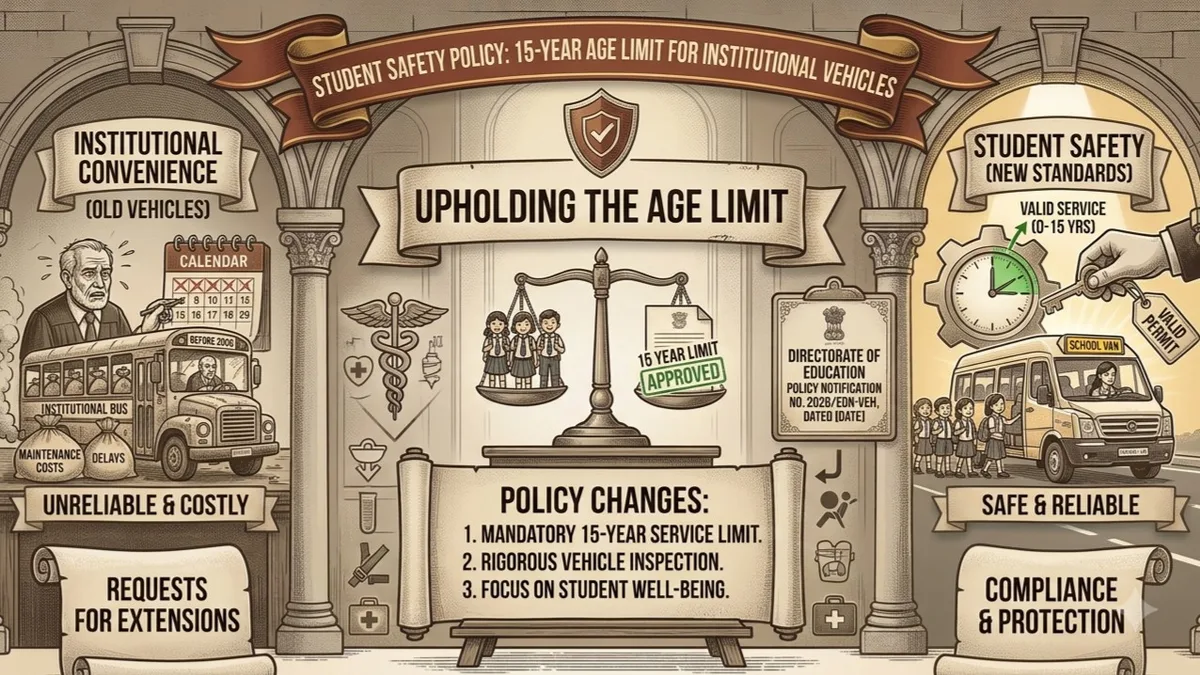
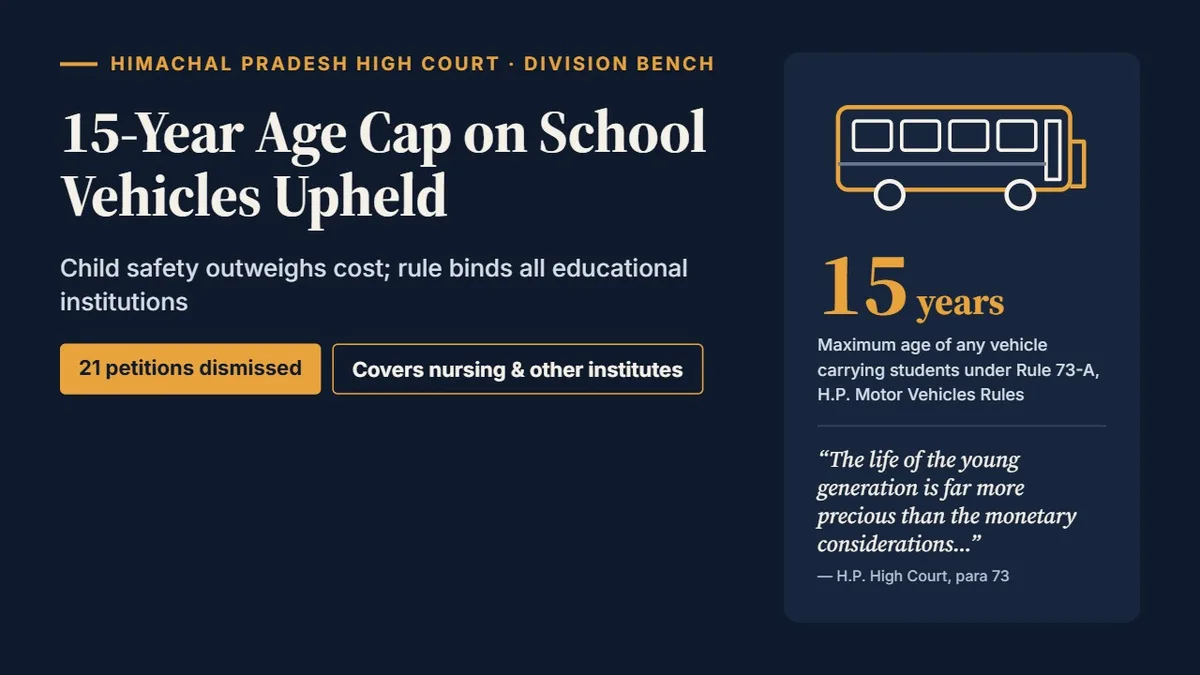
● Clause (xi) of Rule 73-A(1)A stipulated that vehicles providing transportation facilities to schools shall not be more than 15 years old.
● Multiple schools and educational institutions filed Writ Petitions (including CWP No. 11377 of 2025 and CWP No. 2950 of 2026) challenging the constitutional validity and legislative competence of the amendment, claiming economic hardship and that roadworthiness should be the sole criterion.
Issues For Consideration
● Whether the State Government lacks legislative competence to frame Rule 73-A(1)A(xi) under the Motor Vehicles Act, 1988.
● Whether fixing a 15-year age restriction on educational institution buses violates Section 59 of the Motor Vehicles Act, which vests vehicle lifespan fixation powers in the Central Government.
● Whether the impugned clause is arbitrary, discriminatory, or violative of Article 14 of the Constitution by ignoring vehicle roadworthiness and institutional economic viability.
● Whether Clause (xi) applies strictly to schools or extends to other educational institutions like nursing and pharmacy colleges.
Submissions Of Parties
Petitioner / Appellant
● The State Government lacks legislative competence under the Motor Vehicles Act to fix the maximum age of a vehicle, as Section 59 explicitly vests this power exclusively in the Central Government.
● Vehicle age is not indicative of its roadworthiness; periodic fitness testing by transport department officials should be the sole benchmark.
● Educational institutions—particularly nursing and pharmacy institutes—suffer extreme financial hardship and cannot easily replace vehicles, and the rule fails to account for minimal daily running distances.
● The rule creates an arbitrary classification, as students travel in other older public transport or private vehicles without similar restrictions.
Respondent / State
● The amendment was enacted following an extensive consultative process triggered by a devastating school bus tragedy in Nurpur that claimed 23 children's lives.
● Section 96 of the Motor Vehicles Act empowers the State Government to prescribe permit conditions under Chapter V to ensure passenger safety and effective regulation.
● The 15-year limit does not prescribe the "life of a motor vehicle" under Section 59, but merely restricts the operational period for ferrying vulnerable school children, leaving owners free to deploy such vehicles for other permissible purposes.
● Similar or stricter restrictions (such as 12 years in Chhattisgarh, 15 years in Uttar Pradesh and Haryana) exist in other states to safeguard students against structural fatigue and mechanical failure.
Court's Observations & Analysis
Re: Issue (i) & (ii): Legislative Competence and Conflict with Section 59
● Section 59 of the Motor Vehicles Act empowers the Central Government to specify the total "life of a motor vehicle" from its manufacture date, after which it ceases to comply with the Act.
● Conversely, Rule 73-A(1)A(xi) does not declare the vehicle dead or scrap it entirely; it merely regulates the specific use of a vehicle for transporting students to educational institutions beyond 15 years.
● Owners remain fully entitled to deploy a vehicle exceeding 15 years for any other lawful transport purpose permitted under the Act, provided its centralized lifespan has not expired.
● Section 96(1) and Section 96(2)(xxxiii) of the Act confer wide rule-making powers on the State Government to regulate transport vehicles and attach necessary permit conditions under Section 76.
Re: Issue (iii): Arbitrariness, Roadworthiness, and Student Safety
● Roadworthiness inspections cannot always detect latent structural fatigue, material degradation, and outdated safety tech in older vehicles.
● The life of the young generation is far more precious than the commercial and economic convenience of educational institutions.
● Preventive safety measures to protect children from sudden mechanical failures are a high state priority and cannot be equated with mere economics.
● Other states like Chhattisgarh, Uttar Pradesh, and Haryana enforce similar or stricter age caps (12 to 15 years) for school transport.
Re: Issue (iv): Applicability to Other Educational Institutions
● Reading Rule 73-A harmoniously, the term "School" in the transport safety conditions encompasses all educational institutions—including nursing, pharmacy, and professional institutes—that operate buses for students and staff.
● Institutions cannot selectively claim immunity from Clause (xi) while complying with all other general safety conditions under Rule 73-A.
Notable Observations
● "The life of the young generation is far more precious than the monetary considerations of the petitioners. One fatal incident on account of an aged vehicle can ruin and shatter the lives of families forever." (Para 73)
● "Restricting the age of a vehicle to 15 years as per Clause (xi) is a preventive measure to avoid safety risks before they actually indeed manifest." (Para 71)
Decision & Directions
● All connected writ petitions (including CWP No. 11377 of 2025 and CWP No. 2950 of 2026) are dismissed.
● The notification dated 12 October 2018 inserting Rule 73-A, and specifically Clause (xi) of Rule 73-A(1)A into the Himachal Pradesh Motor Vehicles Rules, 1999, is held to be constitutionally valid and intra vires.
● Clause (xi) applies uniformly to all educational institutions subject to the general conditions of Rule 73-A.
● Interim orders stand vacated forthwith.
● No order as to costs
Full Judgement / Attachment
Full Judgement
Frequently asked questions about Himachal Pradesh High Court
- Where does the Himachal Pradesh High Court sit and which areas does it cover?
- The Himachal Pradesh High Court sits in Shimla. It has jurisdiction over the State of Himachal Pradesh. It became a full High Court for the State of Himachal Pradesh in 1971.
- Where can I check HP High Court case status and orders?
- The official website, hphighcourt.nic.in, publishes cause lists, case status and judgements of the High Court at Shimla. Orders are also available on the eCourts High Court Services portal (hcservices.ecourts.gov.in) and the eCourts Judgments portal (judgments.ecourts.gov.in).
- Does the HP High Court hear civil suits directly?
- Yes. Unusually for a newer High Court, it has original civil jurisdiction over high-value suits, so such suits are filed directly before it. It also hears writs on service, forest and land matters, and tax appeals arising from the ITAT Chandigarh Bench, which covers Himachal Pradesh.
- How is a single-judge order of the HP High Court appealed?
- Certain single-judge orders can be challenged before a Division Bench by a Letters Patent Appeal. In commercial disputes, the Commercial Courts Act route applies instead. Final judgements can be taken to the Supreme Court by a Special Leave Petition under Article 136, ordinarily within 90 days.
- How can White Collar Professional help with a HP High Court matter?
- Post your requirement on White Collar Professional to receive proposals from verified Advocates, Chartered Accountants and Company Secretaries, compare them, and pay securely through the platform. This page also tracks the latest HP High Court judgements and legal updates as they are reported.