Student Safety Over Institutional Convenience: Upholding the 15-Year Age Limit for Educational Institution Vehicles
Court / Authority
Himachal Pradesh High Court
Update / Judgement Date
30 Oct 2026
Date of Publication
03 Nov 2026
Case No.
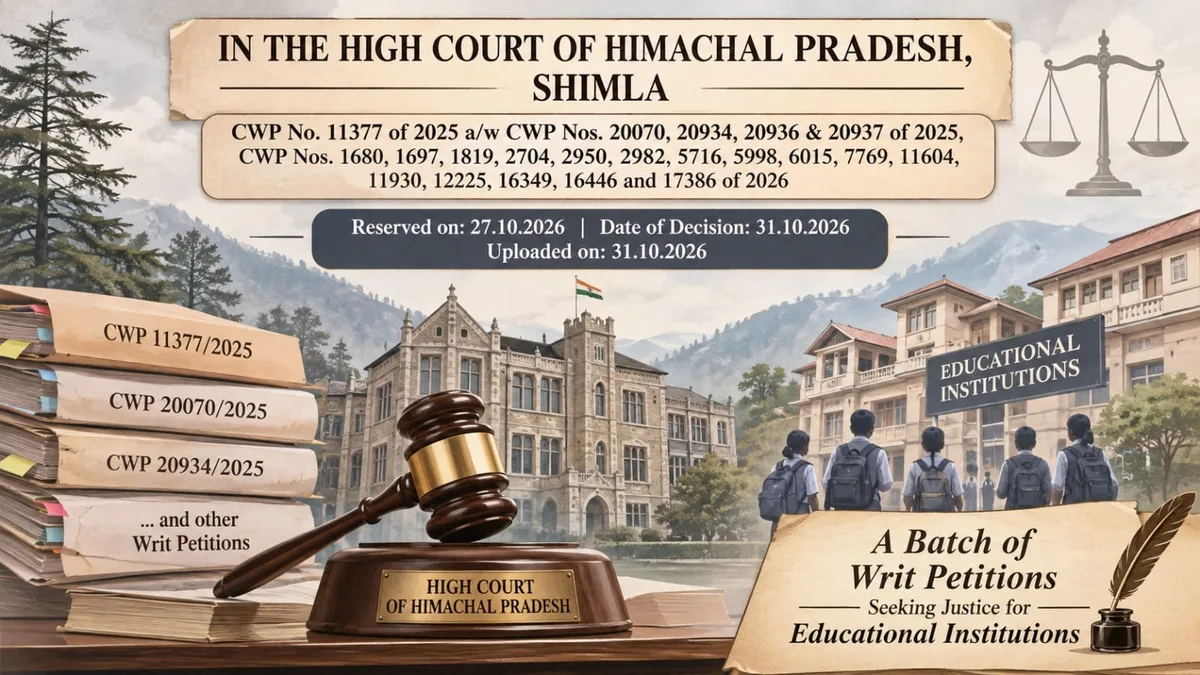
CWP No. 11377 of 2025 and connected petitions
Source
WCP News Bulletin
Author
Pranjal Jha — WCP Legal Desk
Reading Time
4 min read
View Count
Summary
Case: Shivalik Institute of Nursing v. State of Himachal Pradesh & Others
Citation: 2026:HHC:47922
Court: Himachal Pradesh High Court
Case No.: CWP No. 11377 of 2025 and connected petitions
Date: 31 October 2026
Bench: Justice Ajay Mohan Goel and Justice Yogesh Jaswal
Background
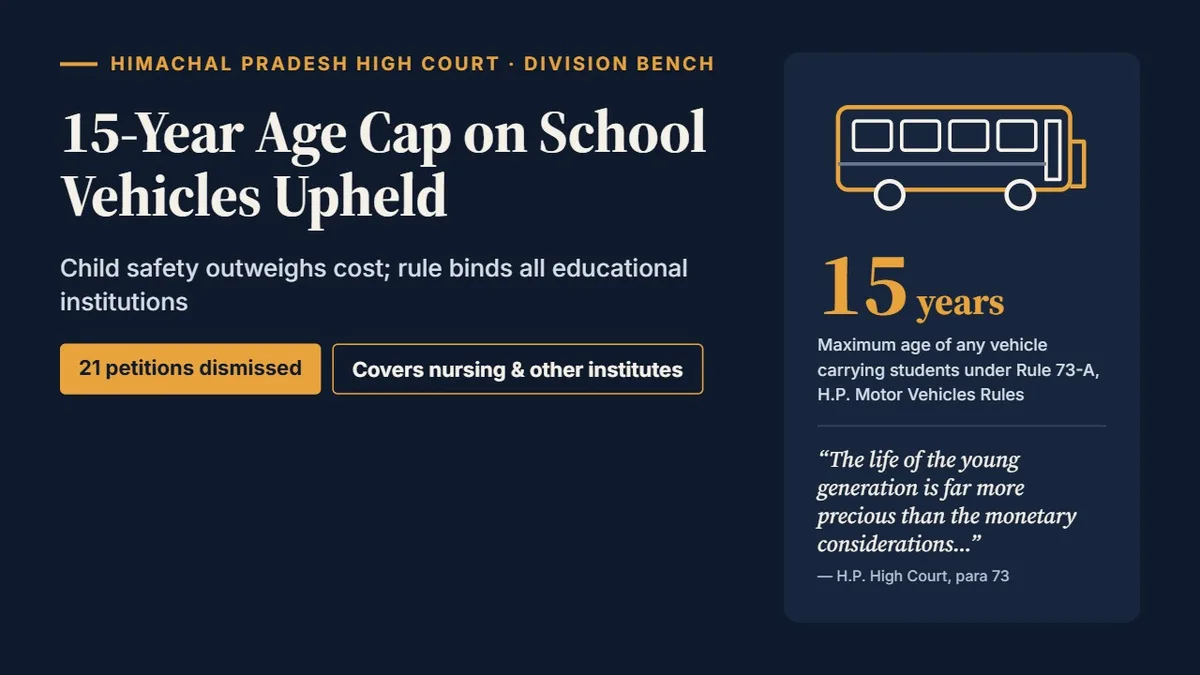
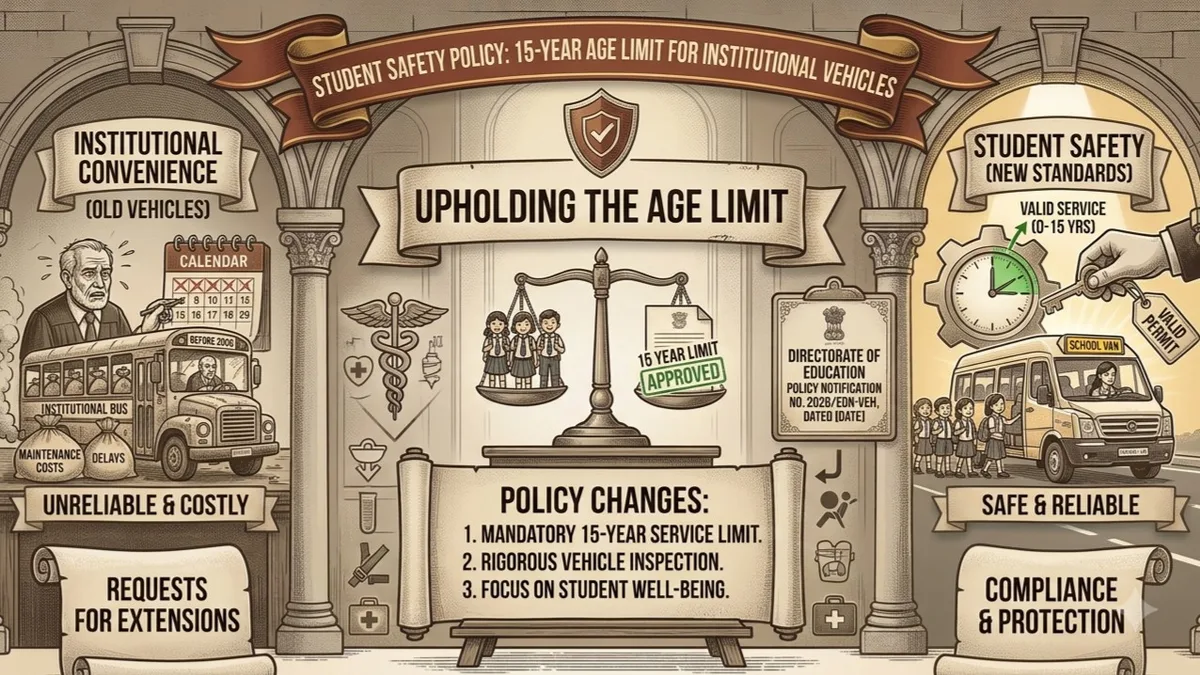
- A group of schools and educational institutions challenged Clause (xi) of Rule 73-A(1)(A) of the Himachal Pradesh Motor Vehicles Rules, 1999. The provision, introduced through a 2018 amendment, prohibits the use of vehicles more than 15 years old for transporting students.
- The petitioners argued that the restriction was arbitrary because a vehicle's age does not necessarily determine its roadworthiness. They also contended that the State Government lacked legislative competence to impose such a restriction, particularly because Section 59 of the Motor Vehicles Act, 1988 empowers the Central Government to prescribe the life of motor vehicles. The institutions further raised concerns about the financial burden of replacing vehicles that remained mechanically fit.
Key Issues and Court's Reasoning
1. Whether the State Government had the power to impose the 15-year restriction.
- The Court distinguished between Section 59 and the impugned Rule. Section 59 empowers the Central Government to prescribe the overall life of a motor vehicle, after which it cannot be treated as complying with the Act. In contrast, Rule 73-A does not declare a vehicle unusable after 15 years. It only restricts its use for transporting students. The vehicle may still be used for other lawful purposes, subject to the applicable statutory requirements.
- The Court therefore held that the State had not encroached upon the Central Government's powers under Section 59. It also upheld the State's rule-making authority under Section 96 of the Motor Vehicles Act, which permits the State to prescribe conditions governing transport vehicles and permits.
2. Whether the 15-year age limit was arbitrary.
- The Court rejected the argument that roadworthiness alone should determine whether a vehicle can transport students. It observed that older vehicles may be more susceptible to structural fatigue, material degradation, outdated safety technology and sudden mechanical failures, even where periodic fitness inspections are conducted.
- The restriction was treated as a preventive safety measure, particularly given Himachal Pradesh's geographical conditions and the heightened responsibility involved in transporting students.
3. Whether the restriction applied only to conventional schools.
- Certain petitioners, including nursing and other educational institutions, argued that the word "School" in the Rule did not cover them. The Court adopted a harmonious interpretation of Rule 73-A and held that its reference to schools must include all educational institutions covered by its general transport-safety conditions, including nursing, pharmacy, engineering and medical institutions.
Decision
- The Himachal Pradesh High Court dismissed all the connected writ petitions. It upheld the validity of Rule 73-A and its 15-year vehicle-age restriction, holding that the provision was neither arbitrary nor beyond the State Government's rule-making powers.
- The Court also clarified that the restriction applies to all educational institutions covered by the general conditions under Rule 73-A(1)(A), and not merely institutions imparting education up to Classes 10 or 12. Interim orders were vacated.
Legal Principle and Significance
- The judgment clarifies the distinction between the Central Government's power to prescribe the overall life of motor vehicles under Section 59 of the Motor Vehicles Act and the State Government's power to impose additional, purpose-specific conditions on vehicles operating under transport permits.
- It also establishes that roadworthiness is not necessarily the sole criterion for determining the permissible age of vehicles used to transport students. The State can impose preventive restrictions based on public safety, provided they fall within its statutory rule-making authority.
- The judgment is particularly relevant to administrative law because it examines delegated legislation, legislative competence, interpretation of statutory rules, and the balance between regulatory objectives and the economic interests of regulated institutions.
Full Judgement / Attachment
Full Judgement
Frequently asked questions about Himachal Pradesh High Court
- Where does the Himachal Pradesh High Court sit and which areas does it cover?
- The Himachal Pradesh High Court sits in Shimla. It has jurisdiction over the State of Himachal Pradesh. It became a full High Court for the State of Himachal Pradesh in 1971.
- Where can I check HP High Court case status and orders?
- The official website, hphighcourt.nic.in, publishes cause lists, case status and judgements of the High Court at Shimla. Orders are also available on the eCourts High Court Services portal (hcservices.ecourts.gov.in) and the eCourts Judgments portal (judgments.ecourts.gov.in).
- Does the HP High Court hear civil suits directly?
- Yes. Unusually for a newer High Court, it has original civil jurisdiction over high-value suits, so such suits are filed directly before it. It also hears writs on service, forest and land matters, and tax appeals arising from the ITAT Chandigarh Bench, which covers Himachal Pradesh.
- How is a single-judge order of the HP High Court appealed?
- Certain single-judge orders can be challenged before a Division Bench by a Letters Patent Appeal. In commercial disputes, the Commercial Courts Act route applies instead. Final judgements can be taken to the Supreme Court by a Special Leave Petition under Article 136, ordinarily within 90 days.
- How can White Collar Professional help with a HP High Court matter?
- Post your requirement on White Collar Professional to receive proposals from verified Advocates, Chartered Accountants and Company Secretaries, compare them, and pay securely through the platform. This page also tracks the latest HP High Court judgements and legal updates as they are reported.