Para Teacher Granted Actual Regularisation from the Retrospective Due Date
Court / Authority
Himachal Pradesh High Court
Update / Judgement Date
25 Nov 2026
Date of Publication
28 Nov 2026
Case No.
CWP No. 15224 of 2026
Source
WCP News Bulletin
Author
Dipanshi Bansal — WCP Legal Desk
Reading Time
4 min read
View Count
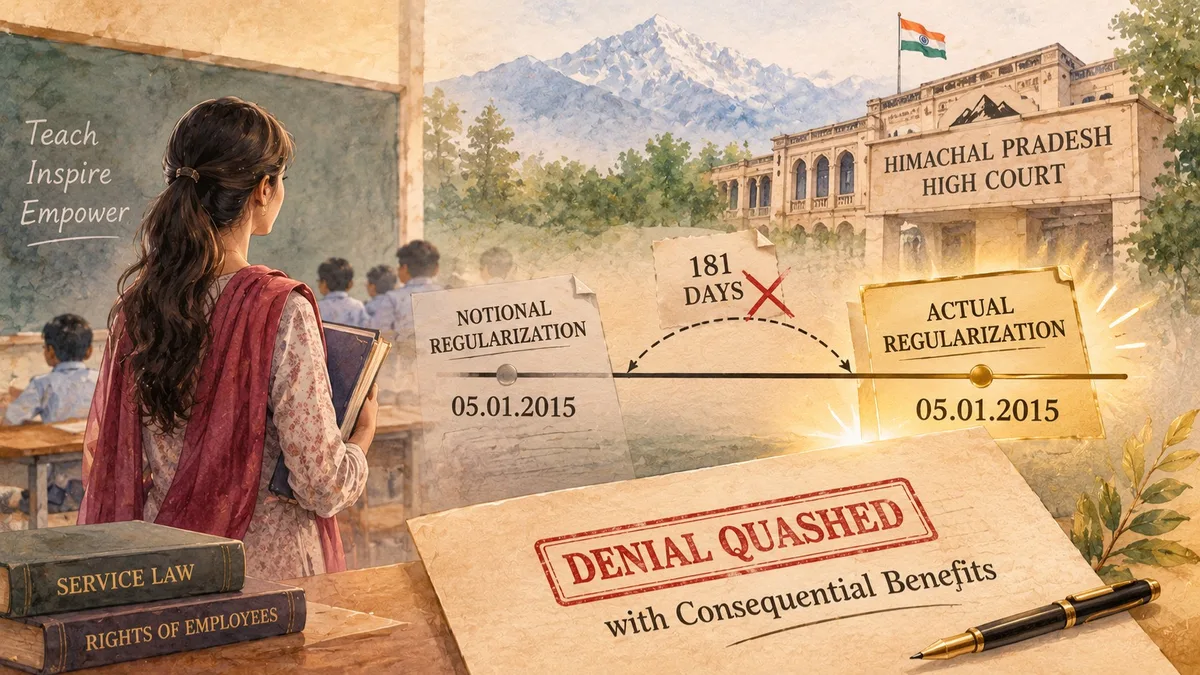
The Court allowed the petition and held that the petitioner, whose services had already been regularised notionally from 5 January 2015, was entitled to actual regularisation from the same date. The State could not deny her the benefit granted to similarly situated para teachers by relying on a 181-day break that had already been accounted for when fixing her notional date.
Key Proposition: Where the State has already fixed a retrospective notional date of regularisation and has extended actual regularisation benefits to similarly situated employees, it cannot deny parity to an employee on a ground already accounted for in fixing that date.
- Constitution of India – Articles 14 and 16 – Service regularisation – Whether a similarly situated para teacher could be denied actual benefits from the notional date? – No.
- Para Teacher Policy – Ten years’ continuous service – Whether a 181-day break justified withholding actual regularisation after the State had counted that period in fixing the notional date? – No.
Background / Synopsis :
- The petitioner was appointed as Trained Graduate Teacher (Medical) under the State’s Para Teacher Policy on 24 February 2004.
- The State had decided to regularise para teachers who completed ten years of service as on 6 August 2013. After litigation before the Supreme Court concluded on 17 April 2020, the State issued an order on 22/24 September 2020 regularising left-out teachers notionally from their due dates and actually from the date of the order.
- The petitioner’s name appeared at serial no. 22 and her notional regularisation date was fixed as 5 January 2015.
- In Arun Kumar v. State of H.P., the High Court had directed actual regularisation from the retrospective due date with consequential benefits; the State implemented that decision and extended similar benefits to other similarly placed teachers.
- The State rejected the petitioner’s request by order dated 1 August 2025, citing a 181-day break in service. The petitioner challenged that decision.
Issues For Consideration :
- Whether the petitioner was entitled to actual regularisation from 5 January 2015, the date already assigned to her on a notional basis.
- Whether the State could distinguish her case on the ground of a 181-day break in service.
Submissions Of Parties :
Parties’ submissions:
- Petitioner: She was similarly situated to para teachers who had received actual regularisation from their retrospective dates under Arun Kumar and connected decisions. The State had already counted the 181-day period when fixing her notional date.
- State: No reply on merits was filed despite repeated opportunities. The impugned rejection relied on a 181-day break in the petitioner’s service.
Court's Observations & Analysis :
Re: Parity with similarly situated para teachers
- The petitioner’s notional regularisation date of 5 January 2015 had been assigned by the State itself. She did not seek alteration of that date, but actual regularisation and consequential benefits from it.
- The State had implemented Arun Kumar and extended the same benefit to other employees whose names appeared in the same regularisation order.
- The 181-day extraordinary-leave period had already been counted when the State fixed the petitioner’s notional regularisation date; it could not be used again to deny actual benefits.
- Held: The petitioner was entitled to actual regularisation from 5 January 2015.
Decision & Directions :
- The writ petition was allowed and the rejection order dated 1 August 2025 was quashed.
- The State was directed to treat the petitioner as actually regularised with effect from 5 January 2015.
- All consequential benefits were to be calculated and released within six weeks.
- Pending miscellaneous applications, if any, were disposed of.
Legal Provisions Discussed & Precedents Cited :
- Constitution of India – Articles 14 and 16: equality and equal opportunity in public employment; applied to parity among similarly situated employees.
- State Para Teacher Policy: ten-year service criterion for regularisation, as described in the judgment.
- Arun Kumar v. State of H.P., CWP No. 1893 of 2021, decided 27 April 2023 – Relied on and applied.
- Yashwant Singh & Ors. v. State of H.P. & Ors., CWP No. 342 of 2021 and connected matters, decided 31 August 2022 – Referred to in the precedent applied in Arun Kumar.
Case Details :
- Case / Party Name: Kamlesh Kumari v. State of H.P. and another
- Case Number(s): CWP No. 15224 of 2026
- Coram / Judges: Jyotsna Rewal Dua, J. – Single Judge
- Counsel Appearances: Devender K. Sharma for petitioner; Seema Sharma, Deputy Advocate General, for respondents.
Disclaimer: This summary is an editorial aid and does not form part of the judgment. Refer to the original judgment before citing.
Full Judgement / Attachment
Full Judgement
Frequently asked questions about Himachal Pradesh High Court
- Where does the Himachal Pradesh High Court sit and which areas does it cover?
- The Himachal Pradesh High Court sits in Shimla. It has jurisdiction over the State of Himachal Pradesh. It became a full High Court for the State of Himachal Pradesh in 1971.
- Where can I check HP High Court case status and orders?
- The official website, hphighcourt.nic.in, publishes cause lists, case status and judgements of the High Court at Shimla. Orders are also available on the eCourts High Court Services portal (hcservices.ecourts.gov.in) and the eCourts Judgments portal (judgments.ecourts.gov.in).
- Does the HP High Court hear civil suits directly?
- Yes. Unusually for a newer High Court, it has original civil jurisdiction over high-value suits, so such suits are filed directly before it. It also hears writs on service, forest and land matters, and tax appeals arising from the ITAT Chandigarh Bench, which covers Himachal Pradesh.
- How is a single-judge order of the HP High Court appealed?
- Certain single-judge orders can be challenged before a Division Bench by a Letters Patent Appeal. In commercial disputes, the Commercial Courts Act route applies instead. Final judgements can be taken to the Supreme Court by a Special Leave Petition under Article 136, ordinarily within 90 days.
- How can White Collar Professional help with a HP High Court matter?
- Post your requirement on White Collar Professional to receive proposals from verified Advocates, Chartered Accountants and Company Secretaries, compare them, and pay securely through the platform. This page also tracks the latest HP High Court judgements and legal updates as they are reported.