No Article 19(1)(c) Right in Government-Created Police Associations: Kerala High Court Upholds Abolition of Kerala Police Officers' Association, Reverses Single Judge
Court / Authority
Kerala High Court
Update / Judgement Date
12 Nov 2026
Date of Publication
13 Nov 2026
Source
WCP News Bulletin
Author
Arshee Saifi — WCP Legal Desk
Reading Time
7 min read
View Count
2
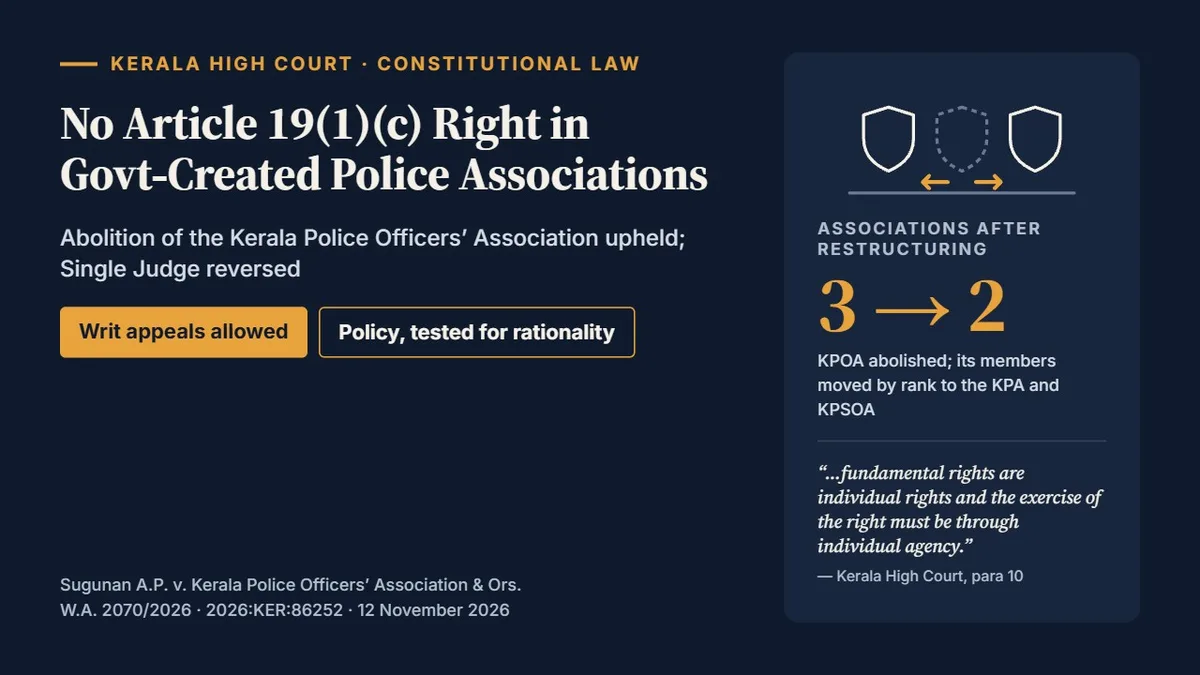
Key Proposition: Where police associations are created by the State Government itself and membership in them is automatic by rank, their members have no right under Article 19(1)(c), read with Articles 19(4) and 33, to the formation or continuation of those associations; their restructuring by the Government is a policy decision under Article 162 that a court may interfere with only if it is irrational in light of the associations' objects.
A. Background / Synopsis :
- Under a 1979 Government Order, three associations were formed: KPA (Civil Police Officers and Senior Civil Police Officers), KPOA (Grade ASIs, ASIs, Grade SIs, SIs and Inspectors) and KPSOA (DySPs and Non-IPS SPs). (Para 2)
- G.O. dated 27.07.2026 abolished KPOA, moved Grade ASIs, ASIs and Grade SIs to the KPA, and SIs and Inspectors to the KPSOA; ad hoc committees were formed. (Paras 2–3)
- The State explained that the 1979 pattern predated the 2008 Grade Promotion Scheme, under which Grade ASIs and Grade SIs remain in the Constabulary Wing though they were in KPOA; KPSOA's membership rose from 451 to 3,769. (Para 3)
- By judgment dated 29.09.2026, a Single Judge allowed W.P.(C) Nos. 26155 and 26295 of 2026 and quashed the G.O.; four writ appeals followed and were heard on 05.11.2026. (Paras 1, 4)
B. Issues For Consideration :
- Whether the members of the police associations, or the associations themselves, have a right under Article 19(1)(c) that the restructuring infringes. (Paras 6–7, 10)
- Whether the bye-laws give members a right against restructuring by the Government. (Para 11)
- Whether the G.O. dated 27.07.2026 is otherwise open to interference under Article 226. (Para 12)
C. Submissions Of Parties :
- Writ petitioners (KPOA and its members; KPA):
The Government had no power to abolish or amalgamate a recognised association without revoking the 1979 order or hearing it; the action was hasty and mala fide. (Para 2)
The bye-law procedure for amendment was not followed, and the restructuring infringed Article 19(1)(c). (Para 2)
- Appellants (State and members of the restructured associations):
The associations were not formed by members in exercise of Article 19(1)(c), so no fundamental right was infringed. (Para 6)
Rule 8 of the 1966 Rules did not apply to associations of the kind created by the 1979 order. (Para 6)
The restructuring is a considered policy decision to group personnel with common service conditions and is a reasonable classification. (Para 3)
Court's Observations & Analysis :
- Re: Issue (i): Scope of Article 19(1)(c) for police officers
Article 19(1)(c) includes the right to continue an association with its agreed composition (Damyanti Naranga), but does not apply where the association is created by statute and not by voluntary act (Daman Singh; Zoroastrian Co-operative Housing Society). (Para 7)
Article 33 lets Parliament restrict or abrogate Part III rights for police forces, and the 1966 Act does so; such restrictions cannot be challenged as violating Part III (Ous Kutilingal Achudan Nair; Delhi Police Non-Gazetted Karmachari Sangh; Prithi Pal Singh Bedi). (Paras 8–9)
The associations here were formed by the Government on a categorisation by rank; members had no role in forming them and membership shifts automatically with promotion, so no individual agency was exercised and no Article 19(1)(c) right is infringed. (Para 10)
- Re: Issue (ii): Bye-laws
As the authority that permits police associations, the Government may itself form them and frame bye-laws; these only regulate functioning and the election of office-bearers. (Para 11)
The limited right to amend bye-laws, subject to Government approval, confers no right, fundamental or otherwise, to formation or continuation of the association. (Para 11)
- Re: Issue (iii): Validity of the G.O.
The 1979 order rests on executive power under Article 162 and continues under Section 109 of the Kerala Police Act, 2011; restructuring is policy, reviewable only for rationality against the associations' objects. (Para 12)
Grouping the Constabulary Wing under KPA and directly recruited SIs and above under KPSOA serves those objects more efficiently and is not at variance with them. (Para 12)
Notable Observations: “…fundamental rights are individual rights and the exercise of the right must be through individual agency.” (Para 10); “The content of his right under Article 19(1)(c) of the Constitution is therefore significantly reduced when compared to a similar right available to other citizens.” (Para 9)
D. Decision & Directions :
1. Writ appeals allowed; the Single Judge's judgment dated 29.09.2026 set aside. (Para 12)
2. W.P.(C) Nos. 26155 and 26295 of 2026 dismissed, and the G.O. dated 27.07.2026 upheld. (Para 12)
3. No costs. (Para 12)
Separate Opinions: None; judgment by Dr. A.K. Jayasankaran Nambiar, J. for the Bench.
The Division Bench does not separately examine the Single Judge's finding under Rule 8 of the 1966 Rules beyond recording the appellants' argument on it. (Paras 4, 6)
E. Legal Provisions Discussed & Precedents Cited :
- Constitution of India – Articles 19(1)(c), 19(4), 33, 162 and 226.
- Police Forces (Restriction of Rights) Act, 1966 and Police Forces (Restriction of Rights) Rules, 1966 (Rule 8).
- Kerala Police Act, 2011 – Section 109.
- Smt. Damyanti Naranga v. Union of India, (1971) 1 SCC 678 – Explained; applies to voluntary associations.
- O.K. Ghosh v. E.X. Joseph, AIR 1963 SC 812 – Relied on by the Single Judge.
- Daman Singh v. State of Punjab, (1985) 2 SCC 670 – Followed.
- Zoroastrian Co-operative Housing Society Ltd. v. District Registrar, (2005) 5 SCC 632 – Followed.
- Ous Kutilingal Achudan Nair v. Union of India, (1976) 2 SCC 780 – Followed.
- Delhi Police Non-Gazetted Karmachari Sangh v. Union of India, (1987) 1 SCC 115 – Followed.
- Lt. Col. Prithi Pal Singh Bedi v. Union of India, (1982) 3 SCC 140 – Followed.
F. Case Details :
- Case / Party Name: Sugunan A.P. (W.A. 2070) and G.R. Ajith (W.A. 2072), members of the ad hoc committees of the restructured associations, and the State of Kerala (W.A. 2100 and 2103) v. Kerala Police Officers' Association, Kerala Police Association and their members
- Case Number(s): W.A. Nos. 2070, 2072, 2100 and 2103 of 2026, arising from W.P.(C) Nos. 26155 and 26295 of 2026; Neutral Citation 2026:KER:86252
- Coram / Judges: Hon'ble Dr. Justice A.K. Jayasankaran Nambiar and Hon'ble Mrs. Justice Preeta A.K. – Division Bench
- Counsel Appearances: For the appellants in W.A. 2070 and 2072: Mr. George Poonthottam, Senior Advocate, with Smt. Kavya Varma M.M. For the State: Mr. P.A. Mohammed Shah, Additional Advocate General, with Smt. Laya Mary Joseph, Government Pleader. For the KPOA: Mr. P.C. Sasidharan. For the KPA: Mr. Babu S. Nair.
Disclaimer: This summary is an editorial aid and does not form part of the judgment. Refer to the original judgment before citing.
Full Judgement / Attachment
Full Judgement
Frequently asked questions about Kerala High Court
- Where does the Kerala High Court sit and which areas does it cover?
- The Kerala High Court sits at Ernakulam, Kochi. It has jurisdiction over the State of Kerala and the Union Territory of Lakshadweep. It was established on 1 November 1956, when the State of Kerala was formed.
- How do I check Kerala High Court case status and judgements?
- The official website, highcourt.kerala.gov.in, provides case status, cause lists, e-filing and judgements. The court has moved most filing and records to digital form. Orders are also on the eCourts High Court Services portal (hcservices.ecourts.gov.in).
- What kinds of cases does the Kerala High Court hear?
- It hears writs, civil and criminal appeals from Kerala and Lakshadweep, and income-tax appeals arising from the ITAT Cochin Bench on substantial questions of law.
- What is a Writ Appeal in the Kerala High Court?
- Under Section 5 of the Kerala High Court Act, 1958, a judgement of a single judge in certain matters, including writ petitions, can be appealed to a Division Bench. A final judgement can be challenged by a Special Leave Petition under Article 136, ordinarily within 90 days.
- How can White Collar Professional help with a Kerala High Court matter?
- Post your requirement on White Collar Professional to receive proposals from verified Advocates, Chartered Accountants and Company Secretaries, compare them, and pay securely through the platform. This page also tracks the latest Kerala High Court judgements and legal updates as they are reported.