Supreme Court Discharges Accused Where Alleged Offences Lacked Essential Ingredients
Court / Authority
Supreme Court of India
Update / Judgement Date
30 Oct 2026
Date of Publication
31 Oct 2026
Source
WCP News Bulletin
Author
Dipanshi Bansal — WCP Legal Desk
Reading Time
7 min read
View Count
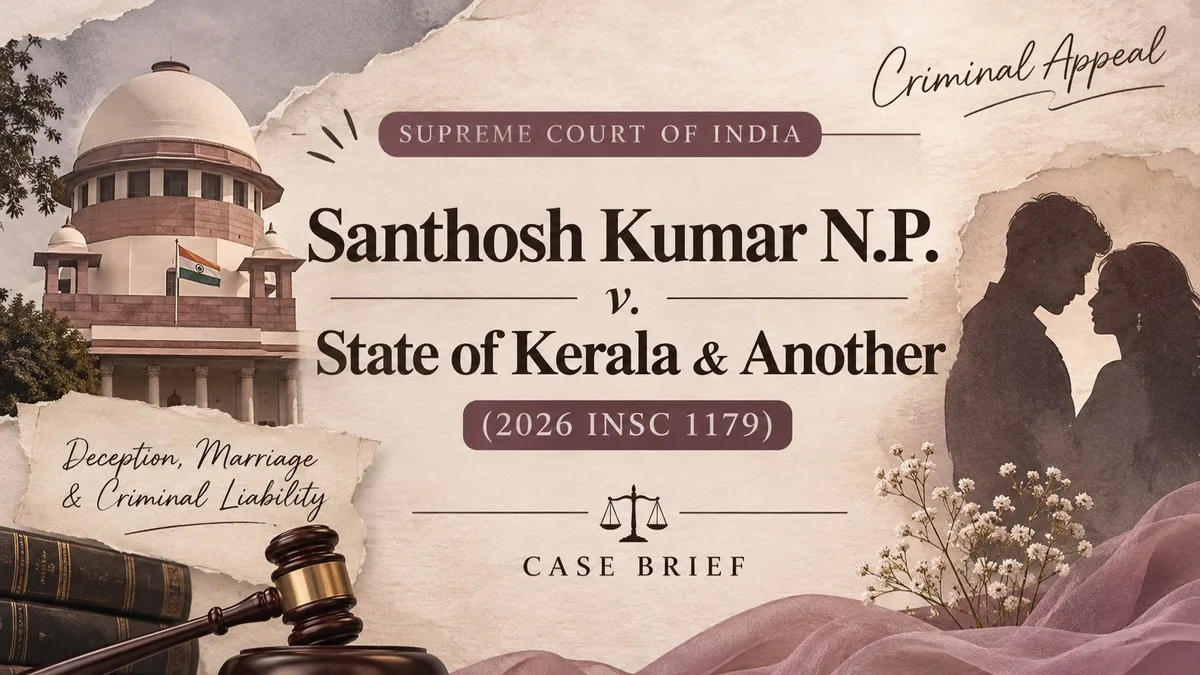
The Supreme Court allowed Santhosh Kumar N.P.’s criminal appeals, set aside the orders of the Kerala High Court and the trial court, and discharged him from the offences alleged in FIR No. 503/2011. On the facts recorded in the judgment, the Court found that the essential ingredients of the alleged offences under Sections 376, 420, 493, 494 and 495 of the Indian Penal Code, 1860, were not made out and that continuing the prosecution was not justified.
Key Highlights :
- The complaint arose from a relationship between the appellant and respondent No. 2, who alleged that he had represented himself as unmarried and that a temple marriage took place in 1996.
- The parties cohabited from 1996 to 2003. The appellant’s earlier marriage and two children became known during the period of cohabitation, a fact central to the Court’s assessment.
- FIR No. 503/2011 was registered for alleged offences under IPC Sections 376, 420, 493, 494 and 495 after a second private complaint was referred to the police under Section 156(3) CrPC.
- The trial court rejected the discharge application and the Kerala High Court dismissed the revision and connected petition by a common order dated 21 May 2025.
- The Supreme Court held that the allegations, even taken at face value, did not establish the necessary elements of the offences charged.
- The Court allowed the discharge application, set aside the orders below and discharged the appellant; the appeals were allowed.
Background :
- Respondent No. 2 had previously been married and divorced before becoming acquainted with the appellant. She alleged that he described himself as a bachelor and offered to marry her.
- She initiated proceedings under the Protection of Women from Domestic Violence Act, 2005, seeking accommodation and financial relief. Those proceedings were dismissed in 2009, and the appeal was also dismissed.
- An earlier private complaint alleging offences under the IPC was dismissed for non-prosecution in 2011. A second complaint containing similar allegations was referred to the police, resulting in FIR No. 503/2011.
- The appellant sought discharge and challenged territorial jurisdiction and the refusal of further investigation. The trial court rejected those applications, and the High Court upheld that position in 2025.
What Has Changed :
- Issue 1 – Whether the material justified continuation of the prosecution. Finding: Applying the discharge standard under Section 227 CrPC and the principles in Union of India v. Prafulla Kumar Samal, the Court held that the allegations and record did not disclose sufficient grounds to proceed. The judge must assess the broad probabilities and total effect of the material, rather than act as a mere conduit for the prosecution (paras 24–27 and 61–63). Outcome: The appellant was entitled to discharge.
- Issue 2 – Alleged offences under Sections 376 and 376(2)(n) IPC. Finding: The Court considered the relationship as a whole, including the parties’ cohabitation and the respondent’s knowledge of the appellant’s earlier marriage during that period. I held that the repeated acts described in the record could not, on these facts, be separated from the continuing consensual relationship to establish the charged offence. Outcome: The ingredients of the alleged rape offence were not made out (paras 37–48).
- Issue 3 – Alleged cheating under Section 420 IPC. Finding: The record did not allege that the alleged deception induced delivery of property or the making, alteration or destruction of a valuable security. Outcome: The essential property-related ingredient of Section 420 was absent (paras 49–51).
- Issue 4 – Alleged offences under Sections 493, 494 and 495 IPC. Finding: The Court found the material insufficient to establish deceitful inducement of a belief in a lawful marriage, a legally established second marriage during the subsistence of the first, or deliberate concealment of the first marriage in the circumstances of this case. Outcome: The ingredients of these offences were not established (paras 52–56).
- Final disposition. The Court held that the prosecution should not continue, allowed the discharge application, set aside the trial court and High Court orders, discharged the appellant from the alleged offences and allowed the appeals (paras 61–65).
Who Is Affected :
- The appellant in FIR No. 503/2011, who has been discharged from the offences alleged in that case.
- Courts considering discharge applications under Section 227 CrPC, which must assess whether the material gives rise to sufficient ground or grave suspicion to proceed.
- Parties and counsel in cases involving allegations of deception, consent and purported marriage may find the Court’s fact-specific analysis relevant; the judgment does not create a blanket rule for all relationship-related complaints.
- The decision does not diminish the need to pursue genuine allegations of sexual violence where the facts and evidence support the statutory ingredients.
Compliance Action Points :
- No direct compliance action. The judgment resolves the criminal appeals and discharges the appellant.
- No filing deadline, fee, penalty or regulatory reporting requirement is imposed by the Supreme Court.
Analysis & Impact :
- For CA / CS / Tax & Legal Professionals: Limited relevance to routine finance and corporate compliance work. For legal practitioners, the principal procedural point is the duty to test each charged offence against its statutory ingredients at the discharge stage, using the record as a whole and the Section 227 standard.
- For Businesses & Investors: Limited relevance.
- For News Readers: The Supreme Court concluded that the material in this particular case did not justify a criminal trial and ordered discharge; the ruling turns on the facts and statutory ingredients considered by the Court.
- Points to Watch: The judgment interprets provisions of the IPC and CrPC in the context of this prosecution. It should not be read as deciding that every allegation arising from a relationship is consensual or legally insufficient.
References :
- Code of Criminal Procedure, 1973 – Section 227: empowers the Sessions Judge to discharge an accused where there is not sufficient ground for proceeding.
- Code of Criminal Procedure, 1973 – Section 156(3): provides for a Magistrate to direct police investigation.
- Indian Penal Code, 1860 – Sections 376 and 376(2)(n): offences and punishment provisions relating to rape and repeated commission alleged in the case.
- Indian Penal Code, 1860 – Section 420: cheating and dishonestly inducing delivery of property or dealing with valuable security.
- Indian Penal Code, 1860 – Sections 493, 494 and 495: deceitful belief of lawful marriage, marrying again during the lifetime of a spouse, and concealment of the former marriage.
- Protection of Women from Domestic Violence Act, 2005 – Section 12: application for reliefs under the Act.
- Union of India v. Prafulla Kumar Samal, (1979) 3 SCC 4: principles governing consideration of discharge and the prima facie threshold under Section 227 CrPC.
- Sajjan Kumar v. CBI: relied upon with Prafulla Kumar Samal in applying the discharge standard; full citation not stated in the supplied judgment extract.
Source & Attribution :
- Santhosh Kumar N.P. v. State–Station House Officer, Kadirur Police, Tellicherry, Kannur District & Another, 2026 INSC
- 1179, Criminal Appeal arising out of SLP (Crl.) Nos. 10173–10174 of 2025, judgment dated 30 October 2026 (supplied
- PDF).
- No other source used.
Disclaimer: This summary is an editorial aid prepared from publicly available information. It is not legal, tax or investment advice. Refer to the original notification, circular, order or report before acting.
Full Judgement / Attachment
Full Judgement
Frequently asked questions about Supreme Court of India
- What is the role of the Supreme Court of India?
- The Supreme Court, established on 28 January 1950, is the highest court of appeal in India. Under Article 141 of the Constitution, the law it declares is binding on all courts in India. It also hears writ petitions for enforcement of fundamental rights under Article 32.
- How can I check Supreme Court case status or download a judgement?
- Case status, cause lists, daily orders and judgements are published on the official website, sci.gov.in. Reported judgements are also available free through the Digital SCR (Supreme Court Reports) on the same website.
- What is a Special Leave Petition (SLP) and what is the time limit?
- An SLP under Article 136 asks the Supreme Court for permission to appeal against a judgement or order of any court or tribunal in India. Against a High Court judgement it is ordinarily filed within 90 days. Leave is discretionary, and most SLPs are decided at the admission stage.
- Who can file a case in the Supreme Court?
- Only an Advocate-on-Record, a lawyer who has passed the Supreme Court's AOR examination, can file pleadings in the Supreme Court. A party may appear in person with the Court's permission, but most litigants engage an Advocate-on-Record along with arguing counsel.
- How can White Collar Professional help with a Supreme Court matter?
- Post your requirement on White Collar Professional to receive proposals from verified Advocates, Chartered Accountants and Company Secretaries, compare them, and pay securely through the platform. This page also tracks the latest Supreme Court judgements and legal updates as they are reported.