Supreme Court Holds Telecom Spectrum Beyond Insolvency Process; Sets Aside NCLAT’s Treatment Of Spectrum As Corporate Asset
Court / Authority
Supreme Court of India
Update / Judgement Date
15 Jul 2026
Source
WCP News Bulletin
Author
Manas Yadav — WCP Legal Desk
Reading Time
2 min read
View Count
Legal Background
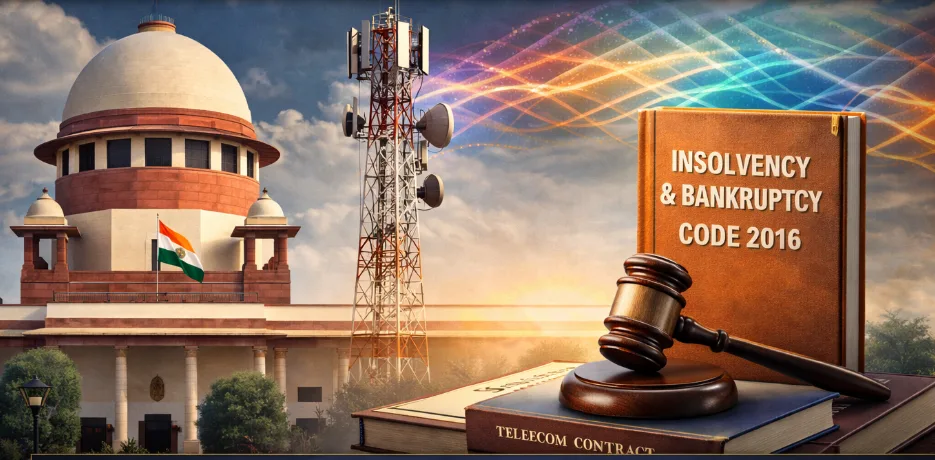
The Supreme Court of India has delivered a landmark ruling clarifying that telecom spectrum, though reflected as an intangible asset in the books of telecom companies, cannot be subjected to insolvency or liquidation proceedings under the Insolvency and Bankruptcy Code, 2016 (IBC). The judgment arose from a batch of appeals led by State Bank of India against the Union of India concerning the insolvency of Aircel Group entities and the status of spectrum usage rights during Corporate Insolvency Resolution Process (CIRP). Aircel entities had entered CIRP after defaulting on substantial licence fees and spectrum usage charges payable to the Department of Telecommunications. Lenders sought to treat spectrum usage rights as assets capable of resolution or transfer under IBC. The NCLAT had held that while spectrum remained a natural resource held in public trust by the Government, the right to use it constituted an intangible asset of the corporate debtor and that government dues were “operational debts”.
Court’s Analysis
The Supreme Court undertook an extensive examination of constitutional principles governing natural resources, telecom statutes, licence conditions, accounting standards and the structure of IBC. It reaffirmed that spectrum is a finite natural resource vested in the Union as trustee for the public and that telecom licences merely confer a conditional and revocable right to use spectrum, not ownership. While acknowledging that spectrum rights may appear as intangible assets for accounting purposes, the Court emphasised that IBC only applies to assets over which a corporate debtor holds ownership rights. Statutory exclusions under Sections 18 and 36 of IBC expressly remove assets held under contractual arrangements involving mere right of use from the insolvency estate.
Crucially, the Court held that insolvency law cannot override the specialised telecom regulatory framework governing spectrum allocation, transfer and recovery of dues.
Full Judgement / Attachment
Full Judgement
Frequently asked questions about Supreme Court of India
- What is the role of the Supreme Court of India?
- The Supreme Court, established on 28 January 1950, is the highest court of appeal in India. Under Article 141 of the Constitution, the law it declares is binding on all courts in India. It also hears writ petitions for enforcement of fundamental rights under Article 32.
- How can I check Supreme Court case status or download a judgement?
- Case status, cause lists, daily orders and judgements are published on the official website, sci.gov.in. Reported judgements are also available free through the Digital SCR (Supreme Court Reports) on the same website.
- What is a Special Leave Petition (SLP) and what is the time limit?
- An SLP under Article 136 asks the Supreme Court for permission to appeal against a judgement or order of any court or tribunal in India. Against a High Court judgement it is ordinarily filed within 90 days. Leave is discretionary, and most SLPs are decided at the admission stage.
- Who can file a case in the Supreme Court?
- Only an Advocate-on-Record, a lawyer who has passed the Supreme Court's AOR examination, can file pleadings in the Supreme Court. A party may appear in person with the Court's permission, but most litigants engage an Advocate-on-Record along with arguing counsel.
- How can White Collar Professional help with a Supreme Court matter?
- Post your requirement on White Collar Professional to receive proposals from verified Advocates, Chartered Accountants and Company Secretaries, compare them, and pay securely through the platform. This page also tracks the latest Supreme Court judgements and legal updates as they are reported.