← back
InformativeSupreme Court of India
Supreme Court: Section 4 Limitation Act Cannot Save IBC Appeals Filed Beyond 30 Days
Court / Authority
Supreme Court of India
Update / Judgement Date
16 Nov 2026
Date of Publication
27 Nov 2026
Source
WCP News Bulletin
Author
Dipanshi Bansal — WCP Legal Desk
Reading Time
3 min read
View Count
Appeal Against OrderInsolvency & Bankruptcy Code
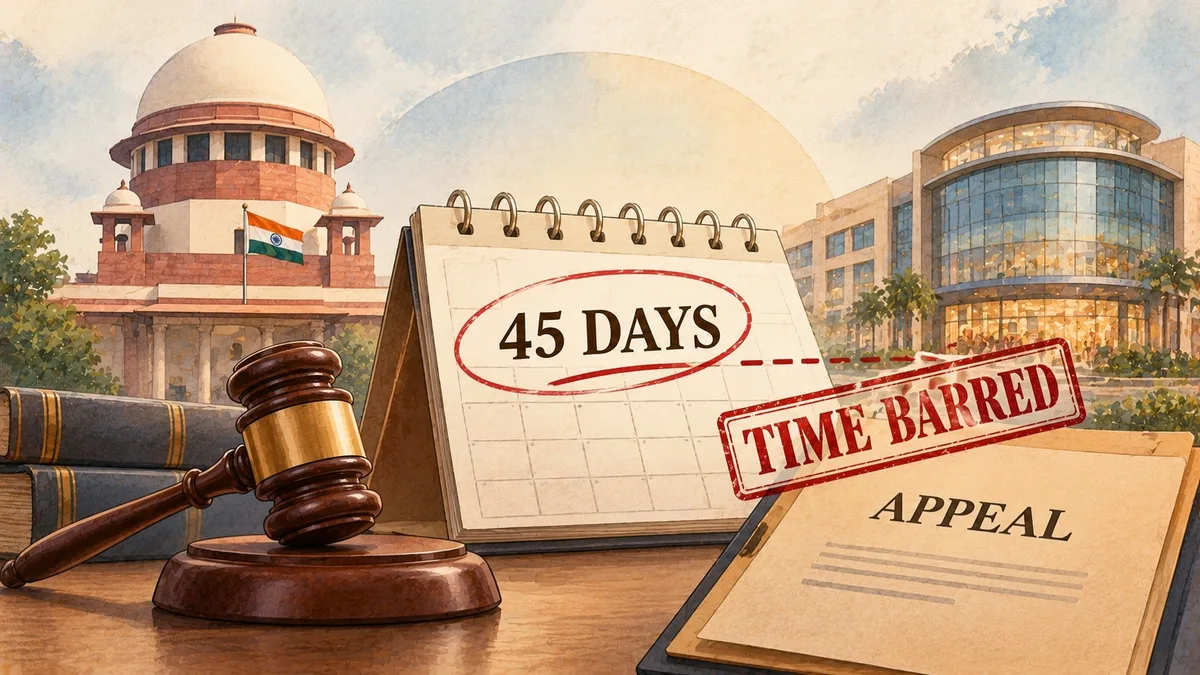
The Supreme Court on 16 November 2026 set aside an NCLAT Chennai order that had refused to recall its condonation of a delayed appeal against a resolution plan. Sanjay Kumar and Sanjeev Sachdeva, JJ held that Section 4 of the Limitation Act, 1963 could not stretch the appeal period under section 61(2) of the Insolvency and Bankruptcy Code, 2016 (IBC), and dismissed the buyers' NCLAT appeals as time-barred.
Key Highlights :
- The NCLT Hyderabad approved Lulu International Shopping Malls Private Limited's plan for Manjeera Retail Holdings Private Limited on 26 March 2025. Lulu says it has invested ₹271.52 crore.
- Section 61(2) allows 30 days plus up to 15 more. These ended on 25 April 2025 and 10 May 2025, but the buyers appealed on 11 May 2025, the 46th day.
- The NCLAT had condoned the delay on 10 October 2025 on the ground that 10 May 2025 was a second Saturday, and refused to recall that order on 10 February 2026.
- The Court held that Tata Steel Ltd v Raj Kumar Banerjee ((2025) 9 SCC 483), decided on 07 May 2025, bars Section 4 benefit beyond the prescribed 30 days. The NCLAT wrongly called that ruling later than its order (para 9).
- The appeals had also been e-filed on a Sunday, so they could have been e-filed on 10 May 2025 itself (para 12).
Background :
- The respondents say they agreed to buy commercial units in Manjeera Mall and complain that the resolution professional (RP) booked their payments as customer advances, not financial debt. The Court did not decide this.
- On 16 March 2026 the Court stayed the NCLAT proceedings.
What Has Changed :
- Issue 1, power to recall: The NCLAT has no review power but can recall its orders under inherent jurisdiction, Rule 11 of the NCLAT Rules, 2016. Finding: Refusing to use it was not justified (paras 10 to 12). Outcome: Recall applications allowed.
- Issue 2, Section 4 of the Limitation Act: Finding: Not available once the 30-day period has run, and no sufficient cause was shown for the extra day (paras 12 and 14). Outcome: The NCLAT's entertaining the appeals was illegal.
- Issue 3, finality of the condonation order: Finding: It was kept alive by the recall applications, and the Court can remedy it under section 62 of the IBC (para 13). Outcome: NCLAT orders of 10 February 2026 and 10 October 2025 set aside, Company Appeal (AT)(CH)(Ins) Nos. 388 and 389 of 2025 dismissed as time-barred, parties bear own costs (para 15).
References :
- IBC, sections 61(2) and 62; Limitation Act, 1963, section 4; NCLAT Rules, 2016, Rule 11.
- Tata Steel Ltd v Raj Kumar Banerjee ((2025) 9 SCC 483); Union Bank of India v Financial Creditors of Amtek Auto Ltd ((2024) 248 Comp Cas 126 (SC)); Greater Noida Industrial Development Authority v Prabhjit Singh Soni ((2024) 243 Comp Cas 452 (SC)); the 5-Judge NCLAT decision in Union Bank of India v Dinkar T Venkatasubramanian.
Source & Attribution :
- Primary source: Supreme Court of India judgment dated 16 November 2026 in Civil Appeal Nos. 3110-3111 of 2026, 2026 INSC 1224. Link: Not stated in source (document supplied as PDF).
- 3rd Party Credit: Not applicable.
Disclaimer: This summary is an editorial aid prepared from publicly available information. It is not legal, tax or investment advice. Refer to the original notification, circular, order or report before acting.
Full Judgement / Attachment
Full Judgement
Frequently asked questions about Supreme Court of India
- What is the role of the Supreme Court of India?
- The Supreme Court, established on 28 January 1950, is the highest court of appeal in India. Under Article 141 of the Constitution, the law it declares is binding on all courts in India. It also hears writ petitions for enforcement of fundamental rights under Article 32.
- How can I check Supreme Court case status or download a judgement?
- Case status, cause lists, daily orders and judgements are published on the official website, sci.gov.in. Reported judgements are also available free through the Digital SCR (Supreme Court Reports) on the same website.
- What is a Special Leave Petition (SLP) and what is the time limit?
- An SLP under Article 136 asks the Supreme Court for permission to appeal against a judgement or order of any court or tribunal in India. Against a High Court judgement it is ordinarily filed within 90 days. Leave is discretionary, and most SLPs are decided at the admission stage.
- Who can file a case in the Supreme Court?
- Only an Advocate-on-Record, a lawyer who has passed the Supreme Court's AOR examination, can file pleadings in the Supreme Court. A party may appear in person with the Court's permission, but most litigants engage an Advocate-on-Record along with arguing counsel.
- How can White Collar Professional help with a Supreme Court matter?
- Post your requirement on White Collar Professional to receive proposals from verified Advocates, Chartered Accountants and Company Secretaries, compare them, and pay securely through the platform. This page also tracks the latest Supreme Court judgements and legal updates as they are reported.