Supreme Court Upholds Non-Parties’ Right to Challenge Prejudicial Consent Decrees
Court / Authority
Supreme Court of India
Update / Judgement Date
30 Oct 2026
Date of Publication
31 Oct 2026
Source
WCP News Bulletin
Author
Dipanshi Bansal — WCP Legal Desk
Reading Time
7 min read
View Count
2
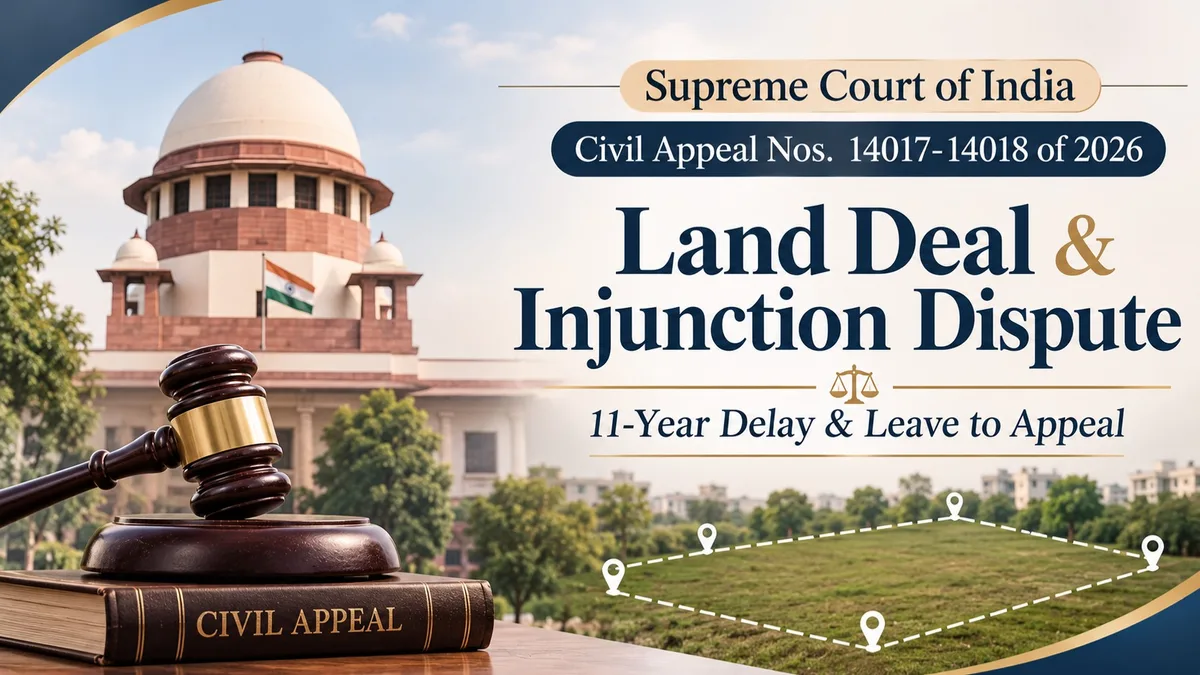
The Supreme Court dismissed Girishbhai Natwarlal Patel’s appeals and upheld the Gujarat High Court’s orders granting nine non-parties leave to appeal against a 2013 consent decree, condoning an approximately eleven-year delay and continuing a injunction over the disputed land. The Court held that the bar on appeals against consent decrees does not automatically prevent a genuine non-party, whose legal interests may be prejudiced, from seeking leave to appeal.
Key Highlights :
- The underlying consent decree was passed on 29 April 2013 in a suit for specific performance instituted in 2012.
- The nine applicants seeking leave to appeal were not parties to the original suit or to the compromise that resulted in the decree.
- The Gujarat High Court granted an ex parte ad interim injunction on 2 April 2024 and, after hearing the affected appellant, continued the protection by its judgment dated 14 August 2024.
- The Supreme Court held that Section 96(3) of the Code of Civil Procedure, 1908, read with Order XXIII Rules 3 and 3A, does not bar a non-party from seeking leave where an independent legal interest is shown to be prejudicially affected.
- The Court accepted, at the leave stage, that the applicants had asserted a legally cognisable interest in the land; it did not decide the ultimate title dispute or finally determine allegations of fraud and collusion.
- The High Court’s condonation of delay was upheld, with the applicants’ claimed discovery of the relevant revenue-record changes around August 2023 and subsequent steps taken by them considered relevant.
Background :
- The original suit for specific performance was filed in 2012 on the basis of an agreement to sell dated 11 September 1996 and ended in a consent decree dated 29 April 2013 in favour of Geetagram Cooperative Housing Society.
- The decree was reportedly not put into execution until 2020. A sale deed in favour of the present appellant was executed on 18 June 2022, with the society joining as a confirming party.
- The non-party applicants relied on an earlier registered sale deed dated 29 August 1975 in favour of their predecessor and related revenue entries to assert an independent interest in the property.
- They claimed to have learned of changes in revenue records and the assertion of rights over the land around August 2023, and relied on information obtained through the RTI process, including a response dated 21 March 2024.
What Has Changed :
- Issue 1 – Whether interim protection over the land was justified. Finding: The High Court could preserve the property while leave and impleadment applications were being considered, since waiting could have allowed alienation or creation of third-party rights. The appellant was later heard before the injunction was continued. Outcome: The injunction was not interfered with (paras 35–41).
- Issue 2 – Whether a non-party may seek leave to appeal against a consent decree. Finding: Section 96(3) CPC and Order XXIII Rules 3 and 3A protect the finality of compromises as between parties to them; they do not deem an independent non-party to have consented. A non-party must nevertheless show a legally cognisable interest and prima facie prejudice, and obtain leave from the appellate court. Outcome: The nine applicants were entitled to seek leave, and the High Court was justified in granting it (paras 42–62).
- Issue 3 – Whether the approximately eleven-year delay was properly condoned. Finding: The elapsed period could not be considered in isolation because the applicants were not parties to the original proceedings and relied on later knowledge of the relevant record changes and steps taken thereafter. Outcome: The High Court’s order condoning delay was upheld (paras 63–65).
- Final disposition. The Supreme Court dismissed the appeals. It clarified that its findings were confined to the interlocutory questions and did not decide the merits of the rival title claims or the allegations of fraud and collusion. The Gujarat High Court was requested to hear and dispose of the main appeal within three months from the Supreme Court judgment (paras 66–72).
Who Is Affected :
- Non-parties who claim an independent legal interest in property affected by a consent decree may seek leave to appeal, provided they establish prima facie prejudice.
- Parties to compromise decrees remain subject to the statutory restrictions on challenging a consent decree through an appeal.
- Appellate courts must assess the nature of the applicant’s interest and the prejudice alleged rather than treating non-party status as an automatic bar or an automatic entitlement.
- The judgment does not finally determine ownership of the disputed land or validate the allegations made by either side.
Compliance Action Points :
- No direct regulatory or filing compliance action arises from this judgment.
- The Gujarat High Court is requested to take up the main appeal and endeavour to dispose of it within three months from 30 October 2026.
- The judgment does not impose a monetary penalty or a payment deadline on the parties.
Analysis & Impact :
- For CA / CS / Tax & Legal Professionals: When advising a person who was not party to a compromise decree, establish the source of the person’s independent right, the precise prejudice caused by the decree, and the date and manner in which the person acquired knowledge. Non-party status alone is insufficient; the applicant must satisfy the appellate court’s leave standard.
- For Businesses & Property Owners: A consent decree may not conclude every dispute where a third party asserts an independent and legally cognisable interest in the property. Due diligence should examine prior title documents, revenue entries, powers of attorney, execution proceedings and subsequent conveyances.
- For News Readers: The ruling distinguishes the finality of a compromise between its parties from the right of an affected outsider to ask an appellate court to examine the decree.
- Points to Watch: The substantive appeal before the Gujarat High Court remains pending. The Supreme Court expressly left title, fraud and collusion issues open for adjudication.
References :
- Code of Civil Procedure, 1908 – Section 96(3): bars an appeal from a decree passed with the consent of the parties.
- Code of Civil Procedure, 1908 – Order XXIII Rule 3: governs recording of lawful compromises and adjustments of suits.
- Code of Civil Procedure, 1908 – Order XXIII Rule 3A: bars a separate suit to set aside a decree on the ground that the compromise was not lawful.
- Triloki Nath Singh v. Anirudh Singh (Dead) through LRs, (2020) 6 SCC 639: distinguished because the claimant there derived title through a party to the original proceedings.
- Pushpa Devi Bhagat v. Rajinder Singh, (2006) 5 SCC 566; Banwari Lal v. Chando Devi, 1992 SCC OnLine SC 541; R. Rajanna v. S.R. Venkataswamy, (2014) 15 SCC 471: considered in explaining the statutory effect of compromise decrees.
- V.N. Krishna Murthy v. Ravikumar, (2020) 9 SCC 501; State of Punjab v. Amar Singh, (1974) 2 SCC 70; Baldev Singh v. Surinder Mohan Sharma, (2003) 1 SCC 34: principles on leave to appeal and the meaning of a person aggrieved.
Source & Attribution :
- Girishbhai Natwarlal Patel v. Gautam Punjabhai Palkhiwala (Dead) by LRs & Ors., Civil Appeal Nos. 14017–14018 of 2026, 2026 INSC 1177, judgment dated 30 October 2026 (supplied PDF).
- No other source used.
Disclaimer: This summary is an editorial aid prepared from publicly available information. It is not legal, tax or investment advice. Refer to the original notification, circular, order or report before acting.
Full Judgement / Attachment
Full Judgement
Frequently asked questions about Supreme Court of India
- What is the role of the Supreme Court of India?
- The Supreme Court, established on 28 January 1950, is the highest court of appeal in India. Under Article 141 of the Constitution, the law it declares is binding on all courts in India. It also hears writ petitions for enforcement of fundamental rights under Article 32.
- How can I check Supreme Court case status or download a judgement?
- Case status, cause lists, daily orders and judgements are published on the official website, sci.gov.in. Reported judgements are also available free through the Digital SCR (Supreme Court Reports) on the same website.
- What is a Special Leave Petition (SLP) and what is the time limit?
- An SLP under Article 136 asks the Supreme Court for permission to appeal against a judgement or order of any court or tribunal in India. Against a High Court judgement it is ordinarily filed within 90 days. Leave is discretionary, and most SLPs are decided at the admission stage.
- Who can file a case in the Supreme Court?
- Only an Advocate-on-Record, a lawyer who has passed the Supreme Court's AOR examination, can file pleadings in the Supreme Court. A party may appear in person with the Court's permission, but most litigants engage an Advocate-on-Record along with arguing counsel.
- How can White Collar Professional help with a Supreme Court matter?
- Post your requirement on White Collar Professional to receive proposals from verified Advocates, Chartered Accountants and Company Secretaries, compare them, and pay securely through the platform. This page also tracks the latest Supreme Court judgements and legal updates as they are reported.