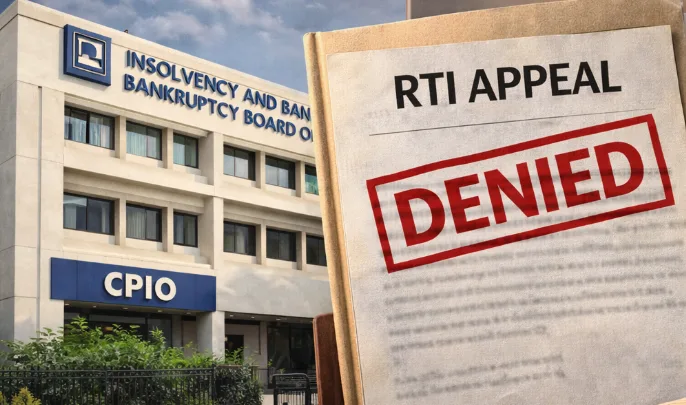
IBBI Rejects RTI Appeal Seeking 1986 Mitra Committee Report On NFDC, Citing Lack Of Custody Of Records
Court / Authority
Insolvency & Bankruptcy Board
Update / Judgement Date
15 Jul 2026
Source
WCP News Bulletin
Author
Manas Yadav — WCP Legal Desk
Reading Time
2 min read
View Count
Background
The First Appellate Authority of the Insolvency and Bankruptcy Board of India (IBBI) has dismissed an RTI appeal filed by Silpa Mukherjee seeking a copy of the 1986 Mitra Committee Report on the functioning of the National Film Development Corporation (NFDC), holding that the requested information was not held by the Board. The appeal arose after the Central Public Information Officer (CPIO) of IBBI responded to Mukherjee’s RTI application stating that no information relevant to the request was available with the authority. The appellant had specifically sought the report prepared by a one-member inquiry committee headed by Ashok Mitra, former Secretary in the Ministry of Information and Broadcasting, which examined NFDC’s operations in the mid-1980s.
While adjudicating the appeal under Section 19 of the Right to Information Act, the First Appellate Authority undertook a brief statutory analysis of the scope of “information” and “right to information” under the Act. It reiterated that access under RTI extends only to material that is held by or under the control of the concerned public authority, subject to statutory exemptions. The Authority noted that IBBI’s regulatory mandate is confined to insolvency and bankruptcy processes and related institutional frameworks. Since the Mitra Committee Report concerned the functioning of NFDC and did not relate to insolvency or bankruptcy matters, the Board did not possess or control the requested document.
On this basis, the appellate authority concluded that the CPIO’s response was legally sufficient and that no further disclosure obligation could be imposed on IBBI.
Accordingly, the appeal was disposed of, reaffirming that RTI obligations are limited to records actually held by the concerned public authority and cannot extend to information lying outside its statutory domain.
Full Judgement / Attachment
Full Judgement
Frequently asked questions about Insolvency & Bankruptcy Board
- What is the IBBI?
- The Insolvency and Bankruptcy Board of India, set up on 1 October 2016 under the Insolvency and Bankruptcy Code, 2016 (IBC), regulates insolvency professionals, insolvency professional agencies, information utilities and registered valuers. It also frames the regulations for insolvency processes.
- When can insolvency be started against a company?
- A financial creditor, an operational creditor or the company itself can apply to the National Company Law Tribunal (NCLT) once there is a default of at least ₹1 crore. On admission, a moratorium starts and an interim resolution professional takes charge.
- How long does the corporate insolvency process take?
- The Code provides 180 days for the corporate insolvency resolution process (CIRP), extendable up to an overall limit of 330 days, including time spent in litigation. In practice, many cases take longer. The IBC (Amendment) Act, 2026, largely in force from 26 May 2026, requires the NCLT to decide admission applications within 14 days and to record reasons for any delay.
- Where can an NCLT insolvency order be appealed?
- An appeal lies to the National Company Law Appellate Tribunal (NCLAT) within 30 days, extendable by up to 15 days for sufficient cause. A further appeal lies to the Supreme Court on a question of law.
- How can White Collar Professional help with a insolvency matter?
- Post your requirement on White Collar Professional to receive proposals from verified Insolvency Professionals, Chartered Accountants and Advocates, compare them, and pay securely through the platform. This page also tracks the latest insolvency IBC and IBBI updates as they are reported.