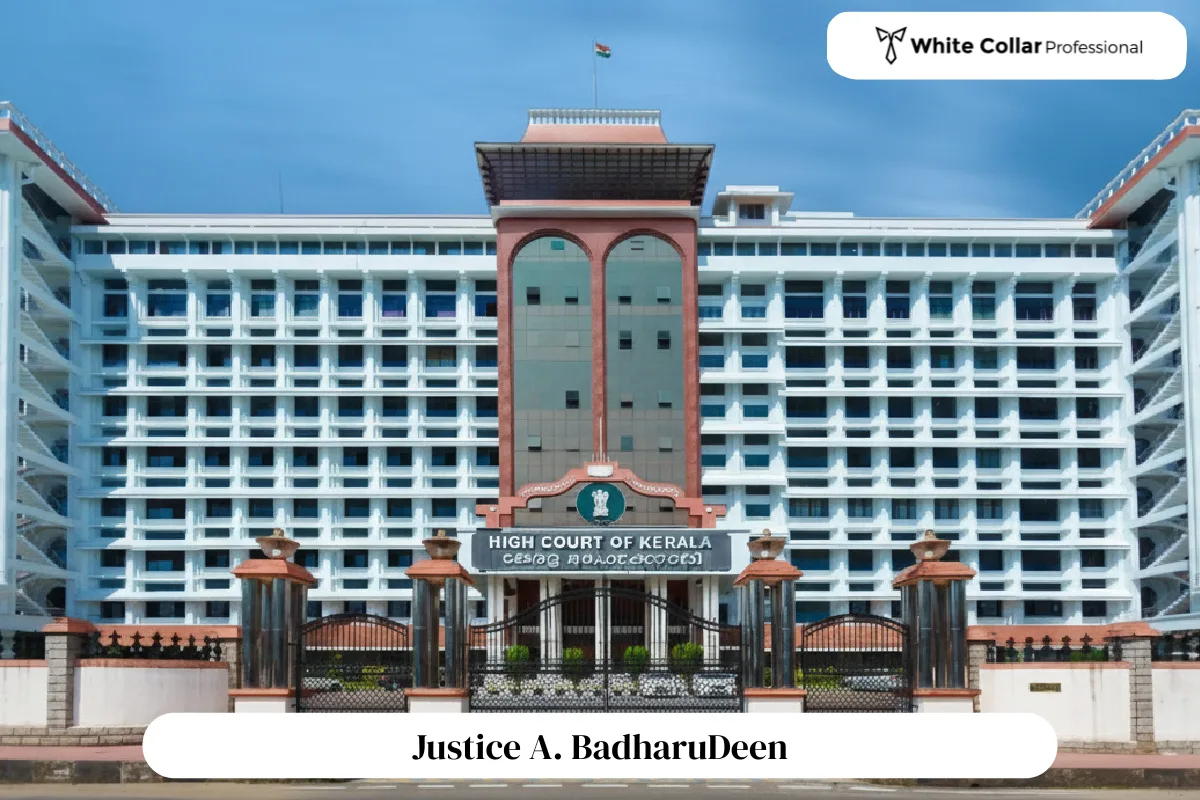
Kerala High Court Holds RBI Must Consult State Government Before Superseding a State-Registered Co-operative Bank
Court / Authority
Kerala High Court
Update / Judgement Date
17 Nov 2026
Date of Publication
18 Nov 2026
Case No.
W.A. Nos. 1385 and 1585 of 2026
Source
WCP News Bulletin
Author
Dipanshi Bansal — WCP Legal Desk
Reading Time
7 min read
View Count

The Kerala High Court held that the Reserve Bank of India (RBI), before superseding the board of a co-operative bank registered with a State Registrar, must consult the concerned State Government as expressly required by the proviso to Section 36AAA(1) of the Banking Regulation Act, 1949. Seeking comments from the Registrar of Co-operative Societies is not a substitute for consultation with the State Government. Although the supersession order was found procedurally defective on this ground, the Court declined to undo the administrator’s completed acts because the challenge had been brought after considerable delay and no interim relief had been obtained. The appeals were dismissed, with a one-month status quo direction to address the interim administrative position.
Key Legal Proposition
Where Section 36AAA(1) expressly requires consultation with the concerned State Government before an order superseding the board of a State-registered co-operative bank, consultation with the Registrar of Co-operative Societies cannot be treated as equivalent. A statutory authority must follow the procedure prescribed by the statute. Nevertheless, writ relief may be moulded in light of delay, public interest and the practical consequences of unsettling actions already taken.
Factual Background
The appellant in W.A. 1385/2026, M.P. Jackson, was the former President of Irinjalakuda Town Co-operative Bank. RBI issued an All-Inclusive Direction on 29 July 2025 under Section 35A of the Banking Regulation Act, restricting the bank’s operations for six months. On 7 October 2025, RBI superseded the Board of Directors and appointed an Administrator under Section 36AAA read with Section 56 of the Act. Jackson challenged the supersession order before the Kerala High Court. The Single Judge dismissed the writ petition but held that any continuation of the supersession beyond 6 October 2026 had to be undertaken in consultation with the State Government. Jackson and RBI both appealed. RBI later issued an extension order dated 6 October 2026, but the required consultation with the State Government had not been completed.
Issues Before the Court
- Whether Section 36AAA(1) requires consultation with the State Government before RBI supersedes the board of a co-operative bank registered with a State Registrar.
- Whether RBI’s communication with, and receipt of comments from, the Registrar of Co-operative Societies satisfies the statutory requirement of consultation with the State Government.
- Whether the Single Judge was right to decline to quash the original supersession order despite finding that the statutory consultation had not been carried out.
- Whether the continuation or extension of the supersession could stand without the required consultation.
Principal Submissions
Jackson challenged the supersession and sought restoration of the elected managing committee. RBI defended its action and relied on its communication with the Registrar of Co-operative Societies, arguing that the statutory framework and the Registrar’s role supported the consultation undertaken. The State’s position also featured in the proceedings concerning the proper authority to be consulted. The appeals further raised the effect of the Single Judge’s decision to leave the Administrator in place for the balance of the supersession period, notwithstanding the procedural defect.
Court’s Analysis and Reasoning
- Personal hearing before supersession- The Division Bench recorded that there was no dispute in the appeals over the Single Judge’s conclusion, supported by the Bombay High Court and Supreme Court decisions in Sandeep S. Ghandat, that the managing committee was not entitled to a personal hearing before the order under Section 36AAA was passed. The decisive issue in the appeals was the separate statutory requirement of consultation with the State Government.
- The statutory text requires the State Government- The proviso to Section 36AAA(1) states that, in the case of a co-operative bank registered with the Registrar of Co-operative Societies of a State, RBI shall issue the supersession order in consultation with the concerned State Government, seeking its comments within the period specified by RBI. The Court held that the statutory language was clear and could not be rewritten to substitute the Registrar for the State Government.
- Consultation with Registrar is not equivalent- RBI had sent a communication to the Registrar of Co-operative Societies. The Registrar’s response did not identify the State Government as the authority to be consulted and stated that the Registrar’s permission was not legally required. The Court held that RBI remained responsible for identifying and complying with the statutory procedure. The fact that Section 56(zg) contains a deeming provision concerning references to the Central Government and the Registrar did not permit the Court to import the same meaning into Section 36AAA, where Parliament had not made that corresponding amendment.
- Mandatory procedure must be followed- The Court relied on settled principles that courts cannot add or subtract words from clear statutory text and that where a statute prescribes the manner in which a power must be exercised, it must be exercised in that manner alone. The consultation requirement was therefore a mandatory precondition, not a procedural formality that could be satisfied through a different authority.
- Why the original supersession was not undone- Although the statutory consultation had not been complied with, the Administrator had taken charge immediately after the October 2025 order. Jackson filed the writ petition only on 27 January 2026 and did not secure interim relief. By the time the Single Judge decided the matter on 3 July 2026, several administrative acts had occurred. The Division Bench accepted that, at that stage, equity and public interest justified not unsettling completed matters through writ jurisdiction. The Single Judge was right to require consultation with the State Government for any continuation beyond 6 October 2026.
- Extension order and interim status quo- RBI’s extension order dated 6 October 2026 could not independently stand because consultation with the State Government had still not been completed. To avoid an administrative vacuum while that process was completed, the Division Bench directed maintenance of status quo for one month from the date of judgment.
Precedents and Their Significance
- Rohitash Kumar v. Om Prakash Sharma, (2013) 11 SCC 451 — Courts interpreting a statute cannot add or subtract words where the statutory language is clear. The Kerala High Court applied this to reject the attempt to read ‘Registrar’ in place of ‘State Government’ in Section 36AAA.
- Sanjay Nagayach v. State of Madhya Pradesh, (2013) 7 SCC 25 — The Supreme Court explained that statutory consultation must be meaningful and effective, and where the law makes prior consultation mandatory before superseding an elected co-operative board, it is a condition precedent.
- Babu Verghese v. Bar Council of Kerala, (1999) 3 SCC 422; OPTO Circuit India Ltd. v. Axis Bank, (2021) 6 SCC 707 — These decisions affirm that where a statute prescribes a particular manner of exercising a power, the authority must follow that procedure and cannot adopt an alternative method.
- Chairman-cum-Managing Director, Coal India Ltd. v. Ananta Saha, (2011) 5 SCC 142 — The principle that when the foundation of an action is removed, consequential proceedings may also fall was considered. The Kerala High Court distinguished the practical situation because the Administrator had acted for months and the challenge was delayed.
Decision and Operative Directions
The Division Bench held that consultation with the Registrar of Co-operative Societies did not satisfy the requirement of consultation with the State Government under the proviso to Section 36AAA(1). It nevertheless declined to quash the original supersession order because the challenge was delayed, no interim relief had been obtained, and the Administrator had already undertaken acts that could not practically be reversed without affecting settled matters and public interest. Both writ appeals were dismissed. The RBI’s extension order dated 6 October 2026 was held unsustainable because consultation with the State Government remained incomplete. The Court directed status quo for one month from 17 November 2026 to avoid an administrative vacuum while the required consultation was completed.
Legal and Editorial Significance
The judgment clarifies the identity of the authority whose views RBI must obtain before superseding the board of a State-registered co-operative bank. It reinforces the mandatory nature of statutory consultation and the rule against substituting one statutory actor for another by interpretation. At the same time, it demonstrates that a procedural illegality does not invariably result in immediate restoration of the previous position: delay, absence of interim relief, completed administrative action and public interest may affect the remedial order.
Full Judgement / Attachment
Full Judgement
Frequently asked questions about Kerala High Court
- Where does the Kerala High Court sit and which areas does it cover?
- The Kerala High Court sits at Ernakulam, Kochi. It has jurisdiction over the State of Kerala and the Union Territory of Lakshadweep. It was established on 1 November 1956, when the State of Kerala was formed.
- How do I check Kerala High Court case status and judgements?
- The official website, highcourt.kerala.gov.in, provides case status, cause lists, e-filing and judgements. The court has moved most filing and records to digital form. Orders are also on the eCourts High Court Services portal (hcservices.ecourts.gov.in).
- What kinds of cases does the Kerala High Court hear?
- It hears writs, civil and criminal appeals from Kerala and Lakshadweep, and income-tax appeals arising from the ITAT Cochin Bench on substantial questions of law.
- What is a Writ Appeal in the Kerala High Court?
- Under Section 5 of the Kerala High Court Act, 1958, a judgement of a single judge in certain matters, including writ petitions, can be appealed to a Division Bench. A final judgement can be challenged by a Special Leave Petition under Article 136, ordinarily within 90 days.
- How can White Collar Professional help with a Kerala High Court matter?
- Post your requirement on White Collar Professional to receive proposals from verified Advocates, Chartered Accountants and Company Secretaries, compare them, and pay securely through the platform. This page also tracks the latest Kerala High Court judgements and legal updates as they are reported.