Nominal Shop Occupants Cannot Claim Ordinary Membership Without Title or a Valid Membership Application
Court / Authority
Bombay High Court
Update / Judgement Date
04 Nov 2026
Date of Publication
05 Nov 2026
Case No.
Writ Petition No. 14414 of 2026 (with WP Nos. 14533–14538 of 2026 and WP (St.) Nos. 31181, 31183 and 31224 of 2026)
Source
WCP News Bulletin
Author
Soumya Gupta — WCP Legal Desk
Reading Time
11 min read
View Count
1
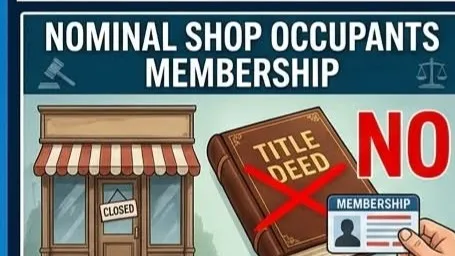
Key Proposition: The 2019 amendment abolishing nominal membership for co-operative housing societies did not elevate existing nominal members to ordinary members, and a Deputy Registrar cannot grant membership under Sections 22(2) or 23(2) without a prior membership application to the society and a resulting non-decision or refusal.
● Maharashtra Co-operative Societies Act, 1960 – Sections 22(2) and 23(2) – Membership application and Registrar’s jurisdiction – Is a prior application to the society necessary? – Held, yes. (Paras 57–59)
● Maharashtra Co-operative Societies Act, 1960 – Sections 154B-1(18), 154B-7 and 154B-31 – Nominal membership after 2019 amendment – Does deletion of nominal membership convert existing nominal members into ordinary members? – Held, no. (Paras 43–45)
● Maharashtra Co-operative Societies Act, 1960 – Section 154B-7, Explanation – Occupancy rights – Do tenant/licensee rights qualify as transferable occupancy rights? – Held, no. (Paras 41–42)
● Transfer of Property Act, 1882 – Section 11 – Restriction repugnant to interest created – Does the provision apply without creation of an absolute interest? – Held, no. (Paras 66–68)
Background / Synopsis :
● Worli Sagar Co-operative Housing Society Ltd. obtained government land at Pochkanawala Road, Worli, Mumbai, on a 99-year lease under the Government Resolution dated 11 May 1987, subject to the policy and eligibility conditions in the Government Resolution dated 12 May 1983.
● The State Government permitted use of built-up area not exceeding 15% of the total FSI for shops, subject to additional lease rent and disclosure of the sub-lessees and purpose of use. The society constructed approximately 53 shops.
● Residential flat allottees were admitted as ordinary members. Shop occupants were granted occupancy rights and nominal membership. The original shop allottees surrendered their rights to the society, which made fresh allotments.
● Respondent No. 4, a private limited company, became the occupant and nominal member in respect of ten shops bearing Nos. 7 to 16. The society was subdivided into five societies on 16 October 2023; the ten shops were situated in the petitioner society’s building.
● For Shop No. 16, the previous allottee surrendered the shop and nominal membership to the society in January 2017. The society thereafter allotted the shop to Respondent No. 4 in 2017, transferring the share certificate and admitting it as a nominal member.
● On 22 August 2024, Respondent No. 4 executed and registered a Deed of Confirmation/Transfer with the former allottee, claiming a transfer of the shop and membership. The High Court found that the former allottee had already surrendered the rights to the society and had no subsisting rights to transfer.
● In May 2026, Respondent No. 4 directly approached the Deputy Registrar seeking ordinary membership. By orders dated 30 June 2026, the Deputy Registrar treated the appeals as proceedings under Section 23(2) and directed ordinary membership and share certificates for all ten shops.
● The petitioner society’s Revision Applications Nos. 291–300 of 2026 were dismissed by the Divisional Joint Registrar on 9 October 2026. The society then filed the connected writ petitions, including WP No. 14414 of 2026, challenging both orders.
● The relief sought was to quash the Deputy Registrar’s order dated 30 June 2026 and the Divisional Joint Registrar’s order dated 9 October 2026.
Issues For Consideration :
● Whether the Deputy Registrar could entertain a direct request for ordinary membership without a prior application being made to the society and without any refusal or non-decision by the society.
● Whether nominal membership granted before the 2019 amendment to the Maharashtra Co-operative Societies Act automatically converted into ordinary membership after insertion of Chapter XIII-B.
● Whether Respondent No. 4 held ownership/title or only conditional occupancy rights in the shops, and whether the Deed of Confirmation/Transfer created any enforceable rights.
● Whether the shop allotment and government land conditions permitted the shop occupants to become ordinary members of the petitioner society.
● Whether Section 11 of the Transfer of Property Act, 1882 invalidated the restrictions imposed on the shop occupants.
Submissions Of Parties :
Petitioner / Society:
● The Deputy Registrar lacked jurisdiction because Respondent No. 4 had not applied to the society for ordinary membership; Sections 22(2) and 23(2) require a prior application and a resulting non-decision or refusal.
● Respondent No. 4 was only a lessee, licensee or occupant, not a purchaser or owner of the shops. The allotment documents restricted transfer, required surrender to the society, and permitted termination of occupancy for breach.
● The 2019 amendment removed the concept of nominal membership for housing societies prospectively; it did not automatically convert existing nominal members into ordinary members. Section 154B-7 excludes tenants and licensees from the expression “occupancy right”.
● The government land was allotted for residential tenements to eligible members under the 1983 GR. Shop occupants were permitted as sub-lessees/occupants, not as ordinary members.
● The Deed of Confirmation/Transfer was ineffective because the previous allottee had surrendered his rights to the society in 2017 and had no subsisting interest to transfer in 2024. Section 11 of the Transfer of Property Act could not apply in the absence of an absolute interest.
Respondent No. 4:
● The shops were allotted for valuable consideration and the company had paid amounts to the society and the previous allottee; the arrangement was said to create rights beyond a mere licence.
● Shop allottees should not be treated differently from residential flat allottees, and the absence of a registered sale deed in favour of ordinary residential members should not defeat membership.
● The company relied on the 2019 amendment, the discontinuance of nominal membership in housing societies, and the decision in Viviana CHSL v. State of Maharashtra to support conversion to ordinary membership.
● The company contended that the society had issued share certificates and treated it as a member, and that the dispute arose when the society’s redevelopment process threatened its position.
● It argued that the agreement with the estate agency and the payments made by shop allottees supported its claim to ordinary membership.
Court's Observations & Analysis :
Re: Issue 1 – Jurisdiction of the Deputy Registrar
● Sections 22(2) and 23(2) operate where a person has first applied to the society for membership and the society either fails to decide the application within the statutory period or refuses membership.
● The making of an application and the society’s non-decision or refusal constitute jurisdictional facts. In their absence, the Deputy Registrar, being a statutory authority, has no plenary or inherent jurisdiction to grant membership.
● Respondent No. 4 approached the Deputy Registrar directly without first applying to the petitioner society for ordinary membership. There was consequently no source application and no refusal or non-decision capable of invoking Sections 22(2) or 23(2).
● Held: The Deputy Registrar’s orders were without jurisdiction and non-est. (Paras 57–59)
Re: Issue 2 – Effect of the 2019 amendment on existing nominal membership
● Chapter XIII-B was inserted by Maharashtra Act No. 23 of 2019 with effect from 9 March 2019. For housing societies, the amended definition of member includes associate, joint and provisional members; the earlier statutory provisions concerning nominal membership were excluded.
● Section 154B-31 preserves existing rules, orders, bye-laws, circulars and instruments until expressly repealed, modified or amended. The amendment was substantive and prospective, so nominal memberships granted before its commencement did not automatically cease.
● Nothing in the 2019 amendment provides for automatic conversion or upgrading of an existing nominal member into an ordinary member. The pre-existing nominal membership continued in its existing character.
● Held: The 2019 amendment did not convert Respondent No. 4’s pre-existing nominal membership into ordinary membership. (Paras 38–45)
Re: Issue 3 – Nature of the shop rights and Deed of Confirmation/Transfer
● The allotment agreement and letters described Respondent No. 4 as a nominal member and imposed restrictions against sale, transfer, assignment, encumbrance or parting with possession without prior written consent. The society could terminate the allotment for breach and recover possession.
● The allotment letter required the shop to be surrendered to the society if the occupant wished to vacate. The previous allottee surrendered his occupancy rights and nominal membership to the society in 2017; the society then made a fresh allotment to Respondent No. 4.
● There was no privity of contract between the former allottee and Respondent No. 4. The 2024 Deed of Confirmation/Transfer falsely portrayed the former allottee as transferor and could not confer title or other rights on Respondent No. 4. Registration of the document did not elevate an occupier into an owner.
● The society retained ownership of the shops; Respondent No. 4 had only permissive occupancy subject to the allotment conditions. Its payment of consideration did not change the legal character of the allotment.
● Held: Respondent No. 4 was merely a nominal member and occupant/licensee, without title or ownership in the shops. (Paras 21–25, 46–50, 68–70)
Re: Issue 4 – Government land policy and eligibility for membership
● The 12 May 1983 GR provided for government land to be granted to co-operative housing societies to construct residential tenements for members meeting specified income and eligibility criteria. The 11 February 1987 allotment imposed corresponding conditions.
● The 22 June 1987 permission to use up to 15% of FSI for shops required disclosure of the names of sub-lessees and the purpose of letting. The eligibility restriction applied to regular members, not to persons inducted as lessees/sub-lessees of commercial shops.
● The society had consciously granted shop occupants nominal membership and did not admit them as ordinary members. The estate agency’s 20 June 1991 letter also referred to nominal membership for the relevant shop allotment.
● Held: The government policy and allotment conditions did not support ordinary membership for Respondent No. 4, whose status was that of a shop occupant under the society’s permission. (Paras 51–55, 63–64)
Re: Issue 5 – Section 11 of the Transfer of Property Act
● Section 11 applies where an absolute interest in property has first been created and a restriction is then imposed on the manner of enjoyment of that interest.
● No absolute interest was created in favour of Respondent No. 4 or the earlier allottees. The restrictions on use, transfer and surrender were part of the limited occupancy arrangement itself.
● Held: Section 11 did not assist Respondent No. 4 because the allotment did not create an absolute interest in the shops. (Paras 66–68)
Notable Observations:
● “Making of application for membership and its ‘non-decision’ or ‘refusal’ becomes a jurisdictional fact for the Deputy Registrar to exercise jurisdiction.” (Para 58)
● “Mere process of ‘registration’ of the Deed does not elevate the status of Respondent No. 4 from an occupier to that of an owner.” (Para 50)
Decision & Directions :
● All connected writ petitions, including WP No. 14414 of 2026, were allowed.
● The orders dated 9 October 2026 passed by the Divisional Joint Registrar and 30 June 2026 passed by the Deputy Registrar were set aside.
● Rule was made absolute in each petition.
● There was no order as to costs.
● The post-pronouncement request by Respondent No. 4 for a six-week stay of the judgment was rejected. (Para 72)
● Separate Opinions: None.
Full Judgement / Attachment
Full Judgement
Frequently asked questions about Bombay High Court
- Where does the Bombay High Court sit and which areas does it cover?
- The Bombay High Court has its principal seat in Mumbai, with benches at Nagpur, Chhatrapati Sambhajinagar (Aurangabad) and Goa, and a circuit bench at Kolhapur that began sitting on 18 August 2025. It has jurisdiction over Maharashtra, Goa and the Union Territory of Dadra and Nagar Haveli and Daman and Diu. Established in 1862, it is one of India's three oldest High Courts.
- How do I search Bombay High Court cases across Mumbai, Nagpur, Aurangabad, Goa and Kolhapur?
- The official website, bombayhighcourt.gov.in, lets you pick the bench (Principal Seat, Nagpur, Aurangabad, Goa or Kolhapur) before searching case status, cause lists and orders. Judgements are also on the eCourts Judgments portal (judgments.ecourts.gov.in).
- What is the Original Side and Commercial Division of the Bombay High Court?
- On its Original Side, the court hears high-value civil suits arising within Mumbai city, and its Commercial Division hears commercial disputes under the Commercial Courts Act, 2015. It also hears arbitration petitions, company and tax appeals, including those from the ITAT Mumbai, Pune, Nagpur and Panaji Benches.
- What is a Letters Patent Appeal in the Bombay High Court?
- In many matters, an order of a single judge can be challenged before a Division Bench by a Letters Patent Appeal under Clause 15 of the Letters Patent. Commercial matters follow the Commercial Courts Act route instead. Against a final judgement, the route is a Special Leave Petition under Article 136, ordinarily within 90 days.
- How can White Collar Professional help with a Bombay High Court matter?
- Post your requirement on White Collar Professional to receive proposals from verified Advocates, Chartered Accountants and Company Secretaries, compare them, and pay securely through the platform. This page also tracks the latest Bombay High Court judgements and legal updates as they are reported.