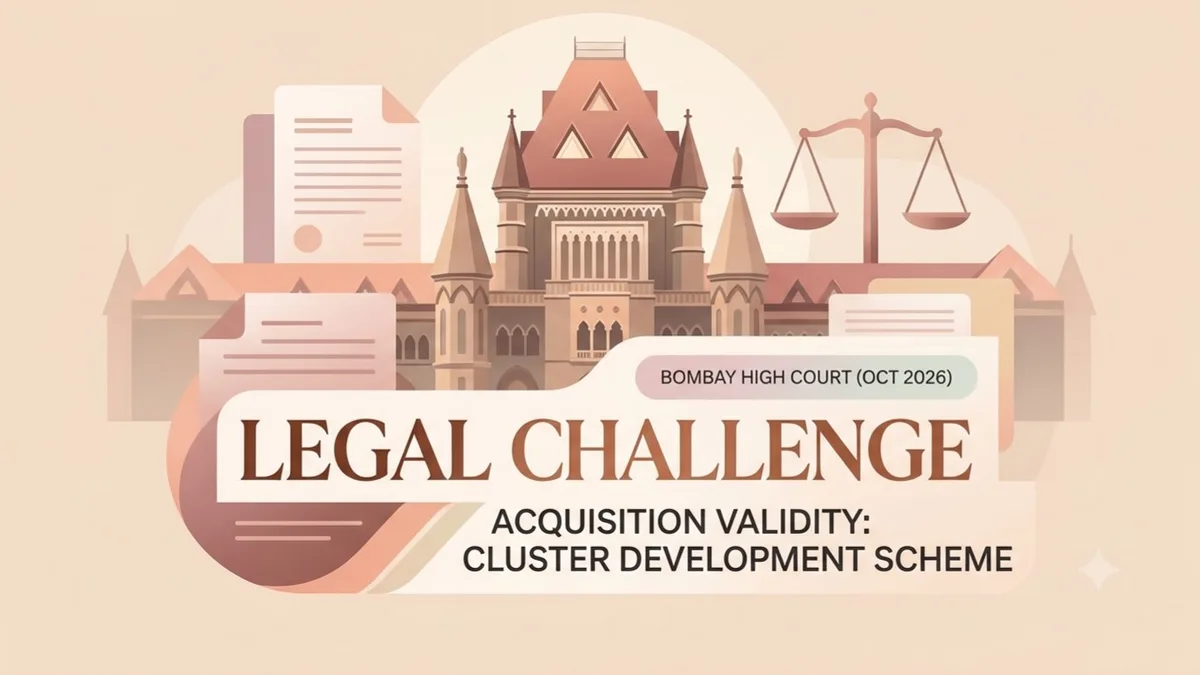
Validity of Acquisition under Cluster Development Scheme Challenged
Court / Authority
Bombay High Court
Update / Judgement Date
23 Oct 2026
Date of Publication
27 Oct 2026
Case No.
Writ Petition No. 2997 of 2021 & Writ Petition No. 4762 of 2024
Source
WCP News Bulletin
Author
Pranjal Jha — WCP Legal Desk
Reading Time
4 min read
View Count
2
- Case / Party Name: Moiz Dawoodbhai Palitanawala & Ors. v. The Municipal Corporation of Greater Mumbai & Ors.
- Court Name: High Court of Judicature at Bombay – Ordinary Original Civil Jurisdiction
- Case Number(s): Writ Petition No. 2997 of 2021 & Writ Petition No. 4762 of 2024
- Citation: Not available
- Coram / Judges: Manish Pitale and Shreeram V. Shirsat, JJ.
- Judgment Authored By: Manish Pitale, J.
- Date of Decision: 23 October 2026
- Nature of Proceedings: Writ Petition (Art. 226)
- Letters Patent / Appeals (if any): None
- Counsel Appearances: Mr. Sagheer A. Khan and others for Petitioners; Dr. Milind Sathe, A.G. and others for Respondents
- Outcome: Dismissed
Headnote
Key Proposition: The regulation concerning cluster development schemes is valid as it does not violate the MRTP Act or the Constitution, particularly regarding the right to property under Article 300A.
Catchwords:
- MRTP Act – Section 125, 126 – Land Acquisition – Is the acquisition for public purpose valid? – Held, yes. (Para 86)
- Development Control Regulations – Are they ultra vires the MRTP Act? – Held, no. (Para 72)
- Right to Fair Compensation – Is it being adequately provided? – Held, yes. (Para 86)
- Headnote: Petitioners challenged the acquisition of properties under the Cluster Development Scheme (CDS), arguing the applicable regulation was ultra vires the MRTP Act and violated their right to property. The court found that the CDS aligns with the MRTP Act and serves a public purpose, thus dismissing the petitions as unsubstantiated (Paras 86, 115).
Background / Synopsis
- Petitioners challenge the legality of property acquisition for urban renewal under CDS in Bhendi Bazaar.
- They allege violations of the MRTP Act and the Constitution due to the absence of prior notification and a formal declaration of the property as dangerous.
- The acquisition process involved multiple approvals over several years, leading to the impugned notification and subsequent property acquisition.
Issues For Consideration
- Is Regulation 33(9)(3)(5) of the Development Control Regulations valid under the MRTP Act?
- Was the petitioners' right to property violated under Article 300A of the Constitution?
- Did the process of acquisition adhere to principles of natural justice?
Submissions Of Parties
Petitioner / Appellant:
- Regulation is ultra vires, violates right to property, and fails to identify land for public purpose.
- The process of acquisition lacked transparency and proper notification.
Respondent / State:
- The DCPR is legally valid, the CDS serves a public purpose, and due process was followed.
- Adequate compensation mechanisms were in place and were complied with.
Court's Observations & Analysis
Re: Issue (i) – Validity of Regulation
Regulation meets statutory requirements and aligns with legislative intent.
Held: Regulation 33(9)(3)(5) is valid under the MRTP Act. (Para 72)
Re: Issue (ii) – Right to Property
Acquisition carried out under lawful authority; thus, Article 300A is not violated.
Held: Right to property was not breached. (Para 86)
Re: Issue (iii) – Principles of Natural Justice
Procedures followed that meet legal requirements; adequate notices were issued.
Held: No breach of natural justice occurred.
Notable Observations: "Public purpose should be liberally construed, not whittled down by logomachy." (Para 74). "The public character of such a Urban Renewal Scheme is not diluted because of the fact that it is implemented with the assistance of a promoter/developer." (Para 81).
Decision & Directions
- Writ petitions are dismissed.
- No further directions issued as the legal requirements were deemed satisfied.
- The court comments on the need for urban renewal in congested areas like Bhendi Bazaar and emphasizes public interest.
Legal Provisions Discussed
- Maharashtra Regional and Town Planning Act, 1966 (MRTP) – Sections 125, 126 – Validity of acquisition for public purpose.
- Right to Fair Compensation and Transparency in Land Acquisition, Rehabilitation and Resettlement Act, 2013 – Procedural adherence in compensation.
Precedents Cited
- State of U.P. vs. Babu Ram Upadhya, AIR 1961 SC 751 – Followed
- Kerala State Electricity Board vs. Indian Aluminium Co., (1976) 1 SCC 466 – Followed
- Bombay Dyeing & Mfg. Co. Ltd. vs. Bombay Environmental Action Group, (2006) 3 SCC 434 – Followed
Full Judgement / Attachment
Full Judgement
Frequently asked questions about Bombay High Court
- Where does the Bombay High Court sit and which areas does it cover?
- The Bombay High Court has its principal seat in Mumbai, with benches at Nagpur, Chhatrapati Sambhajinagar (Aurangabad) and Goa, and a circuit bench at Kolhapur that began sitting on 18 August 2025. It has jurisdiction over Maharashtra, Goa and the Union Territory of Dadra and Nagar Haveli and Daman and Diu. Established in 1862, it is one of India's three oldest High Courts.
- How do I search Bombay High Court cases across Mumbai, Nagpur, Aurangabad, Goa and Kolhapur?
- The official website, bombayhighcourt.gov.in, lets you pick the bench (Principal Seat, Nagpur, Aurangabad, Goa or Kolhapur) before searching case status, cause lists and orders. Judgements are also on the eCourts Judgments portal (judgments.ecourts.gov.in).
- What is the Original Side and Commercial Division of the Bombay High Court?
- On its Original Side, the court hears high-value civil suits arising within Mumbai city, and its Commercial Division hears commercial disputes under the Commercial Courts Act, 2015. It also hears arbitration petitions, company and tax appeals, including those from the ITAT Mumbai, Pune, Nagpur and Panaji Benches.
- What is a Letters Patent Appeal in the Bombay High Court?
- In many matters, an order of a single judge can be challenged before a Division Bench by a Letters Patent Appeal under Clause 15 of the Letters Patent. Commercial matters follow the Commercial Courts Act route instead. Against a final judgement, the route is a Special Leave Petition under Article 136, ordinarily within 90 days.
- How can White Collar Professional help with a Bombay High Court matter?
- Post your requirement on White Collar Professional to receive proposals from verified Advocates, Chartered Accountants and Company Secretaries, compare them, and pay securely through the platform. This page also tracks the latest Bombay High Court judgements and legal updates as they are reported.