← back
Must-ReadBombay High Court
Bombay High Court Quashes Warrant Orders After Accused Undertake to Appear Before Trial Court
Court / Authority
Bombay High Court
Update / Judgement Date
21 Oct 2026
Date of Publication
27 Oct 2026
Case No.
Writ Petition Nos. 4473
Source
WCP News Bulletin
Author
Dipanshi Bansal — WCP Legal Desk
Reading Time
4 min read
View Count
2
Criminal LawSEBI & SCRAOther Legal Matters
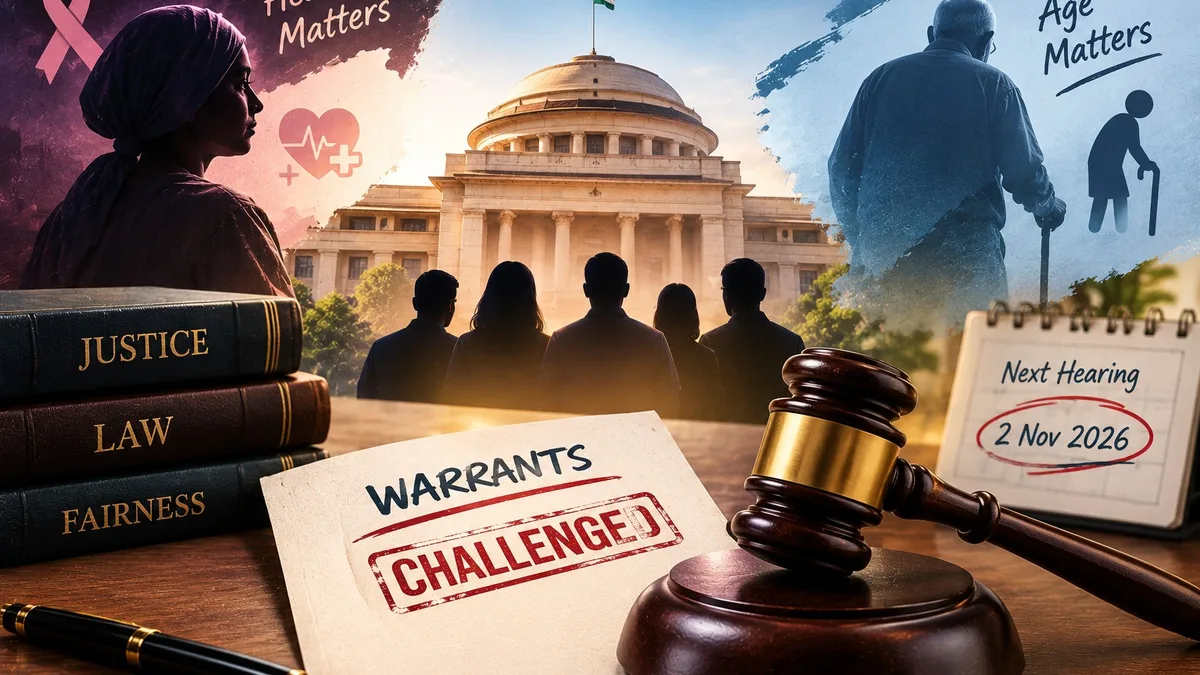
- The Bombay High Court dealt with five connected Criminal Writ Petitions challenging orders issuing bailable or non-bailable warrants against the petitioners. The petitioners, through counsel, undertook that specified petitioners would remain personally present before the trial court on 2 November 2026, while two petitioners sought liberty to file applications for exemption from personal appearance supported by documents. SEBI opposed the requests on the basis that the next stage was framing of charges. The High Court noted that the warrants had been issued to secure the accused persons' presence and accepted the undertaking. It therefore quashed and set aside the impugned warrant orders, while making the disposal conditional upon compliance with the undertaking. (Paras 1–8)
Key Proposition: Where warrant orders have been issued to secure an accused person's presence, the High Court may quash the orders on the basis of a clear undertaking to appear before the trial court, while preserving consequences for breach of that undertaking.
- Criminal procedure – Bailable/non-bailable warrants – Purpose of securing accused's presence – Whether warrant orders could be quashed after undertaking to appear – Held, yes, subject to compliance. (Paras 6–8)
- Personal appearance – Exemption – Whether specified petitioners could seek exemption before the trial court on supporting material – Held, applications could be filed and considered in accordance with law. (Para 7(ii))
Background / Synopsis :
- Five connected Criminal Writ Petitions challenged orders issuing bailable or non-bailable warrants against the petitioners. (Para 1)
- The impugned orders were stated to be substantially similar; the order in Criminal Writ Petition No. 4474 of 2026 was reproduced for reference. (Para 2)
- Counsel for the petitioners undertook that three petitioners—Pavan Kuchana, Kamal Kuchana and Ravi Kusam—would personally appear before the trial court on 2 November 2026. (Para 7(i))
- Durga Kuchana and Ramaswamy Kuchana were to file applications for exemption from personal appearance on 2 November 2026 with supporting documents. (Para 7(ii))
Issues For Consideration :
- Whether the impugned warrant orders should be set aside in view of the petitioners' undertaking to appear before the trial court.
- Whether the two petitioners seeking exemption could be permitted to place their exemption applications before the trial court.
Submissions Of Parties :
Petitioners:
- Counsel undertook, on instructions, that the petitioners would appear before the trial court on the next scheduled date.
- It was submitted that Durga Kuchana had cervical cancer and Ramaswamy Kuchana was an 84-year-old bedridden senior citizen, warranting applications for exemption from personal appearance.
- Most petitioners also intended to file applications seeking discharge.
SEBI / State:
- SEBI submitted that the next stage was framing of charges and therefore the petitioners should remain present before the trial court.
- The State was represented by the APP.
Court's Observations & Analysis :
Re: Purpose of the warrants
- The Court noted that the impugned bailable and non-bailable warrants had been issued to ensure the presence of the petitioners, who were accused in the proceedings. (Para 6)
- Since the petitioners, through counsel, gave the required undertaking regarding appearance, the Court considered that the writ petitions could be disposed of. (Para 6)
- Held: The warrant orders could be quashed and set aside on the basis of the undertaking, subject to its compliance. (Para 7)
Re: Exemption from personal appearance
- The Court permitted Durga Kuchana and Ramaswamy Kuchana to file applications seeking exemption from personal appearance on 2 November 2026 with supporting documents.
- The trial court was directed to consider those applications in accordance with law, having regard to the facts and circumstances. (Para 7(ii))
Notable Observations: Notable Observations: None.
Decision & Directions :
- The impugned warrant orders were quashed and set aside.
- Pavan Kuchana, Kamal Kuchana and Ravi Kusam were to remain personally present before the trial court on 2 November 2026.
- Durga Kuchana and Ramaswamy Kuchana could file exemption applications on 2 November 2026 with supporting documents; the trial court was to decide them in accordance with law.
- If the undertaking made on instructions was breached, all five writ petitions would stand dismissed without reference to the Court.
- The writ petitions were disposed of in the above terms.
- Legal Provisions Discussed & Precedents Cited :
- Criminal procedure concerning bailable and non-bailable warrants: the judgment focused on securing the presence of accused persons.
- Procedural direction on exemption from personal appearance: applications were to be filed before the trial court with supporting documents.
- None discussed.
Full Judgement / Attachment
Full Judgement
Frequently asked questions about Bombay High Court
- Where does the Bombay High Court sit and which areas does it cover?
- The Bombay High Court has its principal seat in Mumbai, with benches at Nagpur, Chhatrapati Sambhajinagar (Aurangabad) and Goa, and a circuit bench at Kolhapur that began sitting on 18 August 2025. It has jurisdiction over Maharashtra, Goa and the Union Territory of Dadra and Nagar Haveli and Daman and Diu. Established in 1862, it is one of India's three oldest High Courts.
- How do I search Bombay High Court cases across Mumbai, Nagpur, Aurangabad, Goa and Kolhapur?
- The official website, bombayhighcourt.gov.in, lets you pick the bench (Principal Seat, Nagpur, Aurangabad, Goa or Kolhapur) before searching case status, cause lists and orders. Judgements are also on the eCourts Judgments portal (judgments.ecourts.gov.in).
- What is the Original Side and Commercial Division of the Bombay High Court?
- On its Original Side, the court hears high-value civil suits arising within Mumbai city, and its Commercial Division hears commercial disputes under the Commercial Courts Act, 2015. It also hears arbitration petitions, company and tax appeals, including those from the ITAT Mumbai, Pune, Nagpur and Panaji Benches.
- What is a Letters Patent Appeal in the Bombay High Court?
- In many matters, an order of a single judge can be challenged before a Division Bench by a Letters Patent Appeal under Clause 15 of the Letters Patent. Commercial matters follow the Commercial Courts Act route instead. Against a final judgement, the route is a Special Leave Petition under Article 136, ordinarily within 90 days.
- How can White Collar Professional help with a Bombay High Court matter?
- Post your requirement on White Collar Professional to receive proposals from verified Advocates, Chartered Accountants and Company Secretaries, compare them, and pay securely through the platform. This page also tracks the latest Bombay High Court judgements and legal updates as they are reported.