Drugs Are Poisons, Not Sweets: Bombay High Court Orders Removal of 'LEFOXIN BIOX' as Deceptively Similar to GSK's 'LANOXIN', Holds Export-Only Use Is Still Use in India
Court / Authority
Bombay High Court
Update / Judgement Date
28 Oct 2026
Date of Publication
30 Oct 2026
Case No.
comm 12/2026
Source
WCP News Bulletin
Author
Arshee Saifi — WCP Legal Desk
Reading Time
11 min read
View Count
1
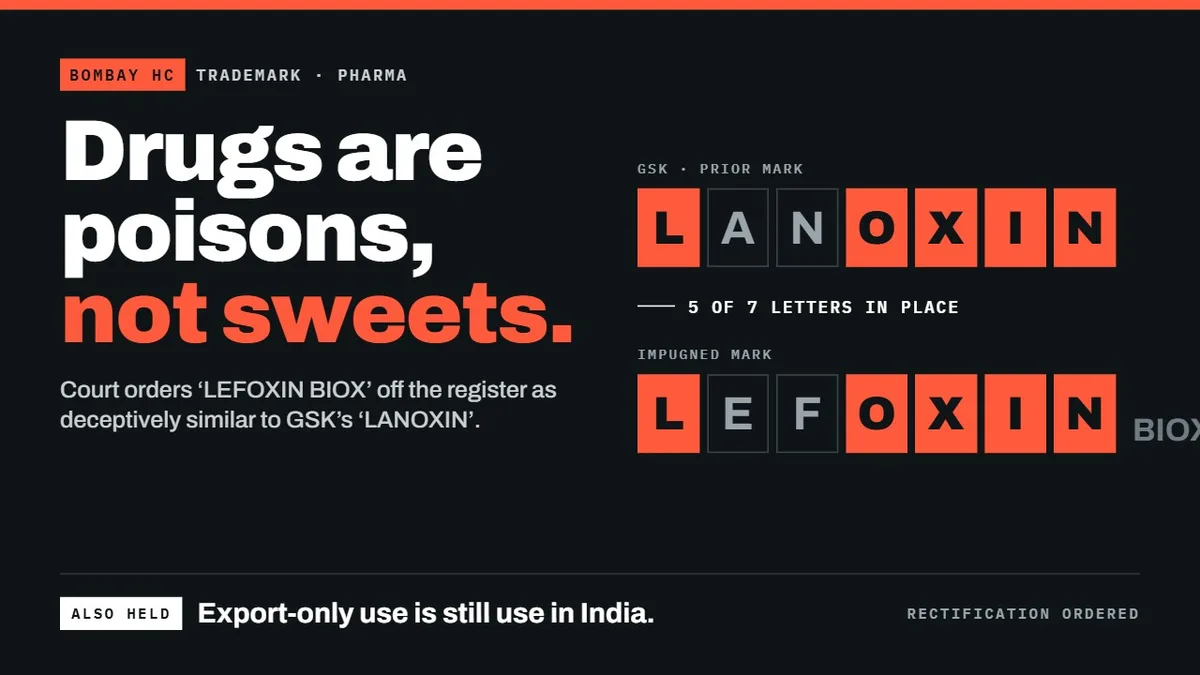
Key Proposition: In rectification proceedings, deceptive similarity of a pharmaceutical mark is judged by the likelihood of confusion at the date of registration under the stricter standard for medicines; different active ingredients, prescription-only sale and absence of proof of actual confusion do not save a confusingly similar mark, and applying the mark in India to goods meant only for export is still use in India under Section 56(1).
Background / Synopsis :
- Glaxo, a GSK group company, owns Registration No. 177607 for LANOXIN in Class 5 (since 17.12.1956, valid till 17.12.2035), used for digoxin tablets for cardiac failure and arrhythmias, with Indian sales since 1958 (Para 2).
- Shreya, an Indian pharmaceutical company, applied for LEFOXIN BIOX on 11.06.2021 on a proposed-to-be-used basis; it was advertised in Trade Marks Journal No. 2009 (19.07.2021) and registered on 09.12.2021 as No. 5001470; Glaxo did not oppose (Para 3).
- Shreya uses the mark on levofloxacin antibiotic tablets made at Aurangabad solely for export to Russia, Ukraine, Uzbekistan, Belarus, Kazakhstan and other countries, claiming exports since 2006–07; Glaxo accepts nothing is sold in India but points to Indian third-party website listings (Paras 5–6).
- Glaxo says it learnt of the registration in June 2024, sent a cease-and-desist notice on 16.08.2024 and affirmed the petition on 05.04.2025 (Para 7).
- Related matters: Glaxo's Commercial IP Suit (L) No. 12430 of 2025 against Shreya (another roster); on 24.04.2026 another Bench removed Shreya's PAXIL registration for non-use under Section 47; Glaxo has opposed Shreya's separate application for LEFOXIN (No. 5285447) (Paras 8, 69).
Issues For Consideration :
- Whether Glaxo is a 'person aggrieved' under Section 57 (Para 11A).
- Whether LEFOXIN BIOX is deceptively similar to LANOXIN under Section 11(1)(b) – including the role of BIOX, whether OXIN is common to the trade, the effect of different APIs and prescription-only sale, and the effect of export-only use (Para 11B).
- Whether Sections 11(3), 11(10) and 18(1) are independently attracted on grounds of bad faith (Para 11C).
- Whether delay, absence of proof of actual confusion and balance of hardship defeat relief (Para 11D).
Submissions Of Parties :
- Petitioner (Glaxo):
LANOXIN is an earlier mark in continuous use since the 1950s; LEFOXIN BIOX is nearly identical, swapping 'AN' for 'EF' (Para 9).
LEFOXIN is dominant; BIOX is descriptive ('bacterial oxidation'); the first and last syllables sound the same (Para 24).
A stricter test applies to medicines; different APIs make confusion more dangerous, not less (Cadila 2001; Macleods) (Para 27).
Only one of sixteen levofloxacin brands uses OXIN, so it is not common to the trade; Shreya itself applied for LEFOXIN (Paras 25, 27).
Manufacture in India for export is use in India (Cadila v. Sami Khatib) (Para 28).
Shreya knew or ought to have known of LANOXIN; honest adoption is no defence (Para 60).
- Respondent No. 1 (Shreya):
Glaxo is not a person aggrieved and shows only a speculative grievance (Infosys; Hardie) (Paras 10, 12–13).
The marks must be compared as wholes; BIOX ('biological oxidation') distinguishes the mark; OXIN is common in the fluoroquinolone family (Para 25).
The APIs, indications and prescribers are entirely different and both drugs are prescription-only (Cadila 2001; Intas; Sun Pharma v. Hetero; Schering) (Para 26).
Nothing is sold in India, so Indian doctors and pharmacists never see both marks; it is willing to undertake not to sell in India (Paras 10, 28–29).
The mark was conceived independently; the Registry did not cite LANOXIN and Glaxo did not oppose; Glaxo delayed (Paras 10, 61).
Court's Observations & Analysis :
- Re: Issue (i): Person aggrieved
Glaxo owns an earlier Class 5 registration for a somewhat similar mark in the same field; it is not a disconnected busybody (Para 14).
Under Hardie, locus in rectification for wrongful entries is ascertained liberally, as purity of the Register is in public interest; the higher threshold for non-use does not apply (Paras 15–16).
Held: Glaxo is a person aggrieved. (Paras 16, 20, 71A)
- Re: Issue (ii): Export-only use
Under Section 56(1), applying a mark in India to goods to be exported is deemed use in India; Cadila v. Sami Khatib (Bom DB), though in an infringement suit, applies equally to rectification (Paras 29–31).
Held: Export-only use and the offer to stay out of India make no difference; with e-commerce, territorial division of trade is of little relevance. (Paras 31, 71E)
- Re: Issue (ii): Comparison of the marks
Both are word marks registered for medicinal and pharmaceutical preparations at large; nothing confines either to a particular formulation (Paras 35, 43–44).
In rectification, the question is likelihood of confusion at the time of registration – 'more of a laboratory diagnosis and less of a clinical diagnosis' – unlike a suit where later facts and proof of no confusion may matter (Paras 36–37, 44).
LEFOXIN is the dominant element; BIOX is descriptive and acts like a suffix; the change from 'AN' to 'EF' is subtle, and the mark may be seen as a variant of LANOXIN (Paras 38–39, 41).
OXIN cannot be dissected out as common to the trade; only ULOXIN among sixteen levofloxacin brands carries it (Para 40).
The Registrar ought to have flagged LANOXIN when Shreya applied (Para 41).
- Re: Issue (ii): Medicines – Cadila, Macleods and Intas
Cadila (2001) requires a stricter approach for medicines, even prescription drugs, given India's conditions; 'Drugs are poisons, not sweets' (Paras 46, 49).
Macleods (Bom DB, OFLOMAC v. OFRAMAX – different APIs and modes of administration), upholding a rectification, binds the Single Judge and is closest on facts; it holds that even the slightest probability of confusion between medicinal marks warrants restraint (Paras 47, 50).
Intas v. Sun Pharma (Del DB, BEVATAS v. BEVETEX) was an appeal from a post-trial decree where evidence showed no confusion, the drugs were given only under oncologist supervision, and 'BEV' was publici juris; it turns on its own facts and was not a rectification case (Paras 52–55).
Here the drugs are not dispensed in such controlled settings; an antibiotic given to a heart patient, or vice versa, is precisely the risk Cadila and Macleods guard against (Para 58).
Held: LEFOXIN BIOX was likely to cause confusion when registered and ought not to have been registered. (Paras 51, 57–59)
- Re: Issue (iii): Bad faith
The mark was used for an antibiotic and is linked to levofloxacin; a dishonest adopter would have entered heart medicines (Para 62).
The record points to lack of diligence rather than dishonesty; negligence and positive dishonest intent cannot coexist; an abandoned 2011 application does not prove knowledge (Paras 63–65).
Held: Dishonesty not proved, but honest adoption is no answer to rectification of a confusing mark; no separate finding under Sections 11(3), 11(10) or 18(1) needed. (Paras 66, 71C)
- Re: Issue (iv): Delay and equities
The public Register gives each party constructive notice of the other's mark; nothing shows Glaxo knew in 2021 (Paras 67–68).
The petition was filed within four years of registration, inside the five-year acquiescence standard of Section 33; Glaxo's opposition to the LEFOXIN application within four months of its advertisement fits its case (Paras 68–69).
Held: Delay does not defeat relief; hardship is mitigated by deferring removal. (Paras 70, 71D)
Notable Observations:
"In rectification proceedings that are filed reasonably within time, such exercise would involve (to borrow medical terminology) more of a laboratory diagnosis and less of a clinical diagnosis." (Para 44)
"Negligence and positive dishonest intent cannot coexist." (Para 64)
"…the risk of doctors, chemists and pharmacists making an error and ending up dispensing an antibiotic to a heart patient or a heart medicine to a person with a bacterial infection is precisely the kind of risk highlighted by Cadila-2001 and further elaborated in Macleods." (Para 58)
Decision & Directions :
- Rectification petition allowed. (Para 72)
- Registrar of Trade Marks directed to remove Registration No. 5001470 for LEFOXIN BIOX from the Register, with effect from 31.12.2026. (Para 72)
- Till then, Shreya to run a communications, marketing and public-relations campaign announcing the change to a new mark from 01.01.2027, and to apply for any necessary regulatory changes; all authorities to act on this judgment when processing them. (Para 72)
- No order as to costs. (Para 73)
- The judgment does not decide Shreya's pending LEFOXIN application (without BIOX) or Glaxo's infringement suit. (Paras 8, 69)
Legal Provisions Discussed & Precedents Cited :
- Trade Marks Act, 1999 – Sections 11(1)(b), 11(3), 11(10) and Explanation (earlier trade mark), 18(1), 29(6)(c), 33, 47, 56(1), 57(2).
- Doctrines applied: anti-dissection rule; dominant feature test; person of average intelligence and imperfect recollection; purity of the Register; stricter standard for medicinal marks.
- Cadila Healthcare Ltd. v. Cadila Pharmaceuticals Ltd., (2001) 5 SCC 73 – Followed.
- Macleods Pharmaceuticals Ltd. v. Union of India, 2023 SCC OnLine Bom 408 (DB) – Followed (binding).
- Hardie Trading Ltd. v. Addisons Paint & Chemicals Ltd., (2003) 11 SCC 92 – Followed.
- Kabushiki Kaisha Toshiba v. Tosiba Appliances Co., (2008) 10 SCC 766 – Followed.
- Infosys Technologies Ltd. v. Jupiter Infosys Ltd., (2011) 1 SCC 125 – Followed.
- Cadila Pharmaceuticals Ltd. v. Sami Khatib of Mumbai, 2011 SCC OnLine Bom 484 (DB) – Followed.
- Intas Pharmaceuticals Ltd. v. Sun Pharma Laboratories Ltd., 2026 SCC OnLine Del 4488 (DB) – Distinguished.
- United Biotech Pvt. Ltd. v. Orchid Chemicals & Pharmaceuticals Ltd., 2012 SCC OnLine Del 2942 – Referred.
- Sun Pharmaceuticals Laboratories v. Hetero Healthcare Ltd., 2022 SCC OnLine Del 2580; Schering Corporation v. United Biotech (P) Ltd., 2005 SCC OnLine Bom 546 – Cited by the respondent.
Case Details :
- Case / Party Name: Glaxo Group Limited v. Shreya Life Sciences Pvt. Ltd. & Anr.
- Case Number(s): Commercial Miscellaneous Petition No. 12 of 2026 [Neutral Citation: 2026:BHC-OS:23361] (CNR HCBM020120912025)
- Coram / Judges: Somasekhar Sundaresan, J. – Single Judge (Commercial Division)
- Counsel Appearances: For the Petitioner: Mr. Hiren Kamod with Ms. Bhavya Shah, Mr. Jaskaran Singh, Ms. Urfee Roomi, Vanshika Bansal, Janaki Arun and Mujtaba Ambekar, i/b A & P Partners. For Respondent No. 1: Mr. Aniket Gautam with Mr. Siddharth Kurrich and Adv. P. Amrut. Respondent No. 2 (Registrar) did not participate.
Disclaimer: This summary is an editorial aid and does not form part of the judgment. Refer to the original judgment before citing.
Full Judgement / Attachment
Full Judgement
Frequently asked questions about Bombay High Court
- Where does the Bombay High Court sit and which areas does it cover?
- The Bombay High Court has its principal seat in Mumbai, with benches at Nagpur, Chhatrapati Sambhajinagar (Aurangabad) and Goa, and a circuit bench at Kolhapur that began sitting on 18 August 2025. It has jurisdiction over Maharashtra, Goa and the Union Territory of Dadra and Nagar Haveli and Daman and Diu. Established in 1862, it is one of India's three oldest High Courts.
- How do I search Bombay High Court cases across Mumbai, Nagpur, Aurangabad, Goa and Kolhapur?
- The official website, bombayhighcourt.gov.in, lets you pick the bench (Principal Seat, Nagpur, Aurangabad, Goa or Kolhapur) before searching case status, cause lists and orders. Judgements are also on the eCourts Judgments portal (judgments.ecourts.gov.in).
- What is the Original Side and Commercial Division of the Bombay High Court?
- On its Original Side, the court hears high-value civil suits arising within Mumbai city, and its Commercial Division hears commercial disputes under the Commercial Courts Act, 2015. It also hears arbitration petitions, company and tax appeals, including those from the ITAT Mumbai, Pune, Nagpur and Panaji Benches.
- What is a Letters Patent Appeal in the Bombay High Court?
- In many matters, an order of a single judge can be challenged before a Division Bench by a Letters Patent Appeal under Clause 15 of the Letters Patent. Commercial matters follow the Commercial Courts Act route instead. Against a final judgement, the route is a Special Leave Petition under Article 136, ordinarily within 90 days.
- How can White Collar Professional help with a Bombay High Court matter?
- Post your requirement on White Collar Professional to receive proposals from verified Advocates, Chartered Accountants and Company Secretaries, compare them, and pay securely through the platform. This page also tracks the latest Bombay High Court judgements and legal updates as they are reported.