Circumstantial Evidence, Investigative Lapses and the Failure to Prove Guilt Beyond Reasonable Doubt
Court / Authority
Bombay High Court
Update / Judgement Date
29 Oct 2026
Date of Publication
02 Nov 2026
Case No.
Criminal Appeal No. 294 of 2020
Source
WCP News Bulletin
Author
Pranjal Jha — WCP Legal Desk
Reading Time
8 min read
View Count
2
Introduction
The Bombay High Court, comprising Justice Manish Pitale and Justice Shreeram V. Shirsat, considered a criminal appeal challenging the conviction of Manishprasad Narsingh Gaud for the kidnapping and murder of a five-year-old child, along with causing the disappearance of evidence. The appeal arose from the Sessions Court's judgment dated 5 May 2018, which had convicted the appellant under Sections 302, 363 and 201 of the Indian Penal Code. The prosecution's case was entirely based on circumstantial evidence, including last-seen testimony, alleged ransom calls, recovery of the child's dead body, mobile phone records and forensic evidence. The central question before the High Court was whether these circumstances formed a complete chain sufficient to establish the appellant's guilt beyond reasonable doubt.
Background and Facts
The case concerned the disappearance of a five-year-old boy, Sagar Sharma, from Kandivali, Mumbai, on 26 August 2012. Following his disappearance, his father allegedly received telephone calls demanding ₹50,000 for the child's return. The investigation led the police to the appellant, who was arrested on 30 August 2012. The prosecution claimed that the appellant's disclosure statement led to the recovery of the child's dead body on 31 August 2012. It further relied on the recovery of the appellant's clothes and mobile phone, the testimony of witnesses who allegedly saw him with the child, and the evidence relating to the ransom calls.
The Sessions Court convicted the appellant under Sections 302, 363 and 201 IPC and imposed life imprisonment for murder, along with additional fixed-term sentences. All sentences were directed to run consecutively. Challenging the conviction, the appellant argued that the prosecution had failed to establish a complete chain of circumstances and that the evidence relied upon by the trial court was unreliable.
Issues Before the Court
The High Court primarily examined whether the prosecution had established the appellant's guilt through reliable circumstantial evidence. It considered the credibility of the last-seen witnesses, the alleged ransom motive, the evidentiary value of the recovery of the dead body and other articles, and the admissibility of electronic evidence relating to the telephone calls. The Court also examined whether the prosecution had established the essential ingredients of kidnapping under Section 361 IPC and whether the trial court was legally justified in directing life imprisonment and fixed-term sentences to run consecutively.
Submissions of the Parties
- The appellant argued that the prosecution's case suffered from serious evidentiary gaps. The last-seen witnesses were unreliable, their statements contained material omissions, and there was a considerable time gap between the alleged sighting of the child with the appellant and the recovery of the body. He further contended that the alleged ransom calls had not been properly connected to him because the caller's voice was not identified and the relevant electronic records were not duly proved. The appellant also challenged the recovery evidence under Section 27 of the Indian Evidence Act, arguing that the place where the body was found was already known to the police. Additionally, he questioned the reliability of the forensic evidence and challenged the consecutive sentences imposed by the trial court.
- The State, on the other hand, maintained that the circumstances, when considered together, established the appellant's guilt. It argued that the testimony of the witnesses, recovery of the body and other articles, and the evidence relating to the ransom calls formed a complete chain of circumstances. The State also defended the conviction on the ground that the recovery had followed information supplied by the appellant and that the evidence should be appreciated as a whole rather than in isolation.
Court's Observations and Analysis
- The Court began by reiterating the settled principles governing cases based on circumstantial evidence, particularly the five conditions laid down by the Supreme Court in Sharad Birdhichand Sarda v. State of Maharashtra. It emphasised that every circumstance relied upon by the prosecution must be fully established and that the circumstances, taken together, must exclude every reasonable hypothesis other than the guilt of the accused.
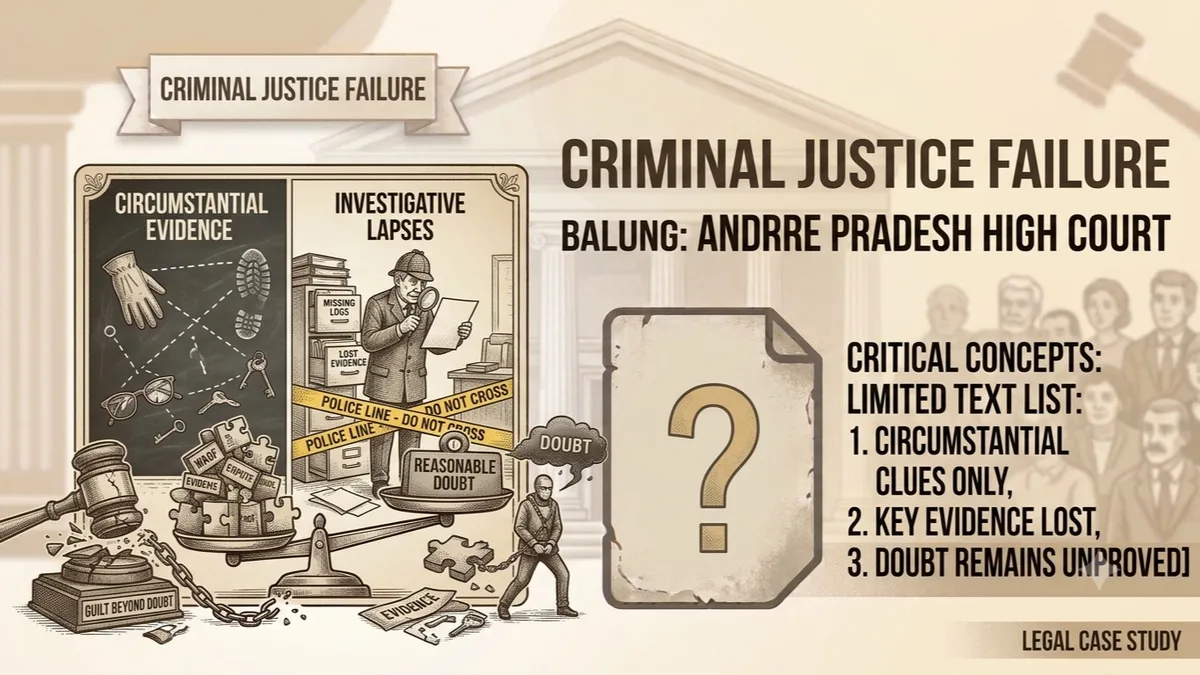
- While examining the last-seen theory, the Court found the testimony of PW 5 unreliable because his statement was recorded approximately fifteen days after the incident, despite his knowledge that the child was missing. He had also failed to disclose the alleged sighting to the police or the child's family. The testimony of PW 6 was similarly found insufficiently corroborated, particularly because the alleged telephone conversations were not supported by call detail records and other persons who could have supported his account were not examined. The Court also noted that the five-day gap between the alleged last sighting and recovery of the body left open the possibility of intervention by another person. Consequently, the last-seen circumstance could not be treated as established beyond reasonable doubt.
- The Court also found that the prosecution had failed to establish the alleged motive of kidnapping for ransom. The father's account of the ransom calls contained omissions, and the voice recordings were not properly supported by expert evidence. The Court observed that although absence of motive does not automatically defeat a prosecution case, it becomes a relevant consideration where the entire case rests on circumstantial evidence.
- On the question of recovery, the Court accepted that the child had died a homicidal death, based on the post-mortem findings of fractured skull bones and head injuries. However, it found the recovery evidence doubtful. The panch witness had acted in several earlier police cases and admitted that he had received a copy of the panchnama before giving evidence. More importantly, the investigating officer admitted that the complainant had already disclosed the location where the body was subsequently found. This created doubt about whether the discovery was genuinely attributable to information supplied by the appellant.
- The Court further examined the electronic evidence relating to the alleged ransom calls. It noted that the complainant had not identified the caller's voice and that the prosecution had failed to produce the relevant expert report. The call detail records, nodal officer reports and certificates required under Section 65B of the Indian Evidence Act were also not produced. Referring to Anvar P.V. v. P.K. Basheer, the Court reiterated the importance of complying with the statutory requirements for proving electronic records. It also clarified that a recovery under Section 27 does not automatically establish guilt unless the prosecution establishes a connection between the recovered article and the commission of the offence.
- With respect to kidnapping, the Court relied on Anversinh @ Kiransinh Fatesinh Zala v. State of Gujarat and observed that mere recovery of a missing minor from the custody of a stranger does not automatically establish kidnapping. The prosecution must prove that the accused actually took or enticed the minor away from the lawful guardian. Since the evidence connecting the appellant with the child's removal was unreliable, the ingredients of Section 363 IPC were also not established.
- Finally, the Court addressed the trial court's direction that the life sentence and fixed-term sentences should run consecutively. Relying on O.M. Cherian v. State of Kerala and Gopi @ Sahaya Puruna v. State, it observed that a sentence of life imprisonment cannot be directed to run consecutively with a fixed-term sentence.
Decision and Final Directions
The Bombay High Court concluded that the prosecution had failed to establish a complete chain of circumstances connecting the appellant with the kidnapping and murder of the child. Although the Court accepted that the death was homicidal, it found insufficient evidence to establish that the appellant was responsible. It therefore allowed the appeal and quashed the convictions and sentences under Sections 302, 363 and 201 IPC. The appellant was acquitted of all charges and directed to be released forthwith, subject to completion of procedural formalities and unless required in another case. He was also directed to execute a personal bond of ₹50,000 under Section 481 of the Bharatiya Nagarik Suraksha Sanhita, 2023.
Important Legal Principles and Precedents
The judgment reiterates several important principles concerning criminal trials based on circumstantial evidence.
- In Sharad Birdhichand Sarda v. State of Maharashtra, the Supreme Court laid down the conditions that must be satisfied before circumstantial evidence can sustain a conviction.
- In Bodhraj v. State of Jammu & Kashmir and Nizam v. State of Rajasthan, the Supreme Court explained the limitations of the last-seen theory, particularly where a considerable time gap exists.
- The Court also relied on Mustkeem @ Sirajudeen v. State of Rajasthan to emphasise that recovery under Section 27 of the Evidence Act does not, by itself, establish guilt.
- Further, Anvar P.V. v. P.K. Basheer was relied upon for the requirements governing proof of electronic records under Section 65B.
Editorial Assessment
The judgment is particularly relevant for its practical application of the law of circumstantial evidence and the evidentiary requirements governing electronic records. It demonstrates that serious allegations and suspicious circumstances cannot substitute for legally admissible and reliable evidence. Its strongest classification is Procedural / Practical, with Academic / Doctrinal as the second-best category, owing to its detailed examination of witness credibility, Section 27 recoveries, Section 65B certification and the last-seen theory.
Editorial status: Pending. No final selection decision has been made.
Full Judgement / Attachment
Full Judgement
Frequently asked questions about Bombay High Court
- Where does the Bombay High Court sit and which areas does it cover?
- The Bombay High Court has its principal seat in Mumbai, with benches at Nagpur, Chhatrapati Sambhajinagar (Aurangabad) and Goa, and a circuit bench at Kolhapur that began sitting on 18 August 2025. It has jurisdiction over Maharashtra, Goa and the Union Territory of Dadra and Nagar Haveli and Daman and Diu. Established in 1862, it is one of India's three oldest High Courts.
- How do I search Bombay High Court cases across Mumbai, Nagpur, Aurangabad, Goa and Kolhapur?
- The official website, bombayhighcourt.gov.in, lets you pick the bench (Principal Seat, Nagpur, Aurangabad, Goa or Kolhapur) before searching case status, cause lists and orders. Judgements are also on the eCourts Judgments portal (judgments.ecourts.gov.in).
- What is the Original Side and Commercial Division of the Bombay High Court?
- On its Original Side, the court hears high-value civil suits arising within Mumbai city, and its Commercial Division hears commercial disputes under the Commercial Courts Act, 2015. It also hears arbitration petitions, company and tax appeals, including those from the ITAT Mumbai, Pune, Nagpur and Panaji Benches.
- What is a Letters Patent Appeal in the Bombay High Court?
- In many matters, an order of a single judge can be challenged before a Division Bench by a Letters Patent Appeal under Clause 15 of the Letters Patent. Commercial matters follow the Commercial Courts Act route instead. Against a final judgement, the route is a Special Leave Petition under Article 136, ordinarily within 90 days.
- How can White Collar Professional help with a Bombay High Court matter?
- Post your requirement on White Collar Professional to receive proposals from verified Advocates, Chartered Accountants and Company Secretaries, compare them, and pay securely through the platform. This page also tracks the latest Bombay High Court judgements and legal updates as they are reported.