IBC Moratorium Does Not Bar a Corporate Debtor’s Counterclaim in Arbitration
Court / Authority
Bombay High Court
Update / Judgement Date
26 Oct 2026
Date of Publication
28 Oct 2026
Case No.
Commercial Arbitration Petition (L) No. 12886 of 2025
Source
WCP News Bulletin
Author
Dipanshi Bansal — WCP Legal Desk
Reading Time
7 min read
View Count
2
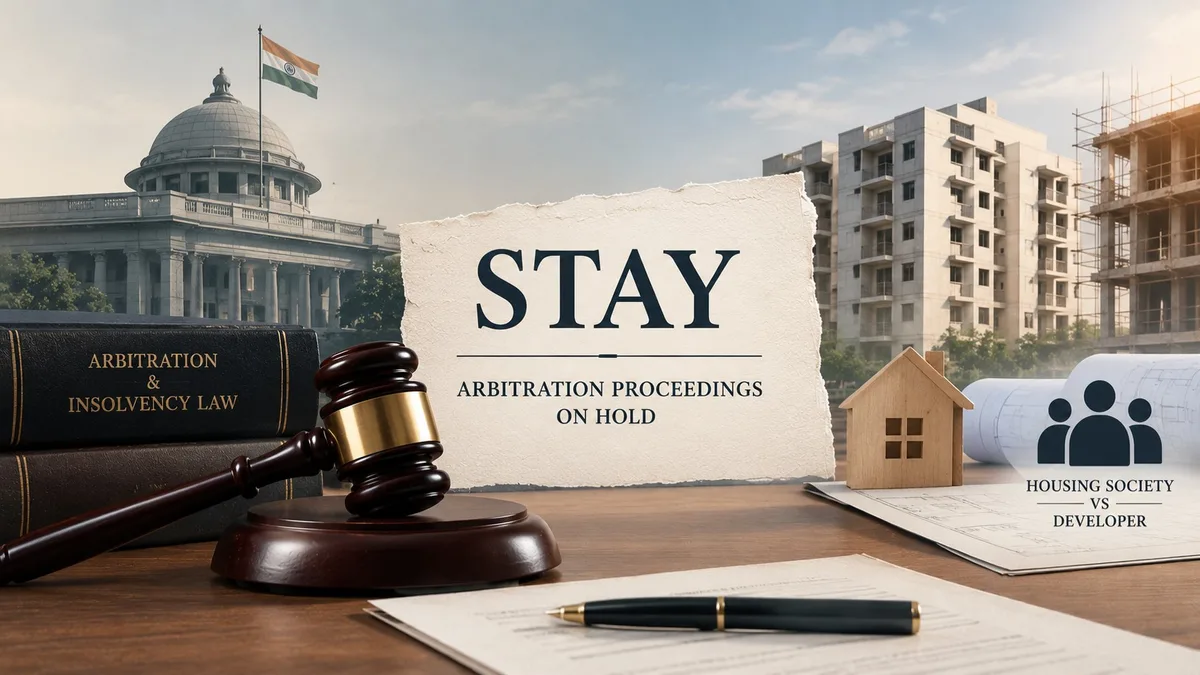
A developer undergoing a second Corporate Insolvency Resolution Process challenged an arbitral tribunal’s order permitting a housing society to appoint a replacement developer, contending that the IBC moratorium deprived the tribunal of jurisdiction. The Bombay High Court held that Section 14(1)(a) bars proceedings against a corporate debtor, not proceedings initiated by it, including a counterclaim. Because the development agreement had been terminated before the CIRPs and was not an asset in the developer’s possession for Section 14(1)(d), the moratorium did not invalidate the tribunal’s interim approach. The challenge was disposed of without interference; the stay on arbitration was vacated and the parties were directed to appear before the tribunal. (Paras 56–58)
Key Proposition: Section 14(1)(a) of the Insolvency and Bankruptcy Code, 2016 bars proceedings against a corporate debtor during the moratorium, but does not prohibit the corporate debtor from pursuing its own claim or counterclaim.
- Insolvency and Bankruptcy Code, 2016 – Section 14(1)(a) – Moratorium – Whether a corporate debtor may pursue its counterclaim in arbitration – Held, yes. (Para 56)
- Insolvency and Bankruptcy Code, 2016 – Section 14(1)(d) – Recovery of property – Whether the provision applied where the development agreement had been terminated before CIRP – Held, no. (Para 56)
- Insolvency and Bankruptcy Code, 2016 – Section 60(5)(c) – NCLT residuary jurisdiction – Whether attracted to a pre-CIRP contractual termination unrelated to insolvency – Held, no. (Para 56)
- Arbitration and Conciliation Act, 1996 – Sections 17 and 37 – Interim measures – Whether the tribunal could revisit a consensual status quo arrangement – Held, yes. (Paras 56–57)
Background / Synopsis :
- A Estates Pvt. Ltd. entered into a development agreement with Govind Niwas Co-operative Housing Society Ltd. on 16 April 2010 to redevelop the Society’s property. Members vacated their flats in 2010–2011, but only excavation and piling were undertaken over the following years; the Society also alleged non-payment of transit rent.
- The Society resolved to terminate the agreement in October 2017 and issued a notice on 7 December 2017. A A Estates disputed the termination.
- In April–May 2018, the dispute was referred to arbitration and the parties agreed to maintain status quo as an interim, provisional arrangement. The Society sought a declaration of termination; A A Estates filed a counterclaim seeking, among other relief, to set aside the termination and obtain specific performance.
- A Estates entered CIRP in November 2019; that process was set aside in June 2020. A second CIRP commenced on 6 December 2022 and remained pending. The Society submitted its claim to the Resolution Professional.
- On 16 January 2025, the arbitral tribunal vacated the status quo arrangement and held that the Society could appoint a new developer. A A Estates challenged the tribunal’s jurisdiction under Section 37(2)(b) of the Arbitration Act.
Issues For Consideration :
- Whether Section 14(1)(a) IBC prevents a corporate debtor from pursuing its own counterclaim during CIRP.
- Whether Section 14(1)(d) applies to the Society’s property where the development agreement had been terminated before CIRP.
- Whether the NCLT’s jurisdiction under Section 60(5)(c) displaced the arbitral tribunal’s jurisdiction over the contractual dispute.
- Whether the tribunal could revisit the earlier status quo order and permit the Society to appoint a new developer.
Submissions Of Parties :
Petitioner – A A Estates Pvt. Ltd.:
- The moratorium under Section 14 barred continuation of arbitral proceedings and, on its case, the interim relief granted to the Society.
- It asserted that it remained in possession of the redevelopment property and that the tribunal could not permit steps inconsistent with the moratorium.
- It challenged the tribunal’s reliance on the Section 29A order and maintained that the disputes and reliefs were intertwined with the CIRP.
Respondent – Govind Niwas Co-operative Housing Society Ltd.:
- The Society relied on the pre-CIRP termination of the development agreement following prolonged non-performance and alleged defaults, including unpaid transit rent.
- It maintained that the status quo arrangement was provisional and did not prevent the tribunal from revisiting interim protection while adjudicating the parties’ claims.
Court's Observations & Analysis :
Re: Scope of Section 14(1)(a) IBC
- The provision prohibits institution or continuation of proceedings against a corporate debtor; it does not prevent the corporate debtor from pursuing proceedings in its own interest. A counterclaim initiated by the debtor is therefore not automatically barred.
- The Court distinguished authorities addressing proceedings against a corporate debtor and declined to import into Section 14(1)(a) wording appearing in Section 60(6). Held: the counterclaim could be pursued. (Para 56)
Re: Section 14(1)(d) and the terminated agreement
- The development agreement had been terminated before either CIRP. In the circumstances addressed by the Court, the terminated agreement was not an asset of A A Estates attracting the property-recovery prohibition in Section 14(1)(d). Held: Section 14(1)(d) was not attracted. (Para 56)
Re: NCLT jurisdiction and contractual termination
- Section 60(5)(c) confers limited residuary jurisdiction and does not displace ordinary adjudication of a contractual termination unrelated to insolvency. Since termination preceded CIRP, the jurisdictional ouster contemplated by Section 63 did not arise. Held: the objection to arbitral jurisdiction failed. (Para 56)
Re: Interim status quo and appellate restraint
- The 2018 status quo order was a provisional arrangement volunteered by the parties, not a final adjudication of their rights. The tribunal could reconsider it to preserve an appropriate balance pending adjudication of the counterclaim.
- An appellate court under Section 37 should not interfere merely because it possesses the power to do so, where the tribunal’s approach is reasonable. The Court did not decide the substantive merits of the interim measures because the challenge pressed before it was jurisdictional. (Paras 56–57)
Notable Observations: “It does not bar proceedings initiated by the corporate debtor, including a Counter Claim.” (Para 56).
Decision & Directions :
- The petition was disposed of without interference with the impugned arbitral order.
- The stay on arbitration proceedings imposed on 30 April 2025 was vacated.
- The parties were directed to appear before the arbitral tribunal within two weeks of the judgment’s upload. The tribunal was to issue further directions and schedule the next steps for a date falling after six weeks from the upload.
- No separate opinion or order as to costs is recorded in the concluding paragraphs.
Legal Provisions Discussed & Precedents Cited :
- Insolvency and Bankruptcy Code, 2016 – Section 14(1)(a): moratorium on proceedings against the corporate debtor.
- Insolvency and Bankruptcy Code, 2016 – Section 14(1)(d): restriction on recovery of property in the possession of the corporate debtor.
- Insolvency and Bankruptcy Code, 2016 – Sections 60(5)(c) and 63: residuary jurisdiction of the Adjudicating Authority and jurisdictional exclusion.
- Arbitration and Conciliation Act, 1996 – Sections 17, 29A and 37(2)(b): interim measures, extension of arbitral mandate, and appeal against specified interim orders.
- Alchemist; Mohanraj; New Delhi Municipal Council; Tata Consultancy; Kher Nagar – discussed in relation to the moratorium, corporate debtor claims, contractual termination and the limits of IBC jurisdiction. The judgment refers to these authorities by short names; full citations should be checked against the original judgment before citation.
Full Judgement / Attachment
Full Judgement
Frequently asked questions about Bombay High Court
- Where does the Bombay High Court sit and which areas does it cover?
- The Bombay High Court has its principal seat in Mumbai, with benches at Nagpur, Chhatrapati Sambhajinagar (Aurangabad) and Goa, and a circuit bench at Kolhapur that began sitting on 18 August 2025. It has jurisdiction over Maharashtra, Goa and the Union Territory of Dadra and Nagar Haveli and Daman and Diu. Established in 1862, it is one of India's three oldest High Courts.
- How do I search Bombay High Court cases across Mumbai, Nagpur, Aurangabad, Goa and Kolhapur?
- The official website, bombayhighcourt.gov.in, lets you pick the bench (Principal Seat, Nagpur, Aurangabad, Goa or Kolhapur) before searching case status, cause lists and orders. Judgements are also on the eCourts Judgments portal (judgments.ecourts.gov.in).
- What is the Original Side and Commercial Division of the Bombay High Court?
- On its Original Side, the court hears high-value civil suits arising within Mumbai city, and its Commercial Division hears commercial disputes under the Commercial Courts Act, 2015. It also hears arbitration petitions, company and tax appeals, including those from the ITAT Mumbai, Pune, Nagpur and Panaji Benches.
- What is a Letters Patent Appeal in the Bombay High Court?
- In many matters, an order of a single judge can be challenged before a Division Bench by a Letters Patent Appeal under Clause 15 of the Letters Patent. Commercial matters follow the Commercial Courts Act route instead. Against a final judgement, the route is a Special Leave Petition under Article 136, ordinarily within 90 days.
- How can White Collar Professional help with a Bombay High Court matter?
- Post your requirement on White Collar Professional to receive proposals from verified Advocates, Chartered Accountants and Company Secretaries, compare them, and pay securely through the platform. This page also tracks the latest Bombay High Court judgements and legal updates as they are reported.