Non-Speaking Arbitral Awards and Patent Illegality: The Duty to Adjudicate Contentious Issues
Court / Authority
Bombay High Court
Update / Judgement Date
30 Oct 2026
Date of Publication
02 Nov 2026
Case No.
Arbitration Petition No. 380 of 2020
Source
WCP News Bulletin
Author
Pranjal Jha — WCP Legal Desk
Reading Time
8 min read
View Count
1
This judgment concerns the challenge to an arbitral award arising from a dispute between a stockbroker, 5 Paisa Capital Limited, and its client, Ankit Agarwal. A technical glitch in the broker’s online trading system allegedly resulted in excess margin being reflected in the client’s account. The parties disagreed over who was responsible for the resulting trading losses.
The Bombay High Court ultimately set aside the arbitral awards, not because it independently decided who was responsible for the losses, but because the arbitral tribunals had failed to give reasoned findings on the central issues in dispute.
Facts of the case
- The Petitioner, 5 Paisa Capital Limited, was a registered stockbroker with NSE and BSE.
- The Respondent, Ankit Agarwal, opened a trading account with the Petitioner on 25 October 2016.
- Between 18 September and 4 October 2018, a technical glitch in the broker's software allegedly caused excess holdings/margins to appear in the Respondent's Demat and trading account.
- The broker maintained that the Respondent continued trading using his own login credentials and was regularly sent contract notes, margin statements and SMS alerts.
- The Respondent alleged that certain trades were unauthorised, that he had not received proper notifications and that the broker's system error caused him financial losses.
The dispute escalated when the broker squared off the Respondent's positions under its Risk Policy because his margin cover had fallen below the prescribed threshold. A debit balance remained outstanding even after the square-off.
The broker claimed that the Respondent owed it approximately ₹6.53 lakh, whereas the Respondent filed a counterclaim for approximately ₹15 lakh in alleged trading losses, along with ₹1.62 lakh towards 1,260 bonus shares of Adani Gas Ltd.
Procedural history
The dispute went through the following stages:
- Sole Arbitrator (6 June 2019): Rejected the broker's claim of ₹6,53,166 and partly allowed the Respondent's counterclaim. It awarded ₹14,30,509 towards alleged trading losses and ₹1,62,162 towards the bonus shares.
- Appellate Arbitral Tribunal (17 October 2019): Rejected the broker's appeal and upheld the original arbitral award. It reasoned that both parties had a responsibility to report abnormalities in the trading system, but the broker was liable for the losses because it had failed to notify its clients adequately and in time about the technical glitch.
- Bombay High Court (30 October 2026): The broker challenged the arbitral awards under Section 34 of the Arbitration and Conciliation Act, 1996.
Main issues before the High Court
The central question was whether the arbitral awards could stand when the tribunals had not properly adjudicated the parties' competing claims.
The Court identified eight unresolved issues in paragraph 20 of the judgment:
- Whether the technical glitch actually resulted in excess margin or credit being made available to the Respondent.
- Whether the Respondent's trades and resulting losses were attributable to the glitch.
- Whether the Member-Client Agreement imposed an obligation on either party to report technical abnormalities.
- Whether the broker had failed to inform the Respondent about the glitch and the additional margin available in his account.
- Whether timely communication from the broker could have prevented or reduced the losses.
- Whether the failure of both parties to report the glitch could justify imposing the entire loss on the broker.
- Whether the incorrect email address mentioned by the broker was merely a typographical error.
- Whether the broker was entitled under its Risk Policy to square off the account and sell the Respondent's shares without his consent.
Important: The High Court did not decide these questions on their merits. It examined whether the arbitral tribunals had actually adjudicated them.
Arguments of the parties
Petitioner's arguments (5 Paisa Capital Limited)
The broker argued that:
- The Respondent had executed the trades using his own login credentials.
- The Respondent had received SMS alerts and other communications regarding margin requirements.
- The square-off was carried out under the agreed Risk Policy.
- The arbitral tribunals had failed to examine the trading records, the alleged technical glitch, the relationship between the glitch and the losses, and the basis for the counterclaim.
- The appellate award merely reproduced the parties' submissions without giving independent findings.
- Such an award suffered from patent illegality and warranted interference under Section 34.
Respondent's arguments (Ankit Agarwal)
The Respondent argued that:
- The broker was responsible for the incorrect margin figures and the technical glitch.
- The broker had squared off his positions without proper prior notice.
- The broker had failed to discharge its obligations under the applicable NSE rules and regulations.
- The losses resulted from the broker's own system failure.
- The High Court could not reappreciate evidence or interfere merely because the broker disagreed with the arbitral tribunal's findings.
Court's analysis and reasoning
The Court began by reiterating that Section 34 does not permit a general appeal against an arbitral award. Judicial interference is limited to the grounds specified in the Act.
However, the Court found a fundamental defect in the appellate arbitral award.
A. Reproduction of submissions is not adjudication
The Appellate Arbitral Tribunal had reproduced the parties' submissions and then concluded that both parties had a responsibility to report abnormalities in the trading system.
It did not explain:
- Which evidence it relied upon.
- Why it accepted one party's arguments over the other's.
- How the technical glitch caused the Respondent's losses.
- Why the entire loss should be imposed on the broker.
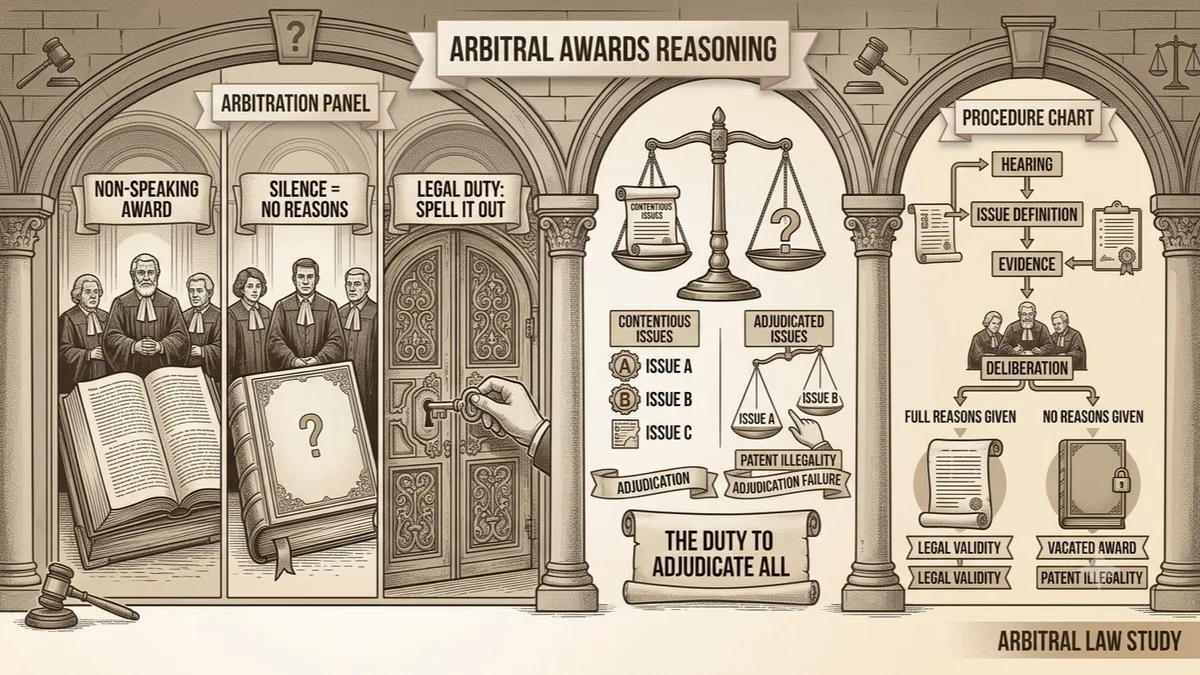
The Court held that merely reproducing submissions cannot amount to adjudication. An arbitral tribunal must actually decide the rival contentions and record its findings.
B. The eight material issues remained unanswered
- The Court specifically identified eight issues in paragraph 20 which had not been adjudicated by the Appellate Arbitral Tribunal.
- These were not minor omissions. They went to the root of the dispute, particularly the connection between the technical glitch, the excess margin, the trades executed and the losses claimed.
- The Court held that it could not itself undertake this exercise and substitute its own findings for those of the arbitral tribunal.
C. The Court cannot supply missing findings
- The Court emphasised that its jurisdiction under Section 34 does not allow it to fill gaps in an arbitral award by independently deciding issues that the tribunal had failed to determine.
- The defect was not simply inadequate explanation of an existing finding. There were no proper findings on the contentious issues in the first place.
D. Patent illegality under Section 34(2A)
- The Court found that the absence of findings on material issues made the award perverse and amounted to patent illegality under Section 34(2A).
- It clarified that this was not an attempt to reappreciate evidence or reconsider the merits of the dispute. The problem was that the arbitral tribunal had failed to perform its basic adjudicatory function.
Important judgments relied upon
Case Legal principle applied
- I-Pay Clearing Services (P) Ltd. v. ICICI Bank Ltd., (2022) 3 SCC 121 An award that fails to record findings on contentious issues may be set aside for patent illegality. A court cannot use Section 34(4) to fill the complete absence of findings on material issues.
- Ssangyong Engineering & Construction Co. Ltd. v. NHAI, (2019) 15 SCC 131 Patent illegality must go to the root of the matter. Mere erroneous application of law or reappreciation of evidence is insufficient.
- Associate Builders v. DDA, (2015) 3 SCC 49 A finding based on no evidence, irrelevant material or disregard of vital evidence may be perverse.
- The Court particularly relied on I-Pay Clearing Services to explain why an award without findings on contentious issues cannot simply be sent back for additional reasoning.
Final decision
The Bombay High Court allowed the Section 34 petition and set aside the appellate arbitral award, which had upheld the original award.
The Court also directed that:
- Any amount deposited in Court be released within one month from the date of uploading the judgment.
- The parties would be at liberty to initiate fresh arbitration proceedings in accordance with law.
- There would be no order as to costs.
Importantly, the Court did not decide whether the broker or the client was ultimately responsible for the trading losses. That dispute remained open for fresh arbitration.
Ratio decidendi
An arbitral award may be set aside under Section 34(2A) of the Arbitration and Conciliation Act, 1996, where the tribunal fails to record findings on material and contentious issues that go to the root of the dispute. Merely reproducing the submissions of the parties and stating a conclusion without adjudicating their rival contentions does not constitute a reasoned award. A court exercising jurisdiction under Section 34 cannot independently supply findings that the arbitral tribunal has failed to make.
Full Judgement / Attachment
Full Judgement
Frequently asked questions about Bombay High Court
- Where does the Bombay High Court sit and which areas does it cover?
- The Bombay High Court has its principal seat in Mumbai, with benches at Nagpur, Chhatrapati Sambhajinagar (Aurangabad) and Goa, and a circuit bench at Kolhapur that began sitting on 18 August 2025. It has jurisdiction over Maharashtra, Goa and the Union Territory of Dadra and Nagar Haveli and Daman and Diu. Established in 1862, it is one of India's three oldest High Courts.
- How do I search Bombay High Court cases across Mumbai, Nagpur, Aurangabad, Goa and Kolhapur?
- The official website, bombayhighcourt.gov.in, lets you pick the bench (Principal Seat, Nagpur, Aurangabad, Goa or Kolhapur) before searching case status, cause lists and orders. Judgements are also on the eCourts Judgments portal (judgments.ecourts.gov.in).
- What is the Original Side and Commercial Division of the Bombay High Court?
- On its Original Side, the court hears high-value civil suits arising within Mumbai city, and its Commercial Division hears commercial disputes under the Commercial Courts Act, 2015. It also hears arbitration petitions, company and tax appeals, including those from the ITAT Mumbai, Pune, Nagpur and Panaji Benches.
- What is a Letters Patent Appeal in the Bombay High Court?
- In many matters, an order of a single judge can be challenged before a Division Bench by a Letters Patent Appeal under Clause 15 of the Letters Patent. Commercial matters follow the Commercial Courts Act route instead. Against a final judgement, the route is a Special Leave Petition under Article 136, ordinarily within 90 days.
- How can White Collar Professional help with a Bombay High Court matter?
- Post your requirement on White Collar Professional to receive proposals from verified Advocates, Chartered Accountants and Company Secretaries, compare them, and pay securely through the platform. This page also tracks the latest Bombay High Court judgements and legal updates as they are reported.