Only RBI Could Sanction Prosecution of ICICI Bank's MD & CEO: Bombay High Court Quashes Board's Sanction Against Chanda Kochhar in Videocon Loans Case
Court / Authority
Bombay High Court
Update / Judgement Date
18 Nov 2026
Date of Publication
19 Nov 2026
Case No.
6636/2024
Source
WCP News Bulletin
Author
Arshee Saifi — WCP Legal Desk
Reading Time
10 min read
View Count
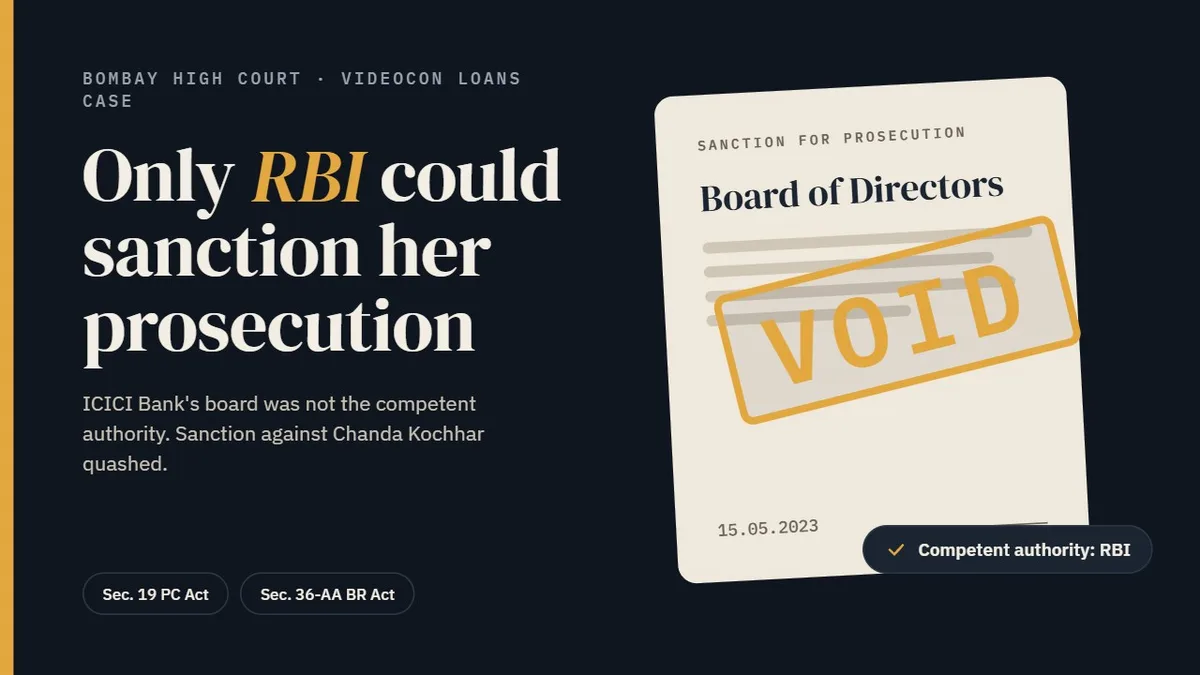
Key Proposition: Under Section 19(1)(c) of the PC Act, sanction to prosecute the MD and CEO of a banking company must come from the authority competent to remove him or her, which, by Sections 5-A, 35-B(1)(b), 36-AA and 36-AC of the Banking Regulation Act, is the Reserve Bank of India and not the bank's Board; a sanction by an incompetent authority is a nullity that the High Court may examine at the threshold.
A. Background / Synopsis :
- CBI registered a Preliminary Enquiry on 08.12.2017 and an FIR on 22.01.2019 under Sections 420 and 120B IPC and Sections 7, 13(1)(d) and 13(2) of the PC Act, alleging illegal gratification linked to loans sanctioned by ICICI Bank to the Videocon Group (Para 3).
- CBI's case: as MD she sanctioned loans to Videocon while her husband had business dealings with Videocon's MD; after a Rs. 300 crore term loan, Rs. 64 crore reached NuPower Renewable Ltd., where her husband was a director; and a Videocon flat was transferred to her husband's family trust for Rs. 11 lakh (Para 6.1).
- She was arrested by CBI on 23.12.2022 and released on interim bail by order dated 09.01.2023 (Paras 3–4).
- CBI sought sanction from the Bank by letter dated 27.03.2023; the charge-sheet was filed on 28.03.2023; the Board's sanction is dated 15.05.2023; the Special Court took cognizance on 12.07.2023; this petition was filed on 04.12.2023 (Paras 4, 11).
B. Issues For Consideration :
- Whether the High Court has jurisdiction to examine the validity of the sanction at this stage (Para 8(i)).
- Whether ICICI Bank's Board of Directors had power to grant sanction under Section 19(1) of the PC Act to prosecute its MD & CEO (Para 8(ii)).
- Whether the sanction prejudiced the petitioner's rights in law (Para 8(iii)).
C. Submissions Of Parties :
- Petitioner:
The Board is not the competent authority; RBI alone may remove an MD/CEO of a banking company under Section 36-AA of the BR Act, with Sections 35-B(1)(b) and 36-AC overriding the Companies Act and the Bank's own policies; CBI itself had written to RBI on 05.02.2019 for approval of her termination (Paras 5–5.2; M. Gopalakrishnan; K. Veeraswami).
The sanction specifies no offence and uses 'undue advantage', a term added to the PC Act only in 2018 (Paras 5.3–5.4).
CBI withheld material, including witness statements later shown in the supplementary charge-sheet and documents showing the CCI Chambers flat stood in her husband's name since 1996 (Paras 5.5–5.7).
The Board did not apply its mind; its own resolution records no loss to the Bank; all six Videocon loans were repaid in 2012 (Paras 5.8–5.9; Mansukhlal Vithaldas Chauhan; Ashok Kumar Aggarwal; Ameerjan).
Absence of valid sanction goes to the root and must be decided at the threshold (Para 5.10).
- Respondent No. 1 (CBI):
The petition is not maintainable; validity of sanction, including competence of the authority, must be tested at trial on evidence (Paras 6, 6.6–6.9; Parkash Singh Badal; Dinesh Kumar; Virendra Kumar Tripathi).
The Board appoints and removes the MD under Article 151(a) of the Articles of Association and the Companies Act; Section 35-B concerns termination, not removal (Para 6.8).
The Board was briefed, received a summary of findings and a jurist's opinion, and granted sanction on 22.04.2023; the Bank suffered a wrongful loss of Rs. 1,033.39 crore (Paras 6.2–6.3).
The same Board granted approval under Section 17A, which was never challenged; new grounds were improperly raised by additional affidavit; the petitioner herself pleaded that the Board was competent (Paras 6.4–6.5).
An error in sanction does not vitiate it unless it causes a failure of justice (Para 6.10; Fuleshwar Gope).
D. Court's Observations & Analysis :
- Re: Issue (i): Jurisdiction of the High Court
Section 19(3) applies only to a court sitting in appeal, confirmation or revision; this Court was asked to examine the sanction itself (Para 10).
The objection was raised four months after cognizance and before framing of charge, satisfying Section 19(4) (Paras 11–12).
Nullity of sanction was pleaded in Ground (K), and the additional affidavit was filed with leave (Para 13).
Held: The High Court has jurisdiction to decide the question at the threshold. (Para 13)
- Re: Issue (ii): Competent authority
Section 5-A gives the BR Act overriding effect over the memorandum, articles and Board resolutions of a banking company, so the Companies Act and Article 151(a) cannot help CBI (Paras 16–18).
Section 35-B(1)(b) makes termination of an MD/CEO ineffective without RBI's prior approval; Section 36-AA vests the power of removal in RBI after a reasoned order and an opportunity of representation; Section 36-AC gives it overriding effect (Paras 19–25).
Under K. Veeraswami, the 'authority competent to remove' includes the authority without whose order the public servant cannot be removed (Para 27).
The petitioner's averment that the Board was competent creates no estoppel against statute (Para 26).
Held: CBI ought to have sought sanction from RBI; the Board was not competent. (Paras 28, 37)
- Re: Issue (iii): Nullity of sanction and prejudice
Absence of a valid sanction ousts the jurisdiction of the Special Court to take cognizance and must be decided at the threshold; relegating it to trial would expose the public servant to a prosecution that may later be void (Paras 29–33; Abdul Wahab Ansari; Nanjappa; State of Goa v. Babu Thomas).
Parkash Singh Badal does not save a sanction that is a nullity for total non-application of mind (Para 35; Ameerjan).
Only CBI's letter and report were circulated to the Board; the sanction gives no reasons; and both the sanction and the Board's minutes record that the Bank suffered no loss (Paras 35, 38, 40–44).
Held: The sanction is void, cognizance on its basis is illegal, and it nullifies all past and future steps in the Special Court. (Paras 39, 46–47)
Notable Observations:
"The public servant cannot be compelled to go through a trial / prosecution in the case of a sanction which is void ab initio in the absence of a valid sanction." (Para 30)
"Nullity of sanction goes to the root of prosecution's case in proceedings under the PC Act as it is a jurisdictional foundational fact and it would stand on the same pedestal as an absent sanction." (Para 46)
E. Decision & Directions :
- Writ petition allowed. (Paras 47–48)
- Sanction dated 15.05.2023 under Section 19 of the PC Act quashed and set aside. (Para 47, prayer (a))
- Consequential actions taken by the Special Court for CBI, Greater Bombay in CBI Special Case No. 874 of 2023 on the basis of the sanction quashed. (Para 47, prayer (b))
- CBI's request to stay the judgment for eight weeks to enable a challenge was declined. (Para 49)
- Record notes: the dates of the Board's decision differ – 22.04.2023 (Para 6.2), minutes of the 291st meeting 'held on 27.03.2023' (Para 35), and sanction dated 15.05.2023 – while the charge-sheet is dated 28.03.2023; Para 19 quotes Section 35-B(1)(b) as 'made without the previous approval' (the provision reads 'with'); Para 2 reads 'Article 2226' and Para 4 dates the PMLA to 1988; CBI's point that Section 17A approval came from the same Board (Para 6.4) is not separately answered.
F. Legal Provisions Discussed & Precedents Cited :
- Prevention of Corruption Act, 1988 – Sections 7, 13(1)(d), 13(2), 17A, 19(1)(c), 19(2), 19(3), 19(4).
- Banking Regulation Act, 1949 – Sections 5(h), 5-A, 35-B(1)(b), 36-AA, 36-AC.
- Companies Act, 2013 – Sections 2(54), 169(1), 203 (as argued by CBI); Articles of Association of ICICI Bank – Article 151(a).
- Constitution of India – Article 226; Code of Criminal Procedure, 1973 – Section 482; Indian Penal Code – Sections 120B, 420.
- K. Veeraswami v. Union of India, (1991) 3 SCC 655 – Applied.
- Abdul Wahab Ansari v. State of Bihar, (2000) 8 SCC 500 – Followed.
- Nanjappa v. State of Karnataka, (2015) 14 SCC 186; State of Goa v. Babu Thomas, (2005) 8 SCC 130; Shankar Moitra v. Sadhna Das, (2006) 4 SCC 584 – Followed.
- CBI v. Ashok Kumar Aggarwal, (2014) 14 SCC 295; State of Karnataka v. Ameerjan, (2007) 11 SCC 273 – Followed.
- Baij Nath Prasad Tripathi v. State of Bhopal, (1957) 1 SCC 338; State of Karnataka v. C. Nagarajaswamy, (2005) 8 SCC 370 – Relied on.
- Parkash Singh Badal v. State of Punjab, (2007) 1 SCC 1; Dinesh Kumar v. Chairman, Airport Authority of India, (2012) 1 SCC 532 – Distinguished.
G. Case Details :
- Case / Party Name: Chanda Kochhar v. Central Bureau of Investigation & Anr.
- Case Number(s): Writ Petition No. 6636 of 2024 [Neutral Citation: 2026:BHC-AS:45634-DB] (CNR HCBM010556872023)
- Coram / Judges: Milind N. Jadhav, J. – Single Judge
- Counsel Appearances: For the Petitioner: Mr. Abad Ponda, Senior Advocate, with Mr. Rohan Dakshini, Ms. Pooja Kothari, Mr. Nimit Bhimjiyani, Mr. Aditya Upadhyay and Mr. Parth Khubalkar (M/s. Rashmikant and Partners). For Respondent No. 1 (CBI): Mr. Anil Singh, Senior Advocate / ASG, with Mr. Kuldeep Patil and others. For Respondent No. 2 (State): Ms. Rajeshree V. Newton, APP.
Disclaimer: This summary is an editorial aid and does not form part of the judgment. Refer to the original judgment before citing.
Full Judgement / Attachment
Full Judgement
Frequently asked questions about Bombay High Court
- Where does the Bombay High Court sit and which areas does it cover?
- The Bombay High Court has its principal seat in Mumbai, with benches at Nagpur, Chhatrapati Sambhajinagar (Aurangabad) and Goa, and a circuit bench at Kolhapur that began sitting on 18 August 2025. It has jurisdiction over Maharashtra, Goa and the Union Territory of Dadra and Nagar Haveli and Daman and Diu. Established in 1862, it is one of India's three oldest High Courts.
- How do I search Bombay High Court cases across Mumbai, Nagpur, Aurangabad, Goa and Kolhapur?
- The official website, bombayhighcourt.gov.in, lets you pick the bench (Principal Seat, Nagpur, Aurangabad, Goa or Kolhapur) before searching case status, cause lists and orders. Judgements are also on the eCourts Judgments portal (judgments.ecourts.gov.in).
- What is the Original Side and Commercial Division of the Bombay High Court?
- On its Original Side, the court hears high-value civil suits arising within Mumbai city, and its Commercial Division hears commercial disputes under the Commercial Courts Act, 2015. It also hears arbitration petitions, company and tax appeals, including those from the ITAT Mumbai, Pune, Nagpur and Panaji Benches.
- What is a Letters Patent Appeal in the Bombay High Court?
- In many matters, an order of a single judge can be challenged before a Division Bench by a Letters Patent Appeal under Clause 15 of the Letters Patent. Commercial matters follow the Commercial Courts Act route instead. Against a final judgement, the route is a Special Leave Petition under Article 136, ordinarily within 90 days.
- How can White Collar Professional help with a Bombay High Court matter?
- Post your requirement on White Collar Professional to receive proposals from verified Advocates, Chartered Accountants and Company Secretaries, compare them, and pay securely through the platform. This page also tracks the latest Bombay High Court judgements and legal updates as they are reported.