CBIC Circular: Procedures Prescribed for Return of Export Cargo Amid Strait of Hormuz Disruption Under Section 143AA
Court / Authority
Income Tax Tribunal
Update / Judgement Date
18 Aug 2026
Source
WCP News Bulletin
Author
Manas Yadav — WCP Legal Desk
Reading Time
3 min read
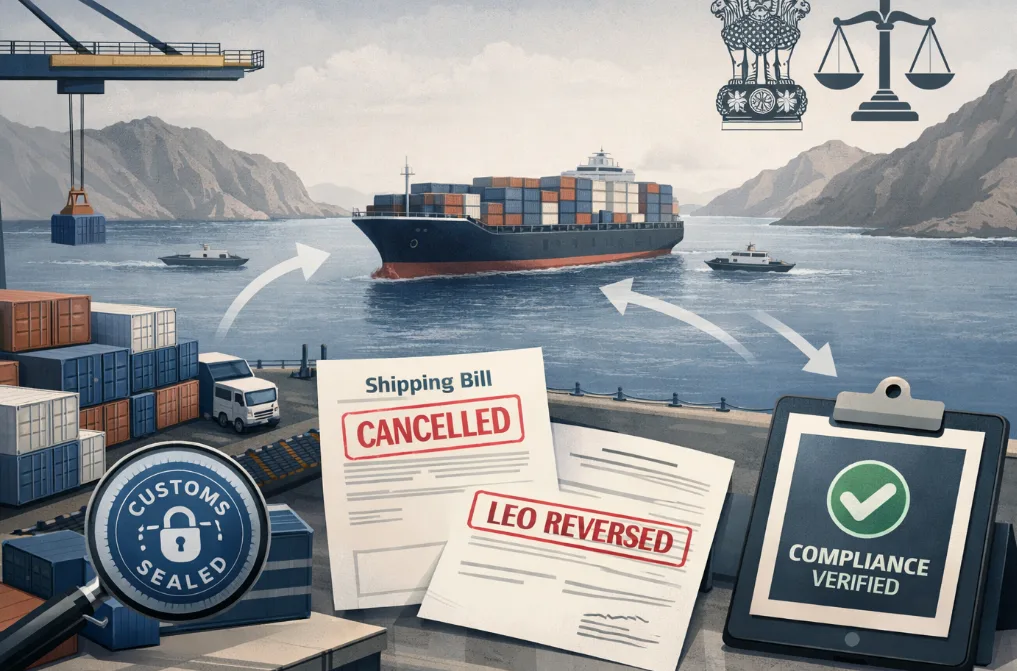
The Central Board of Indirect Taxes and Customs (CBIC) has issued Circular No. 12/2026-Customs dated 17 March 2026, prescribing a detailed procedural framework for handling export cargo returned to Indian ports due to disruptions such as the closure of the Strait of Hormuz. Invoking powers under Section 143AA of the Customs Act, 1962, the Board has introduced measures to facilitate trade and ensure expedited handling of such cargo. The circular addresses scenarios where vessels, having departed from an Indian port, are forced to land at a different Indian port without completing export. In such cases, shipping lines are required to file a Sea Arrival Manifest at the port of landing, following which Customs authorities must verify container integrity, including seal verification. Where tampering is detected, 100% examination is mandated.
A critical procedural requirement involves coordination between the port of landing and the original port of export. Upon request, Customs must verify whether export incentives such as IGST refunds or duty drawback have been disbursed. If so, steps must be initiated for reversal or recovery, alongside cancellation of the Shipping Bill and Let Export Order (LEO). Only after such verification can the “Back to Town” (BTT) facility be permitted, enabling re-entry of goods into the domestic market.
The circular also introduces a system-level change, allowing post-Export General Manifest (EGM) cancellation of Shipping Bills through ICES, with interim manual record-keeping until full implementation.
Additionally, the circular permits international transshipment of less-than-container-load (LCL) cargo from all notified ports and international airports until 31 March 2026, subject to infrastructure adequacy. Special provisions are also outlined for liquid bulk and break-bulk cargo, allowing temporary unloading and bonded storage under strict Customs supervision, with safeguards to prevent diversion into the domestic market.
Practical Implications
The circular reflects a calibrated regulatory response to geopolitical disruptions affecting maritime trade routes. By invoking Section 143AA, the Board has operationalized procedural flexibility while maintaining statutory safeguards. A key legal principle emerging from the circular is the conditional reversal of export status. Once goods re-enter Indian territory due to failed export, prior export benefits cannot subsist. The mandated cancellation of Shipping Bills and LEO, coupled with recovery of incentives, ensures that fiscal benefits are aligned with actual export completion.
The introduction of BTT facility post-verification provides critical relief to exporters, allowing them to re-integrate goods into domestic supply chains without undue procedural delays. At the same time, stringent checks—such as seal integrity verification and inter-port coordination—preserve compliance integrity.
The temporary expansion of international transshipment facilities signals a policy intent to position Indian ports as resilient logistics hubs during global disruptions. Similarly, the framework for handling bulk cargo balances trade facilitation with risk containment through bonded storage and continuous Customs control.
For exporters, logistics operators, and Customs professionals, the circular necessitates heightened coordination and documentation discipline. It also underscores the importance of tracking incentive disbursements and maintaining audit-ready records.
Full Judgement / Attachment
Full Judgement