ITAT Delhi: Assessment Quashed as Time-Barred Under Section 144C; Transfer Pricing Adjustments Also Deleted in Kronos Case
Court / Authority
Income Tax Tribunal
Update / Judgement Date
18 Aug 2026
Source
WCP News Bulletin
Author
Manas Yadav — WCP Legal Desk
Reading Time
3 min read
Key Facts and Tribunal Findings
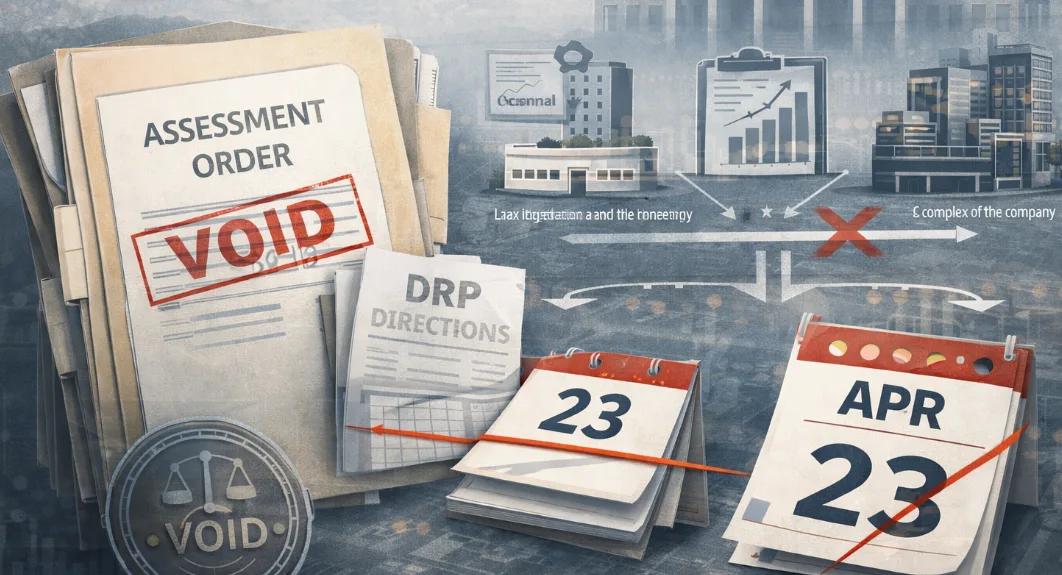
The Delhi ITAT allowed the appeal of Kronos Solutions India Pvt. Ltd. for AY 2018–19, quashing the final assessment order as time-barred under Section 144C(13) and granting relief on transfer pricing adjustments relating to back-office support services. The assessee, a captive service provider rendering software and IT-enabled back-office services to its associated enterprises, was subjected to transfer pricing adjustments initially aggregating ₹14.61 crore, later reduced to ₹2.72 crore pursuant to directions of the Dispute Resolution Panel (DRP). On merits, the dispute centered on the selection and rejection of comparables under the TNMM method. The Tribunal held that certain companies included by the Transfer Pricing Officer (TPO), including Larsen & Toubro Infotech Ltd. and Manipal Digital Systems Pvt. Ltd., were functionally dissimilar, being engaged in high-end engineering and digital solutions, unlike the assessee’s routine support services. Accordingly, these comparables were directed to be excluded.
Further, the ITAT also directed exclusion of certain comparables initially selected by the assessee itself, noting that they failed key filters such as related party transactions and employee cost thresholds. The Tribunal emphasized that inclusion of such entities cannot be sustained merely because they were part of the original benchmarking study. However, the Tribunal ultimately allowed the appeal on a legal ground, holding that the final assessment order dated 17 May 2022 was barred by limitation. The DRP directions were received in March 2022, and under Section 144C(13), the Assessing Officer was required to pass the final order within one month from the end of that month, i.e., by 30 April 2022. Since the order was passed beyond this statutory timeline, it was held to be invalid and quashed.
Legal Analysis and Practical Implications
The ruling underscores the mandatory nature of timelines prescribed under Section 144C. The Tribunal reaffirmed that once DRP directions are issued, the Assessing Officer has no discretion and must pass the final order strictly within the statutory period. Any deviation renders the assessment void, not merely irregular. The decision aligns with consistent High Court jurisprudence treating Section 144C timelines as jurisdictional, emphasizing that procedural delays within the department cannot prejudice taxpayers. The Tribunal also clarified that service of DRP directions through electronic systems constitutes valid receipt for computing limitation.
On transfer pricing, the ruling reiterates the centrality of functional comparability and filter-based selection under TNMM. High-end service providers and entities with materially different risk profiles cannot be benchmarked against captive, low-risk service providers. Additionally, the Tribunal’s willingness to exclude even assessee-selected comparables reinforces that benchmarking must adhere to objective criteria, not procedural admissions.
Full Judgement / Attachment
Full Judgement