ITAT Mumbai Cancels Penalty on Estimated Bogus Purchase Additions
Court / Authority
Income Tax Tribunal
Update / Judgement Date
18 Jul 2026
Source
WCP News Bulletin
Author
Manas Yadav — WCP Legal Desk
Reading Time
2 min read
View Count
2
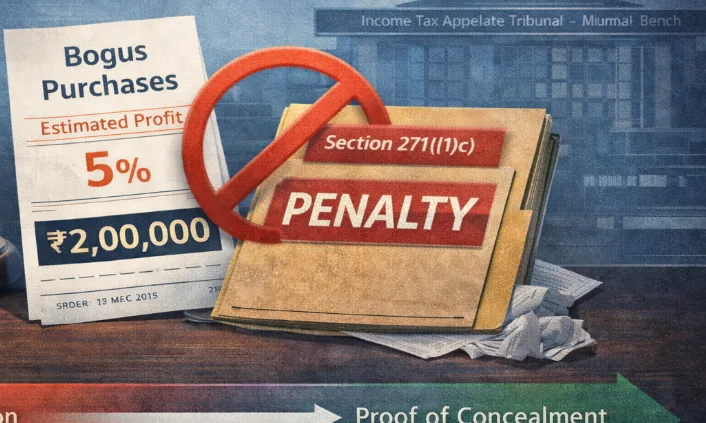
The Income Tax Appellate Tribunal Mumbai Bench has deleted penalties imposed on Chandan Dhingadmal Jain for Assessment Years 2010–11 and 2011–12, holding that penalties under Section 271(1)(c) cannot be sustained where income additions are based purely on estimates. The case arose after the Assessing Officer reopened assessments following information from the Investigation Wing alleging bogus purchase transactions. While the AO added 12.5 percent of the alleged non-genuine purchases as income, the Tribunal in earlier quantum proceedings had reduced the disallowance to 5 percent, recognising it as an estimated profit element rather than proven concealed income.
Penalty Not Sustainable on Estimated Income
During penalty proceedings, the tax department levied 100 percent penalty on the tax allegedly evaded. However, the Tribunal noted that the entire addition rested solely on estimation without concrete evidence of concealment or furnishing of inaccurate particulars. Relying on settled judicial precedents from various High Courts, the Bench observed that when income is determined on a notional or estimated basis, it does not automatically justify penalty under Section 271(1)(c). Penalty provisions require clear proof of concealment, not merely an inference drawn from estimated profits.
Accordingly, the Tribunal directed deletion of the penalties for both years, granting full relief to the assessee and reinforcing the principle that estimation-based additions cannot trigger automatic penal consequences.
Full Judgement / Attachment
Full Judgement
Frequently asked questions about Income Tax Tribunal
- What is the Income Tax Appellate Tribunal (ITAT)?
- The ITAT, set up in 1941, is the second appellate authority in direct tax matters and the final fact-finding body. It hears appeals against orders of the Commissioner (Appeals) and certain other authorities, through benches across India.
- What is the time limit to file an appeal before the ITAT?
- An appeal must be filed within two months from the end of the month in which the order is communicated. This rule has applied since 1 October 2024 and continues under the Income-tax Act, 2025. The Tribunal can condone delay for sufficient cause.
- Can the ITAT stay a tax demand?
- Yes. The Tribunal can stay recovery of a disputed demand while an appeal is pending, usually on deposit of a part of the demand or furnishing security. Stays are granted for a limited period, and the appeal is expected to be decided within it.
- Where does an appeal go after the ITAT?
- An appeal against an ITAT order lies to the High Court, but only on a substantial question of law. A further appeal lies to the Supreme Court.
- How can White Collar Professional help with a ITAT matter?
- Post your requirement on White Collar Professional to receive proposals from verified Chartered Accountants and tax Advocates, compare them, and pay securely through the platform. This page also tracks the latest ITAT ITAT orders as they are reported.









