ITAT Mumbai: CSR Donations Eligible Under Section 80G; Revision Under Section 263 Quashed in Reliance Industrial Infrastructure Case
Court / Authority
Income Tax Tribunal
Update / Judgement Date
18 Aug 2026
Source
WCP News Bulletin
Author
Manas Yadav — WCP Legal Desk
Reading Time
3 min read
Key Facts and Tribunal Findings
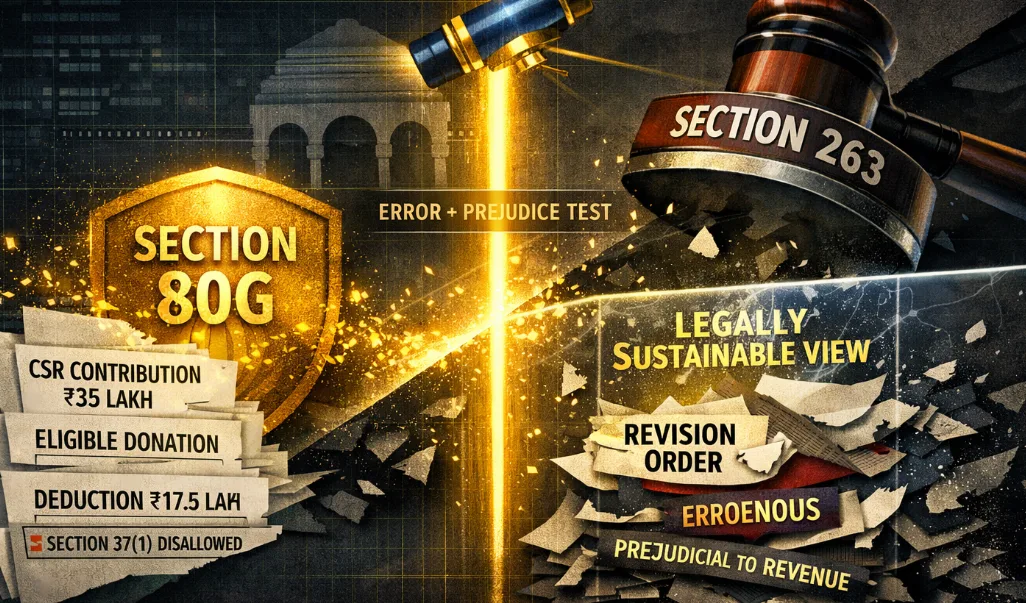
The Mumbai Bench of the Income Tax Appellate Tribunal (ITAT) set aside a revisionary order passed under Section 263 of the Income Tax Act, 1961, in the case of M/s Reliance Industrial Infrastructure Limited for Assessment Year 2020–21. The dispute centered on the assessee’s claim of deduction under Section 80G amounting to ₹17.5 lakh, representing 50% of a ₹35 lakh contribution made towards Corporate Social Responsibility (CSR) expenditure. While the assessee had already disallowed the CSR expenditure under Section 37(1), it claimed the eligible portion as a donation under Section 80G.
The Assessing Officer (AO), in the original assessment under Section 143(3), accepted the claim. Subsequently, the Principal Commissioner of Income Tax (PCIT) invoked revisionary jurisdiction under Section 263, holding that the deduction was not allowable and that the AO had failed to conduct adequate inquiry, rendering the order erroneous and prejudicial to the interests of the Revenue. On appeal, the ITAT examined whether the twin conditions for invoking Section 263—namely, that the order must be both erroneous and prejudicial to the Revenue—were satisfied. The Tribunal found that all relevant material, including details of CSR expenditure and the Section 80G claim, was already on record during assessment proceedings. It further held that mere lack of detailed inquiry by the AO does not automatically render the order erroneous. On merits, the Tribunal noted that judicial precedents from coordinate benches have consistently held that CSR contributions, even if mandatory under the Companies Act, 2013, can qualify for deduction under Section 80G, as the provision does not explicitly require donations to be voluntary. Accordingly, the ITAT concluded that the AO’s decision to allow the deduction was legally tenable. The Tribunal therefore held that the conditions for invoking Section 263 were not met and quashed the revisionary order.
Legal Analysis and Practical Implications
The ruling reinforces a critical limitation on the exercise of revisionary powers under Section 263. The Tribunal relied on the principle that an order cannot be termed “erroneous” merely due to inadequate inquiry if the legal position is determinable from material already on record and the conclusion reached is legally sustainable. A key takeaway is the Tribunal’s affirmation that CSR-related payments, though mandatory under Section 135 of the Companies Act, do not lose their character as eligible donations under Section 80G solely on account of their obligatory nature. The absence of an explicit statutory requirement of voluntariness in Section 80G was central to this interpretation.
From a practical standpoint, the decision provides clarity for corporates structuring CSR contributions. While CSR expenditure remains disallowable under Section 37(1), this ruling supports the position that qualifying contributions may still be claimed under Section 80G, subject to eligibility conditions. Additionally, the judgment serves as a caution against expansive use of Section 263 by tax authorities. It underscores that revision cannot be used as a tool to revisit assessments merely on the ground of perceived inadequate inquiry, particularly where the underlying claim is legally sustainable.
Full Judgement / Attachment
Full Judgement