ITAT Mumbai Remands Exemption Claim Under Section 10(23C) Due to Incomplete Evidence by Assessee Trust
Court / Authority
Income Tax Tribunal
Update / Judgement Date
22 Aug 2026
Source
WCP News Bulletin
Author
Manas Yadav — WCP Legal Desk
Reading Time
3 min read
Key Facts and Tribunal Findings
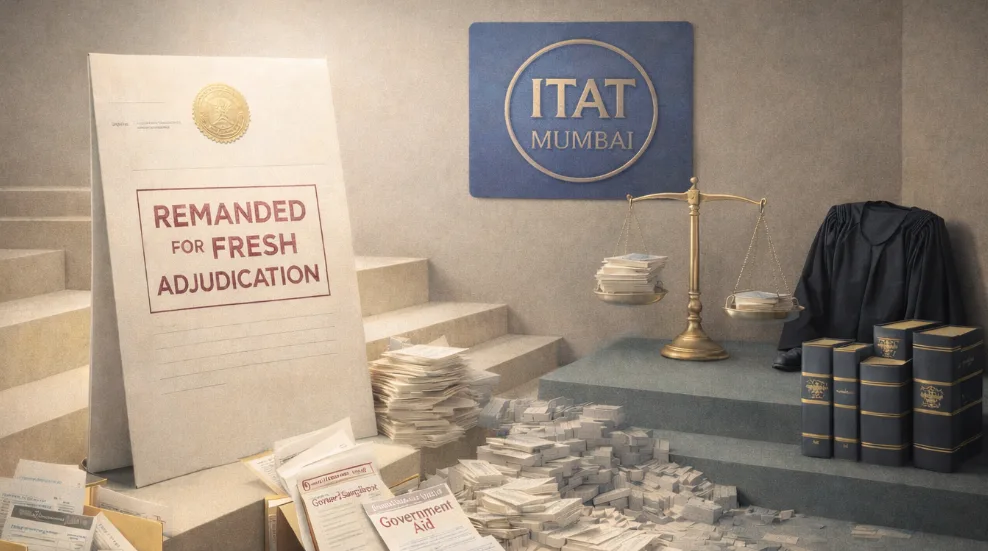
The Income Tax Appellate Tribunal (ITAT), Mumbai Bench, has set aside the order of the Commissioner of Income Tax (Appeals) [CIT(A)] and remanded the matter for fresh adjudication in a case involving denial of exemption under Sections 10(23C)(iiiab) and 10(23C)(iiiad) of the Income Tax Act, 1961. The assessee, Harihar Shikshan Sanstha, a public charitable trust, had filed its return declaring nil income for Assessment Year 2018–19. During assessment proceedings, the Assessing Officer denied exemption under Sections 11 and 12 due to absence of registration under Section 12A, which had been rejected earlier. The alternative claim for exemption under Sections 10(23C)(iiiab) and 10(23C)(iiiad) was also rejected.
The CIT(A) upheld the disallowance, noting that the assessee failed to furnish conclusive evidence demonstrating that it was wholly or substantially financed by the government—a prerequisite under Section 10(23C)(iiiab). Additionally, no reliable material was provided to establish that its annual receipts were within the prescribed threshold under Section 10(23C)(iiiad). Before the Tribunal, the assessee contended that a government-issued letter confirming salary grants was submitted but not considered by the CIT(A). It was further submitted that additional documents, including audited financial statements and supporting evidence, could be furnished if granted an opportunity.
The Tribunal observed that while certain documents relating to government grants were placed on record, critical supporting materials were not submitted before the lower authorities. In view of this, and in the interest of justice, the Tribunal restored the matter to the file of the CIT(A) for de novo adjudication.
Legal Analysis
The Tribunal’s decision underscores the evidentiary threshold required for claiming exemption under Section 10(23C). It reiterates that statutory conditions—such as demonstrating substantial government financing or compliance with prescribed receipt limits—must be supported by documentary proof. The ruling also highlights that appellate authorities are empowered to remand matters where material evidence has not been adequately examined, particularly when the assessee seeks to furnish additional documentation. The emphasis on providing a fair opportunity aligns with principles of natural justice, ensuring that claims are adjudicated on complete factual records.
By setting aside the earlier order, the Tribunal reaffirmed that denial of exemption cannot be sustained solely on procedural lapses if substantive evidence may exist but was not fully considered. The outcome reinforces the importance of comprehensive documentation in tax exemption claims and the Tribunal’s role in ensuring fair adjudication.
Full Judgement / Attachment
Full Judgement