ITAT Mumbai: Section 14A Disallowance Limited to Income-Yielding Investments; Fair Value Under Ind-AS Rejected in Bombay Dyeing Case
Court / Authority
Income Tax Tribunal
Update / Judgement Date
18 Aug 2026
Source
WCP News Bulletin
Author
Manas Yadav — WCP Legal Desk
Reading Time
3 min read

Key Facts and Tribunal Findings
The Mumbai ITAT adjudicated the appeal of The Bombay Dyeing and Manufacturing Company Ltd. for AY 2018–19, primarily addressing disallowance under Section 14A, applicability of Section 43CA, and related issues. On the core issue of disallowance under Section 14A read with Rule 8D, the Assessing Officer had enhanced the disallowance to ₹4.65 crore by applying 1% on the average value of total investments, computed using fair market value under Ind-AS. The CIT(A) upheld this approach.
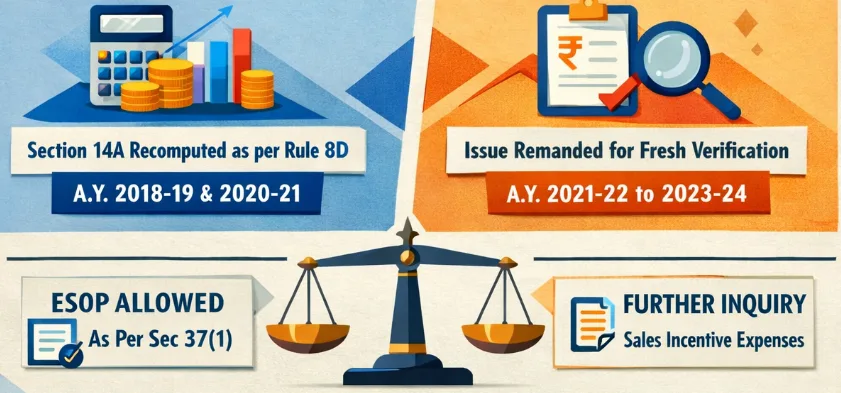
The Tribunal, however, partly allowed the assessee’s appeal. It held that only those investments which actually yielded exempt income during the relevant year should be considered for computing the average value of investments. The ITAT clarified that the amendment introduced by the Finance Act, 2022—expanding the scope to all investments—is prospective and not applicable to AY 2018–19. On the valuation methodology, the Tribunal rejected the Revenue’s reliance on fair market value under Ind-AS. It held that Rule 8D refers to “value of investment” and does not permit substitution with fair value. Accordingly, the disallowance must be computed based on the actual cost of investments, not their book valuation under Ind-AS. With respect to addition of ₹1.35 crore relating to property transactions, the Tribunal noted that the assessee claimed the properties as stock-in-trade and argued for applicability of Section 43CA instead of Section 50C. It further contended that stamp duty value should be determined based on the date of allotment rather than registration. Observing that these factual aspects were not adequately examined, the ITAT remanded the issue to the Assessing Officer for fresh adjudication. The issue of interest under Section 234B was treated as consequential.
Legal Analysis and Practical Implications
The ruling reinforces two significant principles governing Section 14A disallowance. First, for pre-2022 assessment years, only investments that have actually generated exempt income can be considered for disallowance computation. This aligns with established jurisprudence and restricts the scope of disallowance in cases involving large passive investment portfolios. Second, the Tribunal’s rejection of fair value accounting under Ind-AS for Rule 8D purposes is particularly relevant for corporates adopting modern accounting standards. The decision clarifies that tax computation mechanisms remain governed strictly by statutory provisions and cannot be overridden by accounting treatments. The expression “value of investment” must be interpreted as cost of investment unless explicitly provided otherwise. On the real estate transaction issue, the Tribunal acknowledged the legal position that the date of agreement or allotment—where consideration is fixed and part payment is made—can be relevant for determining stamp duty value. However, by remanding the matter, it emphasized the importance of substantiating such claims with documentary evidence.
Full Judgement / Attachment
Full Judgement