ITAT Mumbai: Section 44C Applies to Overseas NRI Desk Expenses; Slump Sale and TDS Disallowance Issues Also Addressed in Bank of America Case
Court / Authority
Income Tax Tribunal
Update / Judgement Date
18 Aug 2026
Source
WCP News Bulletin
Author
Manas Yadav — WCP Legal Desk
Reading Time
3 min read

Key Facts and Tribunal Findings
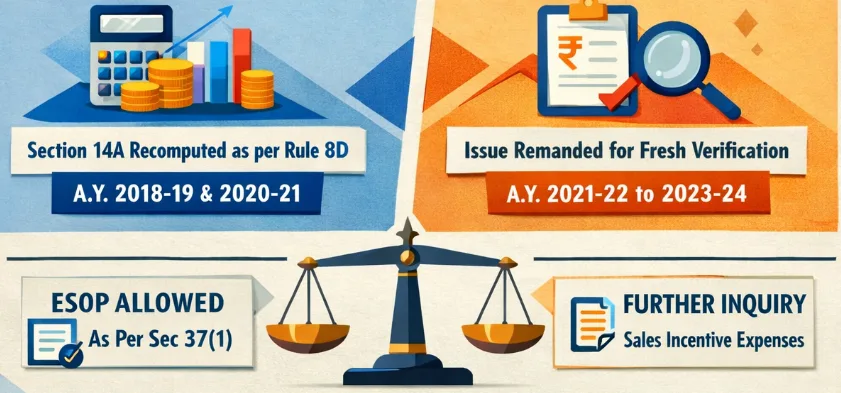
In a detailed ruling involving cross-appeals, the Mumbai ITAT adjudicated multiple issues in the case of Bank of America N.A. for Assessment Year 2000–01, covering exemption claims, head office expenditure, TDS disallowance, and slump sale characterization. On the issue of exempt income under Sections 10(15) and 10(23G), the Tribunal upheld the CIT(A)’s deletion of interest disallowance. It found that the assessee had sufficient interest-free funds exceeding investments in tax-free bonds and infrastructure lending. Accordingly, no disallowance under Section 14A was warranted, and exemption was to be computed without attributing interest expenditure. A key dispute related to expenses incurred by overseas branches (London and Singapore) towards NRI desk operations, claimed as deductions for Indian operations. While the CIT(A) had allowed the claim outside the scope of Section 44C, the Tribunal reversed this finding. Applying the Supreme Court’s ruling in American Express Bank Ltd. (2025), the ITAT held that such expenses—comprising salaries, rent, utilities, and communication costs—constituted “executive and general administration” expenses incurred outside India. These satisfied the statutory test under Section 44C and were therefore subject to the prescribed deduction limits. On computation sequencing, the Tribunal upheld the CIT(A)’s view that deduction under Section 36(1)(viia) must be allowed prior to computing the ceiling under Section 44C, as it is not excluded in the definition of “adjusted total income.”
In the assessee’s appeal, the Tribunal deleted the disallowance under Section 40(a)(i) relating to payments for the Croydon Data Processing Centre. It held that since no actual payment or credit was made to the overseas branch, the obligation to deduct tax under Section 195 did not arise, rendering the disallowance unsustainable. Finally, on the issue of sale of the retail banking business to ABN Amro Bank, the Tribunal upheld the lower authorities’ finding that the transaction qualified as a slump sale under Section 2(42C), thereby attracting capital gains computation under Section 50B.
Legal Analysis and Practical Implications
The ruling provides important clarity on the scope and application of Section 44C in the context of non-resident banking entities. By applying the Supreme Court’s interpretation, the Tribunal confirmed that even expenses exclusively attributable to Indian operations—if incurred outside India and falling within the nature of executive and administrative functions—are subject to Section 44C limits. The characterization of NRI desk expenses as part of core banking operations, rather than marketing expenditure, was central to this conclusion. On exempt income, the decision reinforces the settled principle that where sufficient interest-free funds exist, no disallowance of interest expenditure is warranted. This aligns with established jurisprudence on the presumption of utilization of own funds.
The Tribunal’s approach to Section 195 underscores a strict interpretation of withholding obligations, limiting them to cases involving actual payment or credit. This has direct implications for cross-border cost allocations within multinational enterprises. Lastly, the affirmation of slump sale treatment highlights that the presence of lump sum consideration and transfer of an undertaking as a whole will override attempts to characterize transactions as itemized asset sales.
Full Judgement / Attachment
Full Judgement